Wed 16 Jul 2008
Alice in ‘Wilderness’
Posted by DavidMitchell under agriculture, General News, History, Marin County, Photography, West Marin nature
[2] Comments
“People seeking food will see an opportunity to hunt, gather, or cultivate. People who are well fed, but seek spiritual sustenance in nature, will see a refuge. Wildlife biologists will see a laboratory, archeologists a dig, real estate developers a suburb, park managers a place of employment.” Mark Dowie of Inverness.
(From The Fiction of Wilderness published in the West Marin Review. The essay was adapted from an upcoming book Vital Diversities: Balancing Protection of Nature and Culture. Dowie teaches science and environmental reporting at the UC Berkeley Graduate School of Journalism.)

A small group of Point Reyes National Seashore visitors buying oysters from Drakes Bay Oyster Company and quietly picnicking beside the water a couple of weeks ago.

The tranquility at the oyster company contrasted with the folks screaming in excitement at another national park 200 miles away. In Yosemite, two rock climbers set a speed record for going up the face of El Capitan.
The climbers, one from Lafayette and one from Japan, shaved 2 minutes and 12 seconds off the 2 hour, 45 minute, and 35 second record held by two German brothers.

Back at Drakes Bay, oyster-company owner Kevin Lunny is fighting an attempt by National Seashore Supt. Don Neubacher to close the oyster farm when its lease runs out in 2012.
Supt. Neubacher’s administration says the 125-year-old oyster farm is incompatible with a wilderness area. Of course, the oyster farm isn’t actually in a wilderness area. So far, the government has labeled Drakes Estero, the inlet where Lunny’s oyster company is located, merely “potential wilderness.”

Drake’s Bay Oyster Company’s parking lot in the foreground and the Coast Guard’s white buildings in the background.
But it’s a stretch to call Drakes Estero even “potential wilderness.” By act of Congress, the land around it is reserved for agricultural. From the oyster farm, visitors can view not only this “pastoral zone” and traffic on Sir Francis Drake Boulevard but also a US Coast Guard Communications Station.

One chunk of parkland that is in a designated wilderness area is El Capitan.
The 3,000-foot-high granite monolith is part of what the Park Service boasts is “one of the world’s greatest climbing areas.” Not surprisingly, members of the press and public were on hand for a week to hoot and holler as climbers Hans Florine and Yuri Hirayama repeatedly scrambled up El Capitan. Hirayama has said that if he climbs the rock again, he’ll bring a movie crew from Japan.
Encouraging an international hullabaloo in the Yosemite wilderness area is apparently appropriate when the national park is looking for good publicity. In their own way, national parks do a fair amount of huckstering. The National Seashore, for example, holds sandcastle contests at Drakes Beach every Labor Day to lure crowds to Point Reyes.
 All this commotion suggests that seeking solitude in nature to restore your soul can sometimes be more romantic than realistic — whether you’re wandering on Point Reyes or in Yosemite (right). Even without climbers and their fans, Yosemite’s wilderness is crawling with an estimated 500 black bears. If you don’t want your meditations disturbed, it’s better to follow the Savior’s advice (Matthew 6:6), and “when thou prayest, enter into thy closet.”
So what activities are appropriate in a “wilderness” area? That apparently depends on the park superintendent of the moment and whom he likes or doesn’t. Ever since Lunny helped organize the Point Reyes Seashore Ranchers Association so that ranchers could put up a united front in negotiations with the park, Supt. Neubacher’s Administration has made it clear they don’t like the oyster grower/beef rancher.
From a strictly environmental standpoint, Neubacher’s justification for trying to close Lunny’s oyster farm reveals the irrational way the Pacific West Region of the National Park Service is being administered these days. If this region of the Park Service is so fastidious it wants to close down a 125-year-old oyster farm to protect “potential wilderness” at Point Reyes, what the heck is the region doing promoting environmentally damaging rock-climbing competition in Yosemite’s “wilderness area?”
“As the number of climbers visiting the park has increased through the years, the impacts of climbing have become much more obvious,” the National Park Service acknowledges. “Some of those impacts include: soil compaction, erosion, and vegetation loss in parking areas, at the base of climbs, and on approach and descent trails, destruction of cliffside vegetation and lichen, disturbance of cliff-dwelling animals, litter, water pollution from improper human waste disposal, and the visual blight of chalk marks, pin scars, bolts, rappel slings, and fixed ropes.”
And what about the 2 million visitors a year the National Seashore attracts to Point Reyes. By any chance do they affect the wilderness around here more than a low-key, family-owned oyster company? Or the National Seashore’s filling in a wetland at Drakes Beach to provide parking for for this multitude… how did that preserve nature?
Given all this, just what does the Park Service mean when it talks about protecting the “wilderness?”
“‘When I use a word,’ Humpty Dumpty said, in a rather scornful tone, ‘it means what I choose it to mean — neither more nor less.'” — Alice’s Adventures in Wonderland.
 Homage to Rembrandt. Former Inverness resident John Robbins, who built the Horizon Cable system in West Marin, at my dining-room table Wednesday just before sunset.


 This last story is a pretty good indication of how I live these days. My long-term houseguest Linda Petersen has a 15-year-old dog, a Havanese named Sebastian. As I’ve noted before, he’s virtually deaf and legally blind, but he’s very sweet.
 The artist discusses his painting Still Waters III with two guests at his opening.


 Senator Obama, 46, is the first black presidential nominee of a major US political party.
 Meanwhile, this news blog at 10 a.m. today (which is when I got up) projected Supervisor Steve Kinsey and Congresswoman Lynn Woolsey would easily win their races.
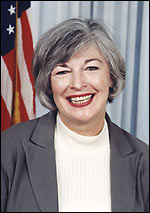 Incumbent Woolsey (right), who represents Marin and Sonoma counties in the US House of Representatives, likewise ran unopposed in the Democratic primary.
 Update on the State Senate Democratic Primary: With 43 percent of the vote, Assemblyman Mark Leno handily outdistanced Assemblyman Joe Nation (29.3 percent) and incumbent Carole Migden (27.7 percent) in the Third State Senate District.


 The bar is now under its fifth ownership, Aragon told me, and as the sign out front reveals, No Name is not really the bar’s name. It literally is a bar with no name. Check the phone book; you’ll find it listed as “no name 757 Bridgeway Sau.”

 Maps from the World Fact Book, which is posted by the CIA.

 During his parents’ visit, Ivan (at left) accompanied them on a trip to Jordan, which is across the Arabian Peninsula from the UAE. Included here are two photos from that trip. While Sally like other women was expected to wear a headscarf, Ivan and Mike are wearing them to ward off a cold wind.

 There are some other [English-language newspapers in the Arab world]: The Daily Star in Lebanon and some newspapers and business magazines in Cairo, where English-language publications have established themselves. But outside the UAE, I don’t think you will find the same conditions of a booming economy and a critical mass of English readers that have spelled success for the local dailies here.


 Now the National Seashore administration has raised a new objection. Even though the bridge would connect two rutted dirt paths, the park says it would have to be wheelchair accessible, and the requisite ramps for the eight-foot-wide bridge would double its length, making it 450 to 600 feet long. That’s more than twice the length of the Green Bridge and more than three times the length of Platform Bridge.

 Now along comes the Bay Area Air Quality Management District and proposes banning the use of woodstoves on the West Marin coast if there is air pollution in, for example, Oakland. Why should smoke building up somewhere that’s a mountain range and a large bay away keep people from using EPA-approved woodstoves in rural areas along the coast from Sonoma to San Mateo counties? Doesn’t the County of Marin, which has already made rural residents spend thousands of dollars on EPA-rated stoves, now have an obligation to defend the use of those stoves?
 Supervisor Kinsey (left) responded: The issue of windy areas is one I researched we researched when we were considering the County ordinance five years ago. The BAAQMD and others provided us with clear information that pollution created in Marin ends up impacting the East Bay and the Central Valley. I believe that if all counties and cities act together we can substantially reduce air pollution in the region, as well as addressing the immediate concern of areas which have inversion layers.
 Supervisor Kinsey: The proposed regulations do not force West Marin residents to switch to propane. Wood burning remains a viable option, although some homeowners will have to pay the price of converting to an EPA-certified stove. I agree that petroleum-based fuels will continue to become more expensive and have their own environmental consequences, even if their impacts occur remotely. Our board is strongly advocating the development of additional renewable energy capacity in our county, and I am very pleased with the operation and cost savings that I am realizing from my own photo-voltaic installation.
 DVM: In general, what should the County of Marin’s role be in all this? What position is the board taking?
 Until now, the administration of Point Reyes National Seashore Supt. Don Neubacher has managed to avoid most of the criticism it deserves by repeatedly giving out misleading information regarding the need for the slaughter, how quickly it would proceed, and what would become of the venison.
 I sure would like to see the press embrace this story and stay on it until we can figure out how the Point Reyes National Seashore was allowed to eradicate axis and fallow deer when so many citizens are against it, including leading politicians. Park Superintendent Don Neubacher’s response to any query is that we all had our opportunity to comment.
 Now that we are hearing the horrible truth about White Buffalo’s barbaric practices, it seems their contraception program is, in fact, merely one way they track herds to kill them.
 I’ve lived here 35 years. This land and this community have been the love of my life, my healing place, my home. Now I wake every day with a pit in my stomach, knowing my animal friends have been terrorized and murdered. I feel sick.
 A Dillon Beach resident discovered the spill Monday afternoon and notified North Marin, which in turn notified county, regional, and state regulatory agencies. NMWD repairmen, along with a truck from Roto Rooter, were dispatched to Dillon Beach, which took them through the town of Tomales. As it happened, the Tour of California bicycle race stopped traffic in and out of Tomales for more than an hour that afternoon, but DeGabriele assured me that the bicyclists were long gone before his crew needed to get through town.


