History


Several hundred people on Saturday attended the annual Inverness Fair at the town’s firehouse green. The day of fundraising began with a pancake breakfast sponsored by the Inverness Volunteer Fire Department. The fair also coincided with the Inverness Library’s annual book sale.

oysters-at-fair

As a benefit for Inverness School, the Inverness Store barbecued oysters and sold beer.

The Inverness Yacht Club sold hotdogs to benefit its youth sailing program, and West Marin Community Services sold tostadas, beer, and sodas to raise funds for the Waterdogs, a program that teaches children living around Tomales Bay how to swim. Jim and Julie Monsoon sold ice cream to benefit West Marin Senior Services.

scoby-at-fair

Scoby Zook, a director of Inverness Public Utility District, sold raffle tickets to raise money for the Inverness Association.

The Inverness Association was founded in 1930 as the Inverness Improvement Association.

In his book Summer Town, the late historian Jack Mason of Inverness traces the association’s origin to 1921 when the “Inverness Association for Fire Protection and General Betterment” first appeared on the public record, complaining about a local real estate magnate’s water system.

In 1930, it was incorporated as the Inverness Improvement Association. The association’s purpose, he noted, was “the collection of funds and their expenditure on the construction and maintenance of roads, trails, bridges, and culverts, and for the public welfare of the town.”

As a “political body with little authority, the trails were the association’s domain,” the historian wrote. “It could petition the county on behalf of its membership, but little more.”

The association began getting involved in “off-the-trail” issues when investors in the 1940s began buying beaches that had been open to the public and building homes on them, board member Michael Mery told reporter Will Kennedy of the old Point Reyes Light four years ago.

Alarmed by the trend, association members successfully fought for the creation of Tomales Bay State Park, which officially came into existence in 1952. Association members in the 1960s also joined the fight to create the Point Reyes National Seashore.

In early 1970 the association’s then-president Michael Whitt, MD, proposed that the group’s name be changed from the Inverness Improvement Association to the Inverness Association. “The idea being there was nothing to improve,” he told The Light reporter.

All the same, the IA (as it is often called) has remained active in land-use planning issues. And in 2004, it spearheaded the drive to have county government create the center median through downtown to slow traffic on Sir Francis Drake Boulevard.

band-at-fair

For a third year, fairgoers were entertained by the band System 9, which played a mélange of jazz, popular music, and hard rock.

inverness-fair-booths

Along with a row of tables providing information about the Coastal Health Alliance, Marin Agricultural Land Trust, and the National Park Service, other booths sold crafts, art, jams and jellies.

Among those selling crafts was Maidee Moore of Inverness, who sold ornate canes to help finance surgery for Third World children with cleft lips and palates. Along with helping these children, Maidee for years was a leader of the Tomales Bay Waterdogs. In June, she was marshal of the Western Weekend Parade.

Co-chairmen for this year’s fair were Jerry Abbott, Tom Branon, and Ken Emanuels.

Cookbook author Steven Raichlen a while back set out to determine who invented West Marin’s practice of barbecuing oysters. In BBQ USA: 425 Fiery Recipes From All Across America (Workman Publishing Company, 2003), Raichlen writes, “As I talked to folks in these parts, one name kept coming up: Anastacio Gonzalez.”

Anastacio, who lives in Point Reyes Station, told Raichlen that “the barbecued oyster was born after a shark-and-stingray fishing tournament in 1972.”

100_2608

Anastacio Gonzalez, who in June retired as head of technical maintenance at West Marin School, on Tuesday spooned his “famous oyster sauce” into shucked oysters grilling on his barbecue.

I myself moved to Point Reyes Station in 1975, and I’ve watched Anastacio’s invention spread around the Tomales Bay area. Now it’s about to go statewide. Jars of Anastacio’s Famous BBQ Oyster Sauce have just gone on sale in Marshall, Point Reyes Station, and Inverness Park. Within the next few weeks, the sauce will be sold at the meat counters of 31 supermarkets stretching from Los Angeles to San Diego. Here’s the story.

The 2000 census found that more than a tenth of West Marin’s population is Latino. Many — but not all — are immigrants or their children from three neighboring small cities not far from Guadalajara: Jalostotitlán, San Miguel el Alto, and Valle de Guadalupe. Anastacio’s family is from Valle de Guadalupe, and before he arrived in West Marin, his brother Pedro had come up from Mexico and taken a job on Charles Garzoli’s ranch near Tomales. Anastacio visited Pedro in 1968 and “liked the area,” he told me Tuesday. So in January 1969 he emigrated to West Marin and went to work as a milker on Domingo Grossi’s ranch.

bottle_1He later moved to Joe Mendoza Sr.’s ranch on Point Reyes. “By then I was legal [had been officially granted US residency], so I bought a car and drove to Mexico for three months.” Meanwhile, Pedro had moved to Anaheim, Orange County, where he was working for a company that made electrical wire. At Pedro’s urging, Anastacio reluctantly went to work for the company and stayed two years. “I started as a coiler and worked my way up to extruder operator. The day they gave me a raise [of only 10 cents per hour] I quit.”

In 1972, he came back to West Marin and began working for Point Reyes Station rancher Elmer Martinelli, who also owned the West Marin Sanitary Landfill. “I worked at the ranch parttime and at the dump parttime pushing garbage [with a bulldozer].”

Always amicable, as well as hardworking, Anastacio was invited to join the Tomales Bay Sportsmen’s Association, which held a two-day “Shark and Ray Derby” every year. “At the end of the second day, Sunday, we always went back to Nicks Cove,” he recalled. Then-owner Al Gibson provided association members with a deck where they could party and barbecue their catch.

In 1972, Anastacio was grilling shark and stingray fillets when Leroy Martinelli, Elmer’s son, showed up with 50 oysters and told him, “See what you can do with these.” With Al’s permission, Anastacio went into the restaurant’s kitchen to see what ingredients he could find. “I put together the sauce my mother used to use for shrimp,” he told me. “I customized it a little bit, and it turns into this [his now-famous sauce].” Part of the customizing would surprise many people. “In my town, the guy who used to make the best carnitas [shredded pork] used Coca Cola,” Anastacio noted, so he did too.

The Nicks Cove owner was as impressed as association members. “We can sell this,” Al told Anastacio and offered him a job barbecuing oysters. Anastacio was already working six days a week, but he finally agreed to do it. “We got oysters for six cents each and used to sell them barbecued three for a dollar.” Nowadays, the price is often $2 apiece.

100_2615

“I was there for about three years. Then Tony’s Seafood offered me a better deal, a percent [of sales]. Nicks Cove used to pay me $20 per day. When I went to work for Tony’s, I doubled the money or better.” From Tony’s, Anastacio took his barbecuing technique to the Marshall Tavern, which was owned by Al Reis, then of Inverness. “I was barbecuing 4,500 oysters on a weekend. Sunset magazine interviewed me in 1980. That’s when everything went crazy.

100_26211

Ad in The Point Reyes Light around 1980.

“After Sunset, I’d get people from Sacramento asking, ‘Are you the one?'” Jose de la Luz, better known as Luis, regularly assisted him. “We were working 12 hours a day to catch up,” Anastacio recalled.

Anastacio worked at the Marshall Tavern about four years “until the IRS closed it.” After that, he barbecued oysters at Barnaby’s by the Bay in Inverness for half a year or so and then moved to Mi Casa, which was located where the Station House Café is today. Each time Anastacio moved to a new restaurant, the one he’d left would continue to barbecue oysters, trying to duplicate his recipe. “Whenever I left,” he told me with a laugh, “I left my footprint.” All the same, he added, “the customers were following me wherever I went.”

100_2613And throughout all this time, Anastacio repeatedly volunteered his barbecuing for a variety of worthy causes: West Marin Lions Club (of which he is a former president), Nicasio Volunteer Fire Department, Sacred Heart Church, Western Weekend, and St. Mary’s in Nicasio (where one day’s barbecuing brought in $4,500 for the church’s building fund). During the Flood of ’82, Anastacio barbecued 6,500 oysters for the National Guard, who were staying at Marconi Conference Center.

Barbecuing oysters on Tuesday, Anastacio ladled melted butter on top of his sauce.

Now after 37 years of barbecuing oysters with his special sauce, Anastacio is ready to sell it. His stepson Matt Giacomini lives in Oregon where he has been working with a chemist at a bottling company to duplicate the recipe. Jars of Anastacio’s Famous BBQ Oyster Sauce are already in the Palace Market, Toby’s Feed Barn, Tomales Bay Oyster Company, the Marshall Store, and Perry’s Inverness Park Store. Drakes Bay Oyster Company will stock it as soon as another shipment arrives from Oregon.

The biggest outlets, however, could prove to be 31 Northgate Gonzalez supermarkets, which are owned by Anastacio’s cousins, who also own a bank. “One of the owners [Antonio] is married to my brother’s daughter,” he explained. These Southern California supermarkets plan to sell the sauce at the meat counter rather than just stock it on the shelves. “Antonio is in charge of the meat departments of all the stores,” Anastacio noted.

Even with the sauce, there is an art to barbecuing oysters. Anastacio ladles melted butter on top of his sauce while the oysters are on the grill. And he stresses that the oysters need to be shucked before barbecuing. Cooks sometimes try to skip the shucking by placing unopened oysters on the barbecue and letting the water inside the shells steam and pop them open. It may be less work, he said, but “you ruin your oyster.” It becomes overcooked and rubbery.

And while it’s called oyster sauce, Anastacio’s creation has other uses as well. I found it delicious on hamburgers, and as a bartender at Nicks Cove discovered when he ran out of V-8 juice, it’s also a great Bloody Mary mix. Just add lemon juice and Tobasco sauce.

For the moment, virtually all the oyster barbecuing anywhere is occurring around Tomales Bay, Anastacio said. However, with any luck at all, people throughout California will soon be giving it a try.
100_2428_1_11

A female Anna’s hummingbird has taken to frequenting the flowers growing in wine-barrel tubs on my deck.

The website Hummingbirds in Motion reports, “The hummingbird (scientific family: trochilidae) does not fly in the same way other birds do. They can fly forward, backward, up, down, and even upside-down. The motion of their wings changes its angle with each flap. Unlike other birds, hummingbirds flap their wings horizontally in the shape of a figure 8. They also expand and contract their tail feathers, which allows them to hover in mid-air.”

100_19661This week I saw a wild turkey scare off a young deer on this hill by flapping its wings, and I’ve previously seen horses having fun chasing turkeys around in the Giacomini family’s pasture next to mine.

Wild turkeys are not native to West Marin but were introduced here for hunting. In 1988, wildlife biologists from the California Department of Fish and Game released a small flock on the Loma Alta Ranch overlooking the San Geronimo Valley. This original flock quickly grew, and many of the birds migrated first to the San Geronimo Valley and then to other parts of West Marin.

When a flock took up residence in a stand of eucalyptus trees west of Tomales in 2000, relations with townsfolk soon became strained. The turkeys tore up gardens, scratched parked cars by climbing over them, and threatened children walking along the street.

The menacing peaked in January 2001 when two tom turkeys lunged at a pair of schoolchildren riding scooters. The children escaped unharmed but had to abandon their scooters as they fled.

In March 2005, a low-flying turkey hit a power line over Highway 1 in Tomales, causing the line to slap against another line and blacking out the town. The turkey, which fell to the ground with some singed tail feathers, was initially dazed by the incident but then wandered off.

100_2354

To enhance habitat for great blue herons at Bear Valley Ranch (Historic W Ranch), the Point Reyes National Seashore has torn down historic structures, built new ones, and restored the primeval parking lot on land the previous owner had treated as an open field.

curious-possum2

With a typically inquisitive expression, possums are among the cutest of creatures, as I’m sure you would agree.

possum-reflection

A possum admires its reflection in the glass of my kitchen door.

The “common opossum” is not native to California but rather the Deep South and was introduced into the San Jose area around 1900 “for meat, delicious with sweet potatoes,” Point Reyes Station naturalist Jules Evens writes in The Natural History of the Point Reyes Peninsula. By 1931, he notes, possums had spread as far south as the Mexican border but did not reach Point Reyes until 1968.

First an update on the condition of Linda Petersen since so many people have asked about her. As was reported here, she fell asleep at the wheel in Inverness a week ago and drove into a utility pole.

Linda, who is 61 and lives in Inverness, suffered multiple broken bones and a punctured lung. Her 16-year-old Havanese dog Sebastian, well known in Point Reyes Station for his sweet disposition, died in the crash.

seba-raccoon

Sebastian and a raccoon appear to be seated across the table from each other à la C.M. Coolidge’s series of paintings a century ago, Dogs Playing Poker. In fact, there was a window pane between these two.

I visited Linda today at the Kaiser Permanente Medical Center in Oakland where she has been transferred from Marin General Hospital.

Although she faces more surgery, Linda was in remarkably good spirits. She is, of course, the advertising manager for The West Marin Citizen, and while we were talking, she received a call on her cell phone from Citizen publisher Joel Hack. Suddenly Linda was back on the job from her hospital bed. “Check with Toby’s,” she told Joel. “Susan Hayes’ ad won’t be ready till Wednesday….”

Linda’s head and neck are immobilized by a medical “halo,” and she can raise only one arm. Nonetheless, she cracked jokes with Joel and later remarked that by staying involved in her work, she’s reducing the boredom of being stuck in a hospital. Now there’s a brave response to an awful predicament.

fox_1

Now for an update on the wildlife around my cabin. In the past couple of weeks, I’ve seen as great a variety of critters on my deck at night as I normally see in a year. Here’s a gray fox that stopped by last week.

possumcoon-redder5

A raccoon finds its wandering obstructed by a possum on my deck.

possum-snarls

When the possum didn’t leave, the raccoon took a run around it, giving the possum a wide berth. The possum hissed and bared its teeth but did nothing else. For several weeks, I’ve periodically seen this possum and raccoon warning off each other as they pass by on my deck. Sometimes, however, they ignore each other entirely.

100_2402

A blacktail doe on this hill gave birth to a couple fawns roughly two months ago. Today they followed their mother around my pasture while a year-old buck grazed nearby.

100_24081The fawns appear healthy and are now old enough to enjoy bounding across my fields. I see them as a good omen for this summer.

Despite what was reported last week in the calendar sections of The West Marin Citizen and Point Reyes Light, the Western Weekend Parade will be held on Sunday this year, as always. Both papers were apparently led to believe the annual parade would be held a day early on Saturday, June 6; however, a check with the county firehouse in Point Reyes Station Monday confirmed it is making arrangements for a parade on Sunday.

100_74851

A procession of antique tractors in last year’s parade.

The Western Weekend Livestock Show will likewise be held Saturday as always. However, it is no longer held at the Red Barn but at the Dance Palace.

The event, which is scheduled from 8 a.m. to 2 p.m., is a time for 4-H club members to exhibit crafts and animal projects they have been working on all year.

Sunday’s parade will march down Point Reyes Station’s three-block-long main street at noon. Because the route is short and the number of entries is sometimes small, it is not uncommon for several entries, after they finish the procession, to circle around via sidestreets in order to parade down the main street a second time.

The 34th annual Dance Palace Silent Auction will be held from 10 a.m. to 4 p.m. Sunday with live music by Moonlight Rodeo from 1:30 to 3:30 p.m.
Oysters and drinks will be sold on the lawn, starting at 11 a.m.

Launching the forerunner of Western Weekend on Aug. 6, 1949, was a women’s sorority called Companions of the Forest. Their turreted former hall still stands across Mesa Road from the Marin Agricultural Land Trust office. That first celebration included a dance, a queen contest, a carnival, and a cakewalk, which together raised $440.65 for repairing the hall.

Western Weekend didn’t become a celebration of West Marin’s agricultural heritage until the following year when the women’s husbands, who belonged to the newly formed West Marin Lions Club, got involved. They added a parade, a chicken barbecue, and a livestock show at the Red Barn (now also called the Old Engine Barn).

100_74741In subsequent years, the event increasingly focused on 4-H and FFA (Future Farmers of America).

During the early 1950s, 4-H and FFA were the main youth groups on the coast, and in those days members had relatively few places to exhibit their animals and other projects.

Parade judges’ viewing stand last year.

By 1962, the West Marin Junior Livestock Show was attracting cows from throughout Marin County, and 100 head showed up that year. The Lions added a lean-to onto the Red Barn to house the overflow. (The “Junior” referred the competitors all being 4-H or FFA members.)

The women held fashion shows on Sunday afternoons, and the Lions brought in carnival rides. Eventually the Point Reyes Station chapter of Companions of the Forest merged with the Petaluma chapter, which continues to this day.

Throughout the 1970s, the parade grew every year. In 1980 and 1981, it drew about 150 entries. An ad hoc group calling itself the Tomales Bay Explorers Club annually entered elaborate floats: Nessie, the bay’s own underwater monster; King Tut’s Tomb, a large pyramid complete with the king’s court; and a hug replica of one Imelda Marcos’ open-toed shoes, out of which a tap-dance group periodically slid and then performed in the street.

100_74881The Wells Fargo stagecoach in last year’s parade.

By then, 10,000 or more people sometimes jammed the town’s sidewalks and store roofs to watch the parade.

Some merchants would later discover that drunken spectators, who had without permission used roofs for vantage points, had dropped empty beer cans down drainspouts.

With the first heavy rain each fall, several flat roofs would flood, and the stores below would have water dripping through their ceilings.

With so many people jamming Point Reyes Station for these monster parades, beer flowed in the gutter by the time the last floats disappeared each year, sometimes to be replaced by outlaw bikers doing wheelies down the main street.

The Lions too were finding it difficult to cope with the throng, so in 1982 and 1983, they eliminated the parade although the West Marin Junior Livestock Show was held as usual. When the parade was revived in 1984, it was much smaller with far fewer groups from outside West Marin.

Nowadays, a variety of groups ranging from the Lions Club to the 4-H Council to the Dance Palace to the Farm Bureau help put on Western Weekend. The gods too seem to help out. In 58 years, it’s never rained on our parade although high winds have occasionally blown floats apart.

In San Anselmo last Thursday, an SUV parked near my car caught my attention because its tailgate was plastered with bumper-stickers, some of which had a Stinson Beach or other West Marin theme.

100_1834

When the driver returned to the vehicle, I asked if he was from Stinson Beach. No, he replied before driving off, the car belongs to his sister, and she often goes to Stinson to walk her dog. As the SUV disappeared, I wondered about “Save a Cow, Eat a Vegetarian.” It’s obviously a jab at political correctness, but what exactly does it imply? That bovine and hominid vegetarians compete for ruffage?

100_1828

Most of us have seen bumper-stickers that boast, “My Child is an Honor Student at St. Swivens High [or whatever] School,” and it was this sassy spoof that prompted me to start snapping pictures of the tailgate’s humor.

100_1831Here’s a poke at the kind of personal ads that show up locally in The Bay Guardian or on Craigslist.

100_1829

In the unlikely event that some drivers actually find their inamoratas through ads on bumper-stickers, the SUV also offers this caution.

And should any reader in Stinson Beach spot this red Nissan Xterra, please ask the driver to explain the cow-and-vegetarian joke — and then forward her answer to this blog.

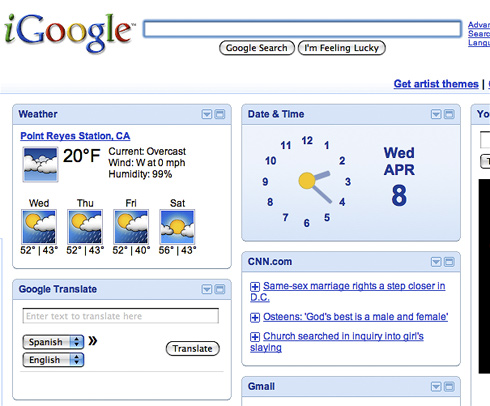
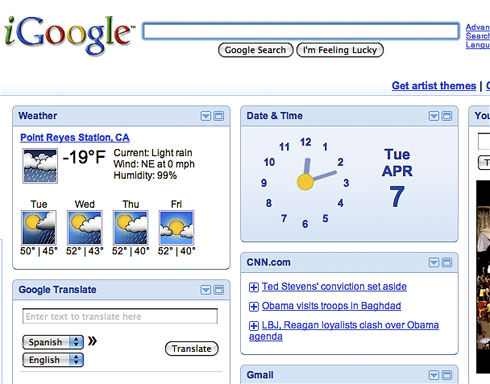
Before signing off, I have one last question. What are we to make of the weather boxes that are now offered on Google homepages? Shingles can be blowing off roofs around here, and Google will report a windspeed of 3 mph for Point Reyes Station. Usually, Google’s current temperature bears a closer resemblance to reality than its windspeed, but recently even its current-temperature reports for Point Reyes Station have been goofy.

google-weather

Skies were mostly overcast at noon Tuesday with a light drizzle, but the air was neither still nor 51 degrees below freezing. With all its technical expertise, you’d think Google would realize its system was crashing when it reported Arctic air in Point Reyes Station.

google-weather-2Just to see if the goofy temperature Google had listed around noon Tuesday was merely a brief aberration, I checked again at 2:22 a.m. Wednesday. By now the air outside had warmed up some, according to Google, but our springtime night was still 12 degrees below freezing. Meanwhile, my own outdoor thermometer showed an air temperature of just over 50 degrees.

google-weather-31By 2 p.m. Wednesday, my thermometer indicated the air outdoors had risen to 60 degrees, so I checked what Google was reporting and this time found Point Reyes Station sounding like a town in the tropics. If I were to believe Google, the temperature here had soared by 113 degrees in 26 hours. What is going on?
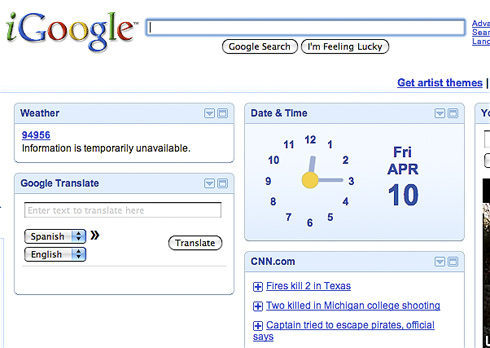
google-weather-4Addendum: By Friday, Google was reporting that in Point Reyes Station’s zip code, current temperature “information is temporarily unavailable.” I’d like to think that this blog had something to do with that, but I doubt it.
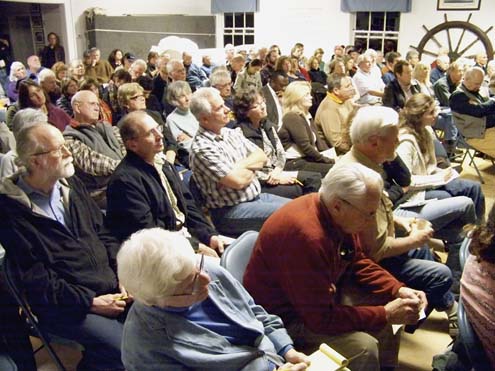
Against my better judgment I showed up for Friday’s “Community Conversation” concerning the Point Reyes National Seashore’s intention to close Drakes Bay Oyster Company. Since retiring three years ago, I’ve continued to write about public issues in West Marin, but I haven’t taken part in many political events. Having achieved Nirvana, I’d rather not disturb it.

community-conversation1

But Friday evening, I was one of 125 or so West Marin residents who filled the Inverness Yacht Club for a heavily structured discussion of the park.

Sounding like marriage counselors, a team of moderators started the meeting by telling us we were there to express our feelings, not to present facts.

To avoid bad feelings, we couldn’t criticize anybody by name (e.g. National Seashore Supt. Don Neubacher) but could only refer to his organization (e.g. “the park”). In fact, the moderators later called me out for naming names when I said President Obama is an improvement over President Bush.

The members of a “community” need to “communicate,” the moderators said more than once. No speaker should hog the microphone, they added, but were themselves slow to relinquish it. After more than half an hour of a two-hour meeting had been spent on these introductory comments with no letup in sight, I began eying the door next to me only to discover it merely went to a fire escape. On the other hand, the moderators’ efforts to ensure parlor-like decorum did pay off. I can recall more acrimony during a public discussion of museum hours.

Phyllis Faber told the group that Supt. Neubacher was away but had said that even if he were in town, he wouldn’t attend.

Faber added that Neubacher also said the park’s associate superintendent was likewise out of town but would have attended were she here. (Faber is co-founder of MALT, a fellow of the California Native Plant Society, and an author of a botanical guide, so her account is probably reliable.)

100_17551

At the Drakes Bay Oyster Company site (seen here), oysters are sold and canned. A Park Service use permit, which expires in 2012, is strictly for these onshore facilities and not for oyster growing in the estero itself, which has been designated “potential wilderness.” Neubacher supporters have claimed that extending the onshore facilities’ use permit would be a threat to wilderness nationwide because of the precedent it would set. Others claim that makes neither legal nor logical sense.

Gordon Bennett, a member of the Marin Group of the San Francisco Bay Chapter of the national Sierra Club, has been carrying Neubacher’s water (not always with the support of his group) ever since the park superintendent three years ago first proposed shutting down the oyster company come 2012. On the eve of Friday’s meeting, Bennett sent an email to those sympathetic to Neubacher, warning them off by claiming the meeting was a “set-up” which had been “organized by proponents” of the oyster company.

It’s hard to tell whether the email had any effect. Some members of the Environmental Action Committee of West Marin, which supports Neubacher’s position, were on hand, including its president and a former board member. A couple of people, including forester Tom Gaman of Inverness, said the park should get rid of the oyster company to create wilderness.

Most of those who spoke, however, like most West Marin residents one hears on the street, supported the company. Several people, such as innkeeper Frank Borodic of Olema, said the oyster company is well run and good for the environment.

After two hours, however, only a couple of proposals got virtually unanimous support from the audience: 1) have additional oyster-company critics at future Community Conversations in order to create more of a dialogue; 2) get Congresswoman Lynn Woolsey to introduce legislation resurrecting the Citizens Advisory Commission to the GGNRA and Point Reyes National Seashore.

Because the two parks were established to serve the Bay Area’s mostly urban population, Congress in 1972 decided that Bay Area local governments should nominate candidates for a Citizens Advisory Commission, which would then be appointed by the US Secretary of the Interior.

Since they were appointed by a member of the president’s cabinet, the commissioners’ decisions, while only advisory, carried weight with the park administration. A superintendent could not ignore them without risking his job, former Supt. John Sansing once told me.

100_16711

Supt. Neubacher and his staff have tried to discredit Drakes Bay Oyster Company by telling county and federal officials that seals are frightened away by the growing and harvesting of oysters. Apparently not having heard about this, the 18 harbor seals seen here are sunning themselves on oyster racks in neighboring Tomales Bay.

The advisory commission had needed Congressional reauthorization every few years, and for almost three decades, Congress approved it. However, in 2002, its term expired, and with Republicans in charge of Congress and the White House, the commission was allowed to die.

This time [then-Interior Secretary] Gale Norton and the Park Service said, “It’s been a very good commission for 29 years, but we don’t need it anymore,” former Commissioner Amy Meyer told me in 2007. National Seashore spokesman John Dell’Osso in 2004 had already told me the park administration did not want the commission revived because it sometimes interfered with what the Park Service felt should be done.

The Neubacher administration has also argued that local residents don’t speak for all Americans. It’s a specious argument since most park visitors are from the nine-county Bay Area and are far more familiar with the park, and with anything going wrong in it, than are people in other parts of the country, who seldom, if ever, see the National Seashore.

100_1815Closely following Friday’s discussion are oyster company owners Kevin and Nancy Lunny.
Meyer noted the commission had acted as an “interface” between the public and the park, and its absence has been felt. In the past four years, there has been widespread public dissatisfaction with the National Seashore over: 1) a 2004 ranger-pepper-spray scandal; 2) the inhumane slaughter of non-indigenous deer a year ago; 3) the present oyster-company dispute. Without the advisory commission to provide the public with a forum for resolving these issues, they have become so contentious that Supt. Neubacher is seldom seen around town anymore.

Congresswoman Woolsey four years ago introduced legislation to resurrect the commission, and it was attached to a House bill (which was being pushed by now-Speaker Nancy Pelosi and others) to acquire land in San Mateo County for the GGNRA. The bill passed in 2005, but when it did, the rider resurrecting the commission was gone.

Meyer said she and other people went to Congresswomen Pelosi and Woolsey, asking that they temporarily drop the advisory-commission legislation. The fear, Meyer said, was that the Bush Administration would pack the advisory commission with people who shared his ideology.

On Friday night, I suggested that since we now have the Obama administration, the time is ripe to resurrect the commission. A number of other speakers, including Liza Crosse, aide to Marin County Supervior Steve Kinsey, agreed. And when a show of hands was taken later, almost everyone supported the idea, regardless of where they stood on the oyster-company issue.

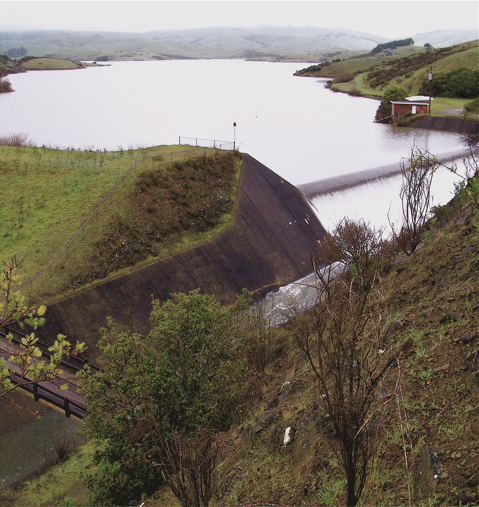
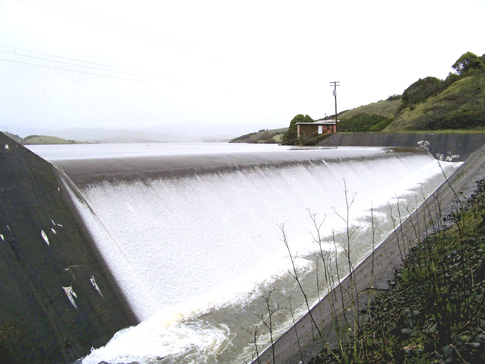
Nicasio Reservoir overflowed early today, symbolically extricating West Marin from California’s three-year drought. The land draining into the Marin Municipal Water District reservoir has received seven inches of rain in the past eight days, district spokeswoman Libby Pischel told me.

On April 1, the amount of water in MMWD’s reservoirs will determine whether the district considers this a drought year, Pischel said, and district projections now are far rosier than they were at the end of January. MMWD reservoirs currently are 75 percent full, she noted, adding that they would normally be 85 percent full at this time of year.

The present storm system and one a week ago have been especially welcome in Bolinas. Two weeks ago Bolinas Community Public Utility District’s main reservoir, Woodrat II, was essentially dry, and BCPUD directors had voted to limit each household, regardless of size, to 150 gallons of water per day. By mid-afternoon today, the reservoir had risen to within two feet of capacity.

“We’re very grateful,” BCPUD general manager Jennifer Blackman told me during this afternoon’s rainfall. “We’re in a much better place than we were last month.” Although “rationing is still in place,” Blackman said, BCPUD directors last week held off voting on further restrictions because the current rain was being forecast.

dam4

Nicasio Reservoir that overflowed today is one of seven belonging to Marin Municipal Water District, which serves the San Geronimo Valley and most of East Marin south of Novato.

Shortly after noon, I began clambering up the embankment across the spillway from the dam in order to photograph the historic event.

Twice before in the past 30 years, I did this for The Point Reyes Light to record the ends of previous droughts. It’s never an easy climb. The slope is rocky and extremely steep with few hand holds in some places and dense brush in others.

This time was worse than ever. I was halfway to a ledge high enough to look down on the reservoir when my feet slid out from under me. I dropped to my hands only to have my camera fall out of a parka pocket. With dismay I watched as it tumbled away down the rocky slope.

Gloomily, I crawled and slid after it, muddying my pants, as well as bloodying my hands on the rocks. When I finally reached the bottom, however, I found a happy surprise. The camera had survived the rough descent better than I had. Kodak cameras are apparently as sturdy as they’re cheap. After wiping mine off, I secured it around my neck and once again began climbing.

100_15172

Luckily, deer trails crisscross the slope, which made traversing it at least possible although not easy. But when I finally reached the ledge from which I could photograph the dam and spillway with the reservoir behind them, the scene easily compensated for my scrapes and bruises.

100_1525

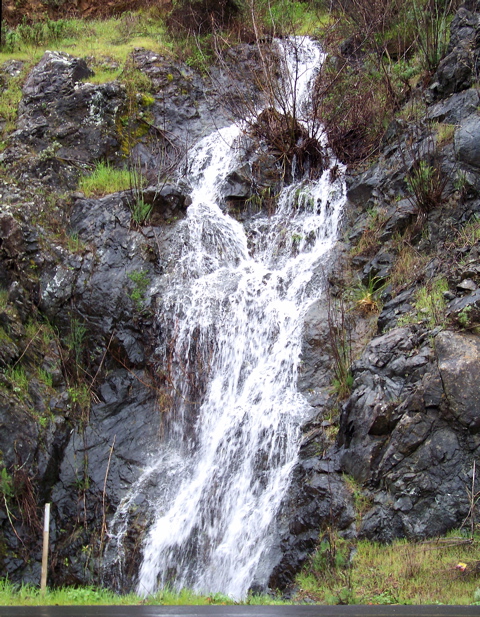
Seasonal waterfall. Driving from Point Reyes Station to the dam and back, I noted that every gully along the Point Reyes-Petaluma Road had become a stream which flowed into Papermill/Lagunitas Creek. When rainfall is normal, these small waterfalls are annual roadside attractions.

100_1507_1

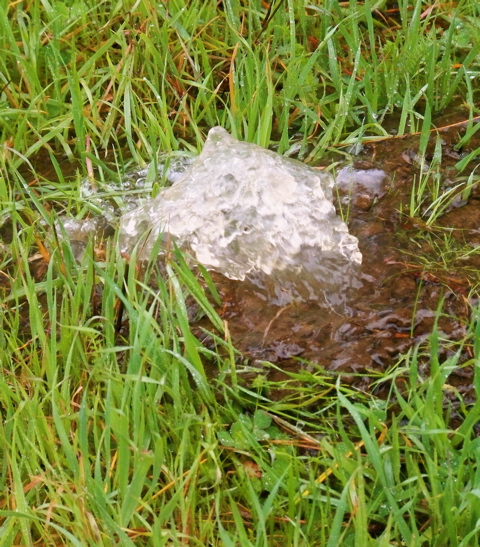
My hill too changes during heavy rains. When I looked out the dining-room window yesterday morning (that’s my cabin in the background), I spotted what appeared to be a piece of plastic flapping in the grass. My first impulse was to wait until the rain stopped before going outside to pick it up, but then I realized that what appeared to be plastic was actually water bubbling up.

100_1503_1

An artesian spring had sprung up out of a gopher hole. That’s common in these coastal hills and, in fact, can damage ranchers’ pastures. During heavy rains, hillsides that have become honeycombed with gopher tunnels act like a sponge. If the top two or three feet of soil become over-saturated, wholesale slumping can occur.

And finally for all you cynics out there, no, there is no water pipe or septic line uphill from this artesian spring. Stay warm and enjoy the bad weather. With any luck, we’ll get more of it.

100_2346_1

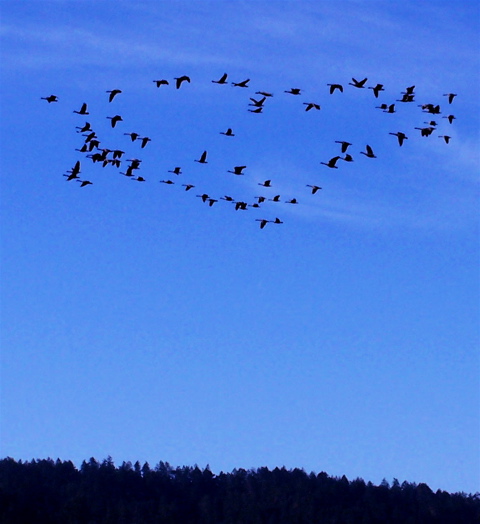
This Valentine’s Day greeting comes to you from a flock of Canada geese aloft between Inverness Ridge and my cabin.

Since the Middle Ages, Valentine’s Day, or St. Valentine’s Day, has been associated with lovers. But it wasn’t always this way.

In fact, the Catholic Church until as recently as 1969 recognized 11 St. Valentine’s Days annually, each in memory of a different religious martyr named Valentine. The Valentine’s Day traditionally celebrated on Feb. 14 is in honor of St. Valentine of Turni (a bishop martyred 197 AD during a persecution of Christians by the Roman Emperor Aurelian) and St. Valentine of Rome (a priest martyred in 269 AD).

The remains of St. Valentine of Turni are buried in Rome while those of St. Valentine of Rome are buried in Rome, Dublin, and (according to islanders) on Malta. In any case, after a few hundred years went by, lay people didn’t distinguish between these two St. Valentines.

Another St. Valentine was supposedly executed under orders from the Emperor Claudius II, who had unsuccessfully urged him to become a pagan. According to lore, this St. Valentine healed his jailer’s blind daughter, and on the eve of his execution, he sent her a message, which he signed, “Your Valentine.” Other lore says he sent the message to a girlfriend, which may explain why a religious holiday evolved into a romantic celebration.

However, it wasn’t until the 1800s that the tradition of lovers exchanging Valentines on Feb. 14 began. The tradition started in England and spread to the United States just in time for the Industrial Revolution to make possible the mass production of  Valentine’s cards. By now an estimated one billion are mailed each year worldwide.

100_1330_1

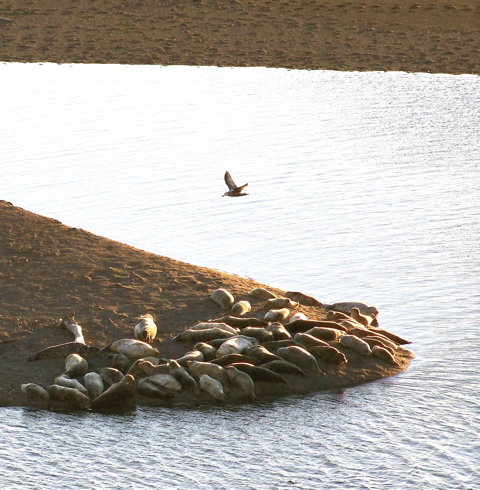
Sealed with a kiss. I spotted these harbor seals sunning themselves last month on a sandbar at the mouth of the Russian River. And may you too find yourself with a warm companion this Saturday.

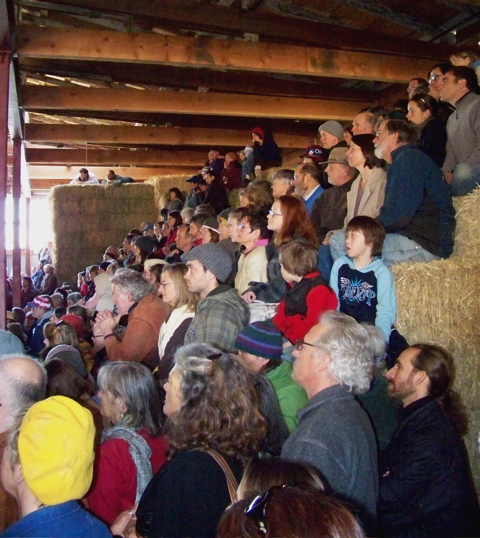
100_1379_11For nearly 500 West Marin residents watching TV inside Toby’s Feed Barn this morning, the inauguration of President Barack Hussein Obama carried the excitement of Prince Charles’ visit, mankind’s landing on the moon, and Western Weekend all happening at once.

Residents sat around a screen on which was projected CNN’s coverage of the ceremonies.

Other residents stood around those residents, and still more sat on piles of seed sacks or on towering stacks of hay bales.

Although the 2000 census found that whites account for 89 percent and Latinos for 10 percent of West Marin’s population, residents of all races and ages were on hand to witness together the swearing in of the first black president in US history.

100_1393_13Some adults brought children as young as toddlers to this historic celebration. Others brought dogs. However, no one that I saw brought both.

In November’s presidential election, President Obama had carried West Marin with 86 percent of the vote, and a number of people today celebrated the fact that bigotry can no longer control nationwide election results. Indeed, as soon as President Obama finished taking the oath of office, the woman standing in front of me began shaking hands with everyone around her, saying to each, “Congratulations, my fellow American.”

100_13381

The center of attention at Toby’s was a projection screen intriguingly located under pallets piled with sacks of seed and fertilizer, and in front of a wall festooned with bunting, the Stars and Stripes, and President Obama’s call to action.

100_14111

Feed Barn proprietor Chris Giacomini (foreground) and other celebrants clap during President Obama’s inaugural address.

100_1389

Watching televised coverage of history being made.

Tuesday’s schedule of inaugural celebrations around Tomales Bay began with a sunrise swim at Chicken Ranch Beach in Inverness. I’m as enthusiastic about our 44th president as the next West Marin resident, but I wasn’t about to brave the cold or the hour.

100_1372Inverness tree trimmer Tom Kent, who did go, told me approximately 75 people were on hand, and others told me that most of those got in the water, including one young woman who braved the the chilly bay au naturel. Did Tom take a dip in the bay too? “I borrowed a wetsuit,” he replied. “It was the first time I’d ever worn one. Boy, do they take a long time to get into!”

President Barack Obama takes the oath of office. One hand is on a bible (held by First Lady Michelle Obama) that Abraham Lincoln used for his 1861 inauguration.

Today’s events are being hosted by: Point Reyes Books, Toby’s Feed Barn, Mainstreet Moms, The Dance Palace, and Point Reyes Nation. A breakfast including pastries, orange juice, coffee and tea was provided for the crowd that squeezed into Toby’s Feed Barn.

From 6 to 10 p.m., an inaugural ball will be held in the Dance Palace, $10 (“West Marin formal”). Soup will be provided (“bring your own beverages and bowl”).

« Previous Page — Next Page »