Thu 8 Mar 2007
Nature’s Two Acres Part IX: Point Reyes Station’s Blackbirds
Posted by dave under Uncategorized, Point Reyes Station, West Marin nature, Wildlife, Photography, agriculture
[3] Comments
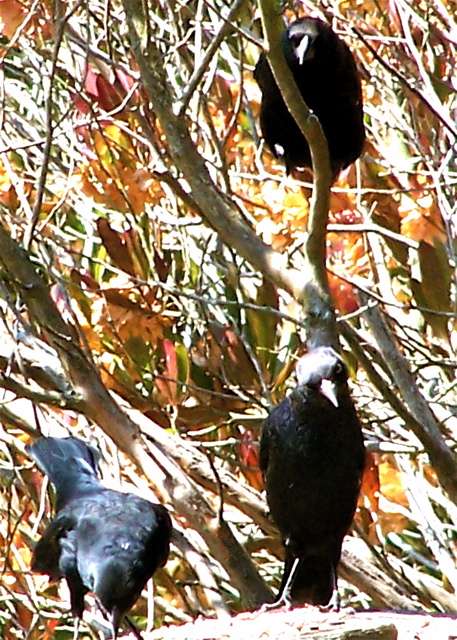
I happened to photograph three Brewer’s blackbirds last Sept. 20, the day Venezuelan President Hugo Chavez drew applause at the UN by comparing President Bush’s supposed sulphuric stench to the devil’s and the day after Iranian President Mahmoud Ahmadinejad and President Bush clashed in the General Assembly over Iran’s nuclear program. Chavez’s sarcastic comments were, in fact, mild given that the Bush Administration had taken part in a 2002 coup that tossed Chavez out of office — only to have Venezuela’s poor take to the streets and reinstall him two days later. The widespread applause Chavez and Amadinejad received in the UN General Assembly made this picture seem symbolic: Chavez (at left) eats the lunch of a frustrated President Bush (center) while Ahmadinejad ominously looks on.
.
Now that the Park Service has bought the farm, and rancher Rich Giacomini’s cows no longer give Point Reyes Station its traditional redolence, perhaps it’s time for a new town mascot to replace the Holstein.
Having often sat on the bench in front of the Bovine while eating a sweet roll, I would vote for the Point Reyes Station’s ubiquitous blackbird. Not only do Brewer’s blackbirds strut about the sidewalk in front of the bakery looking for crumbs, hundreds of them often flock across the street in the Bank of Petaluma’s pine trees, where their chirping creates a din that’s audible a block away.
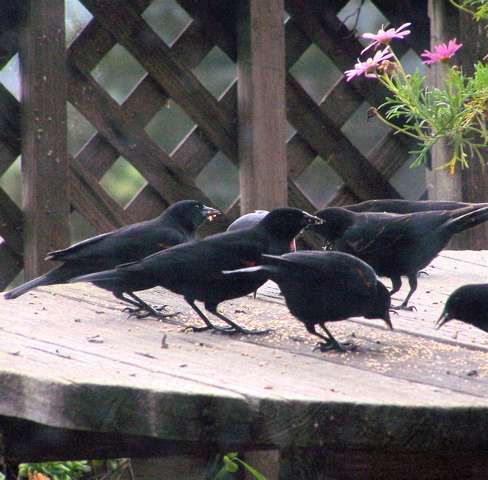
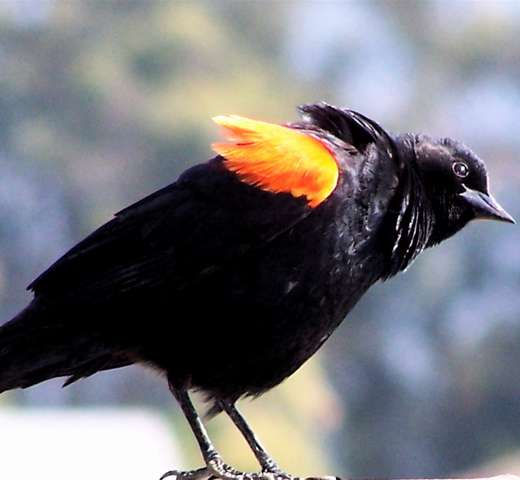
Although set off by several white feathers, the red on a Tricolored blackbird’s wing is far less noticeable than on a Red-winged blackbird’s. Tricolors are often found in the company of Brewer’s and Red-winged blackbirds.
On Point Reyes Station’s main street, the blackbirds’ best show occurs in Spring when they brood in the trees and hedges around the bank and neighboring market. The typical drama consists of Palace Market customers parking their cars and walking through the store’s parking lot, only to suddenly flinch and look around in bewilderment after an unobserved blackbird pecks them on the head as it flies by.
Indeed, Brewer’s blackbirds seem fearless during the brooding season. I once saw a blackbird peck a housecat on the head along Mesa Road behind the bank. When a second blackbird pecked it, the cat ran across the bank’s parking lot and ducked under a car.
I was impressed that two birds could have a cat on the run, but the show was just getting underway. There was no stopping one particularly aggressive blackbird that landed under one side of the car, causing — to my amazement — the cat to dash out from under the opposite side.
Blackbirds are members of the Icteridae family, and “the big flocks of Icterids in West Marin,” Point Reyes Station ornithologist Rich Stallcup told me this week, “are made up mostly of Red-winged blackbirds — invariably with a sprinkling of Brewer’s and Tricolors.
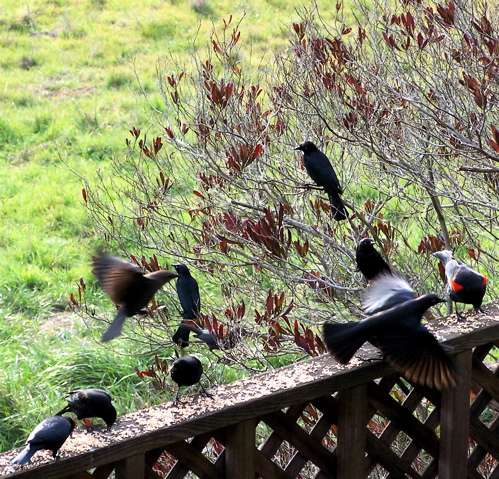
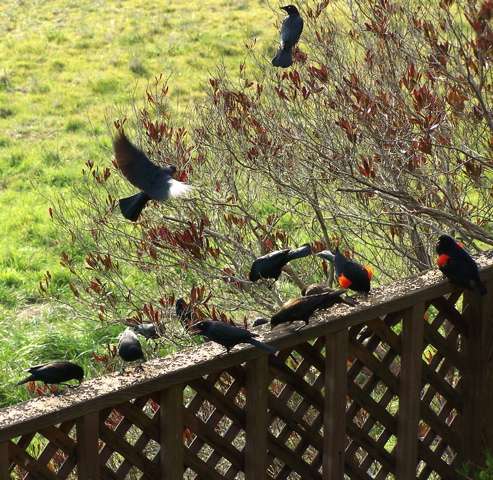
A mix of Brewer’s and Red-winged blackbirds on my railing.
The flocks that gather on powerlines along the levee road around sunset each evening, are Red-winged blackbirds, Point Reyes Station naturalist Jules Evans pointed out Wednesday when we ran into each other at the post office.
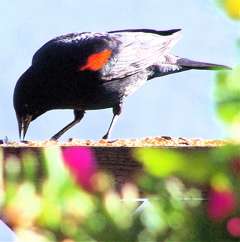 Blackbirds typically head to their roosting site “from 30 minutes before sunset to 15 minutes after sunset,” researcher Gordon Boudreau of Santa Rita Technology in Menlo Park reported to the Third Vertebrate Pest Conference 40 years ago at the University of Nebraska.
Boudreau added that although the bulk of a Red-winged flock has reached the roost site by 15 minutes after sunset, “stragglers continue to arrive for an additional 15 minutes…. All but the late stragglers habitually ‘pre-roost’ on elevated perches nearby for varying lengths of time before moving into the night roosts.
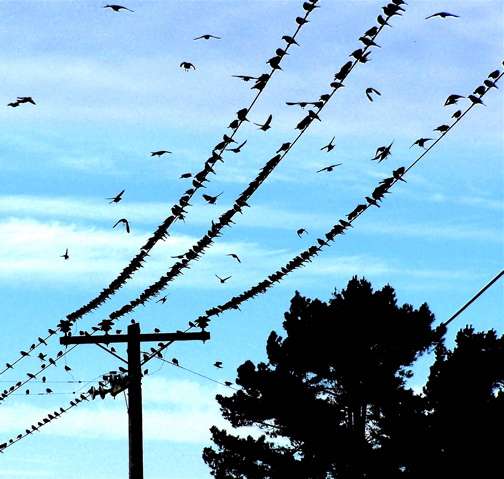
“These pre-roosts may be atop their roost vegetation; it may be in trees or on powerlines a quarter to a half mile away…. Late-arriving stragglers fly directly to the night roost.”
Why do blackbirds chatter so much when they flock together? Both Stallcup and Evans attributed the noise to their being “gregarious.” Said Stallcup, “They chatter incessantly as do all animal groups that can.”
Evans added that even small shorebirds continually chatter when in flocks although usually too softly for us to hear.
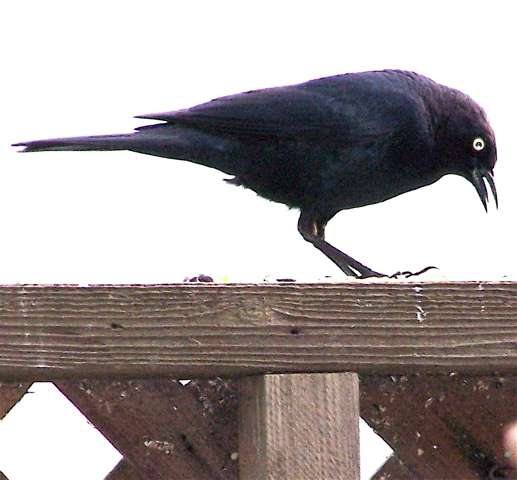
The Brewer’s blackbird (seen here) is named after 19th century ornithologist Thomas Mayo Brewer of Boston. Brewer’s blackbirds (Euphagus cynanocephalus) are protected under the 1918 Migratory Bird Treaty Act, but their survival, Wikipedia notes, is of the “least concern” among protected birds.
In fact, most ornithologists don’t consider the Brewer’s blackbird a “migratory species” at all. The birds do, however, move from place to place seeking abundant sources of food, which for them is mostly insects, spiders, and (particularly in Fall and Winter) seeds.
“During the day,” Boudreau reported, “wintering blackbirds alternately feed and then loaf, depending on the availability of food. Feeding in open fields is usually [done] in leapfrog fashion, in which all move in one direction, the rear birds rising and landing ahead of [those in front].
“If undisturbed, this feeding pattern continues until the end of the field is reached whereupon the flock may move to another spot in the field or fly to a different area.”
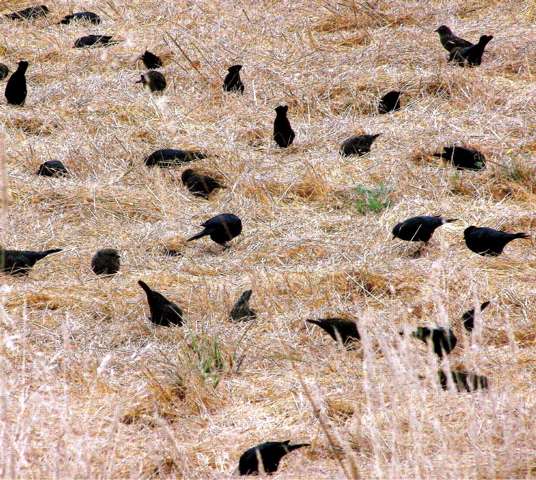
Ornithologist Rich Stallcup of Point Reyes Station on Wednesday noted that “at least some of the birds” in this field uphill from my cabin are Tricolored blackbirds.” (At upper right, for example.) Tricolors are nearly “endemic” in California although their worldwide population is small, Stallcup added.
While blackbirds benefit agriculture by eating enormous amounts of caterpillars, beetles, grasshoppers, and other destructive insects, they can also consume large amounts of grain and seed. And when in season, fruit and nuts are also part of their diets.
At the third Vertebrate Pest Conference held back in 1967, researcher Boudreau revealed he had found a way for farmers and ranchers to avoid losing grain, seed, and nuts to Red-winged blackbirds. After experimenting with scarecrows, explosions, shotguns etc., he concluded the only control that works is “biosonic.”
The trick is to tape record the alarm call of each kind of blackbird, which is quite “species specific,” Boudreau reported. These alarm sounds are then “amplified and projected at the birds through loudspeakers. The method is highly effective if the proper sounds are used….
“[An alarm call] indicates the presence of a predator and is usually well developed in gregarious species.” Blackbirds tend, Boudreau had observed, “to avoid areas where these sounds are present.”
Interesting aside: By 1979, twelve years after Boudreau presented his findings, Lee Martin of BlueBird Enterprises in Fresno told a subsequent University of Nebraska conference that by then biosonic controls were in use internationally to keep gulls away from major airports. He suggested they also be used to keep migrating birds from resting at industrial-waste ponds where they frequently ingest lethal amounts of waste materials.
I’ve yet to hear any biosonic blasts of bird alarms in West Marin, which suggests the local blackbird population isn’t too serious a problem for all the ranches, airports, and industry here. Just for housecats and springtime shoppers at the Palace Market.

 “This time [then-Interior Secretary] Gale Norton (at right) and the Park Service said, ‘It’s been a very good commission for 29 years, but we don’t need it anymore,’” noted former Commissioner Amy Meyer in an interview I conducted for Marinwatch.
 Congresswoman Lynn Woolsey (at right), who represents West Marin, did introduce legislation to resurrect the commission, and it was attached to a House bill being pushed by now-Speaker Nancy Pelosi and others to acquire land in San Mateo County for the GGNRA.
 Meyer said she and other people went to Congresswomen Pelosi (at left) and Woolsey and asked that they drop the advisory-commission legislation.
 I’ve never heard Lunny himself say this, but some ranchers on Point Reyes see Supt. Neubacher’s plans to close the oyster company as “payback time.”
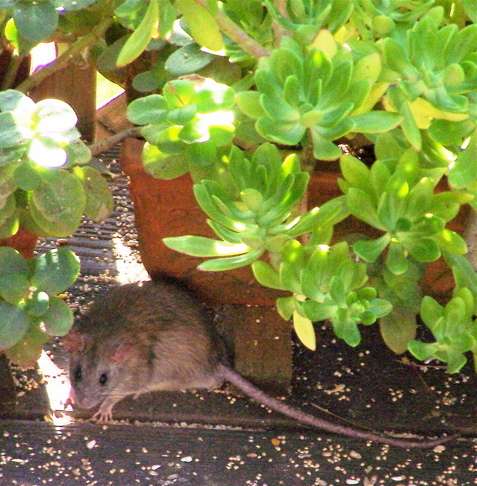
 Traps are more effective in controlling roof rats.
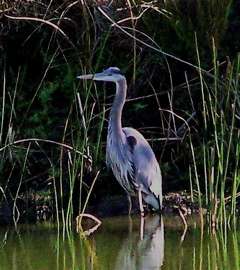 Here a Great blue heron picks its way through the reeds along the edge of the stockpond.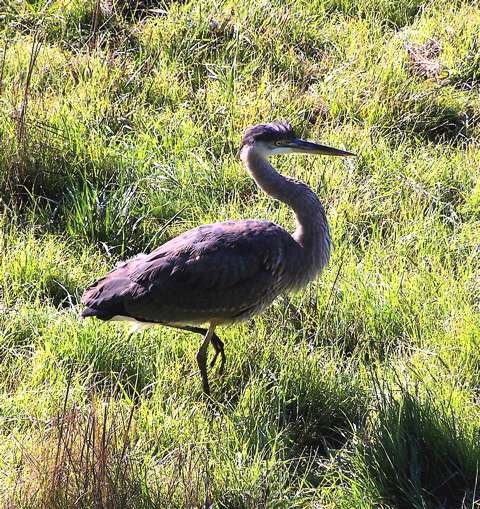
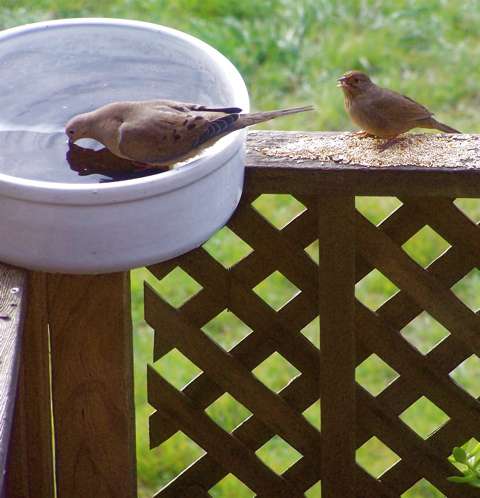
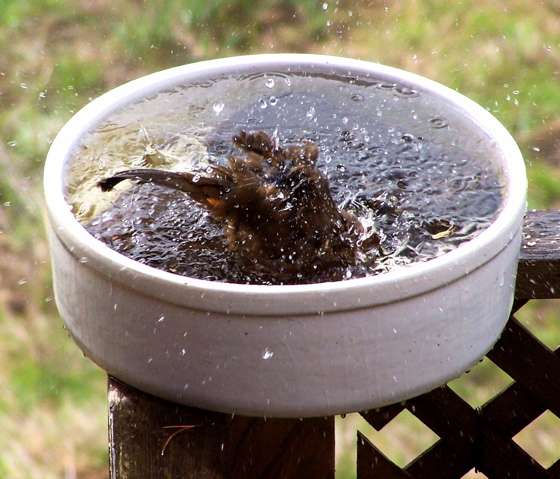
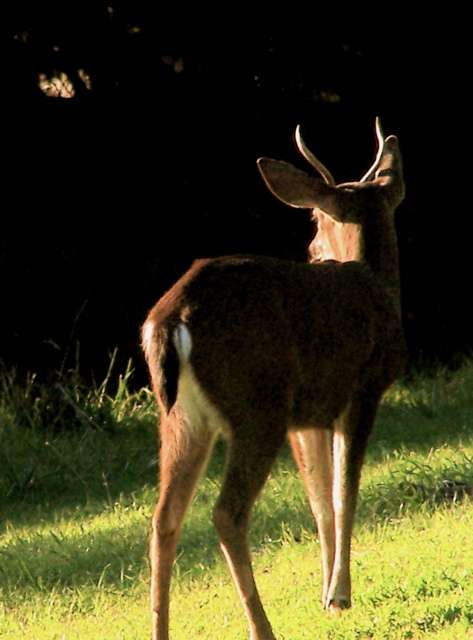
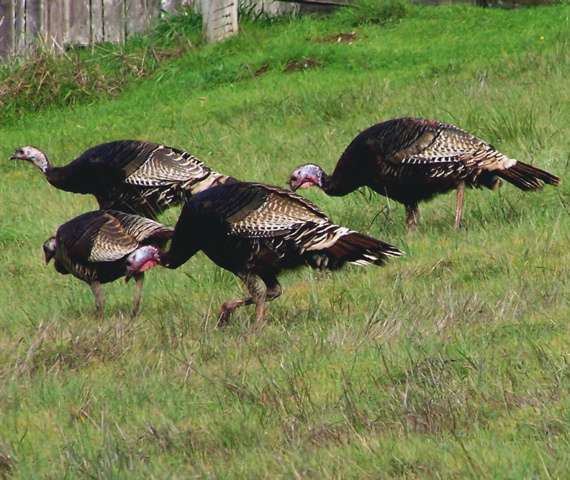
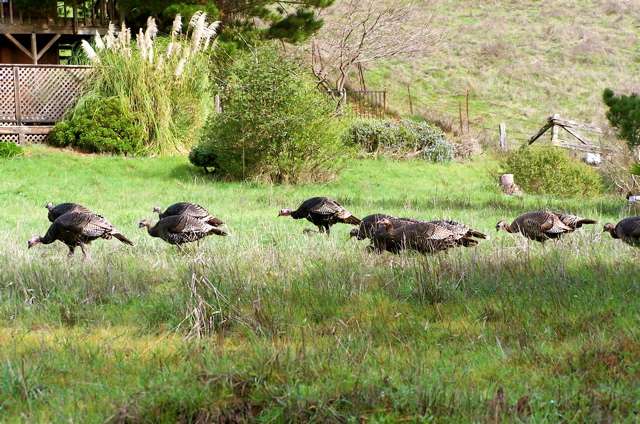 A dozen wild turkeys forage downhill from my cabin.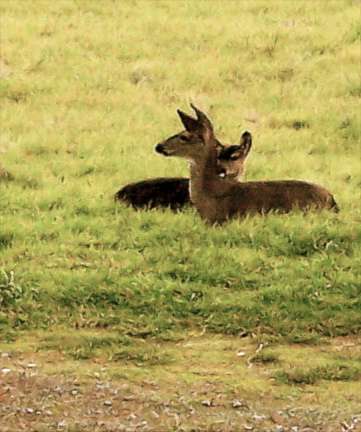
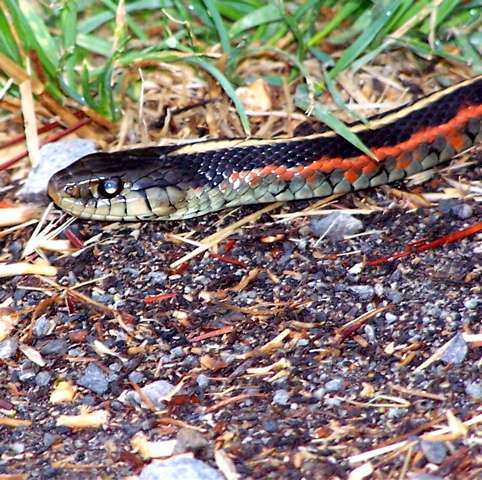
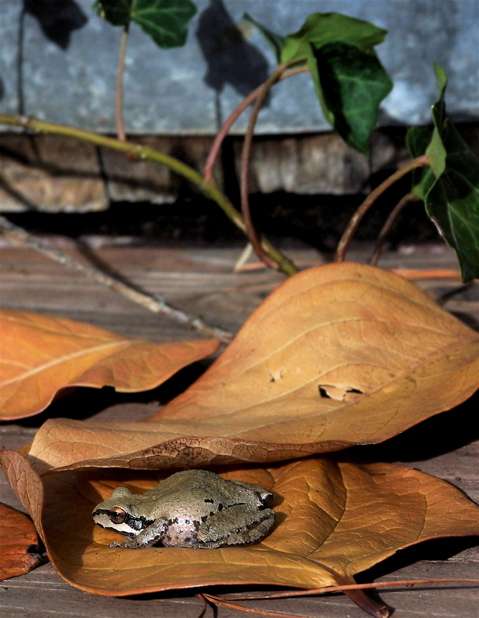 Pacific tree frog hiding out in leaves from my persimmon tree.
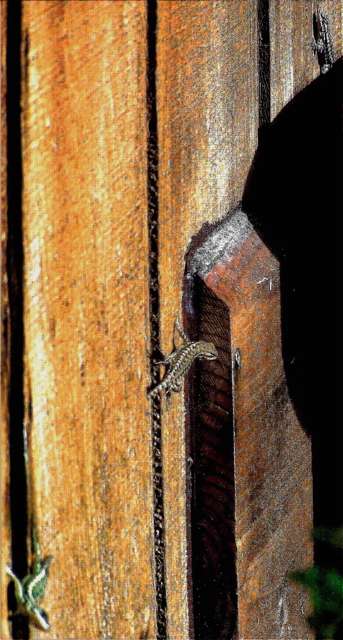 I photographed three lizards on the wall of my cabin and then was unable to find any naturalist either in town or at the Point Reyes National Seashore who could identify the green lizard at lower left.

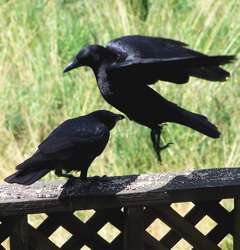 And while it’s amusing to talk in terms of “dinosaurs” eating birdseed on my deck, realizing that that they are, in fact, reptilian is illuminating. When a crow lands on a railing, it might as well be a Tyrannosaurus Rex as far as the other dinosaurs are concerned; they scatter in panic.