Wed 29 Nov 2006
Nature’s Two Acres: A Point Reyes Station Exhibit
Posted by dave under Point Reyes Station, Marin County, West Marin nature, Wildlife, Photography
[10] Comments
Walt Disney’s 1951 documentary Nature’s Half Acre was unusually successful for having such a simple premise: that there is an amazing spectrum of nature to be found on even a relatively small piece of open property. In fact, the movie’s cast was both huge and small — hundreds of little insects, various birds, spiders and lizards, flowers and other plants galore.
Likewise, the theme of this exhibit is the abundance of plants and animals I’ve managed to photograph from the two acres around my cabin overlooking Point Reyes Station.
Fortunately, the small town (population 820) remains a bit of the Old West despite being only 40 miles north of San Francisco. How much longer the town’s historic charm will last has, however, been uncertain ever since the opening of the Point Reyes National Seashore in 1965. Often now on weekends, the town is overrun with tourists (almost two million per year) en route to the nearby park. The tread of that many visitors on the flora and fauna of this area is crushing in more ways than can be easily imagined. Here, therefore, are some glimpses at what still survives.
A photography collection in progress:
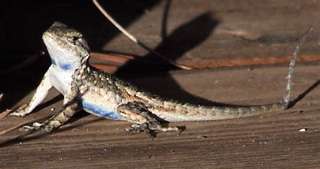
1. Male Western fence lizards do pushups to intimidate rivals, exposing their blue bellies in the process. When under attack, the tip of their tail twitches to draw the predator’s attention away from the body of the lizard. While the lizard can survive the loss of the tip, the loss takes a toll on the lizard which stores food there. The Western fence lizard is pestered by ticks, but when ticks that carry the Lyme Disease spirochete bite a “blue belly,” the spirochete dies.
— Photos by Dave Mitchell
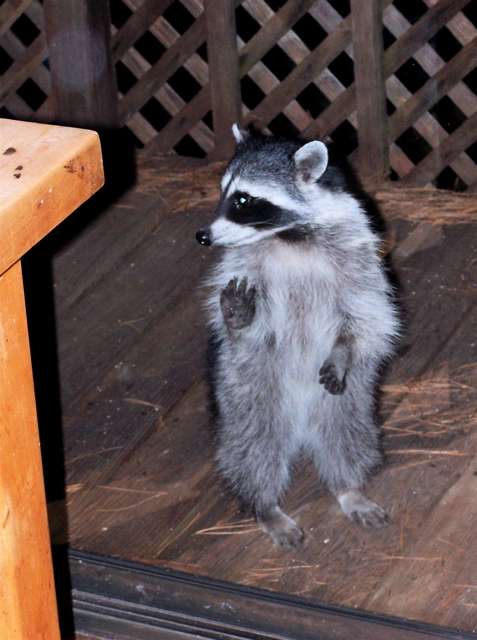
2. A raccoon showed up at my kitchen door at Halloween and stood up with a paw on the glass to catch my attention. The young raccoon was obviously used to begging from humans, and given the occasion, I rewarded it with a Halloween cracker.
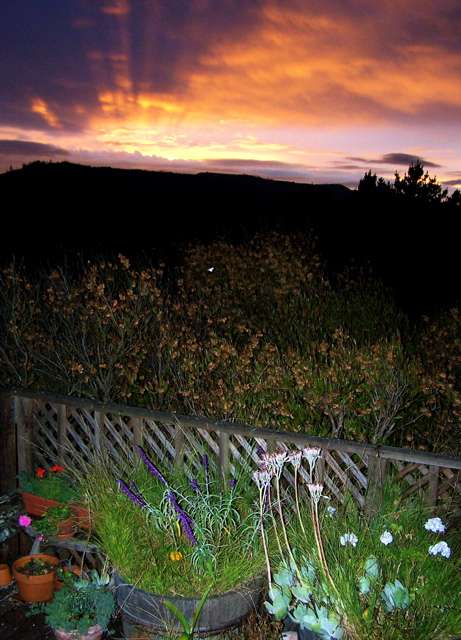
3. Sunset looking southwest from the deck of my cabin. In the middleground, the setting sun casts a glint off a shiny leaf. In the background is Inverness Ridge, much of which is in the Point Reyes National Seashore.
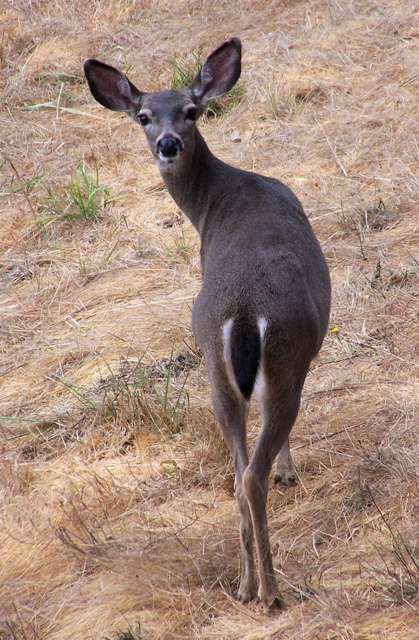
4. I have blacktail deer on my property throughout the year. I photographed this doe through my dining room window. At some times of the year, as many as 14 blacktails can be found around my cabin at one time.
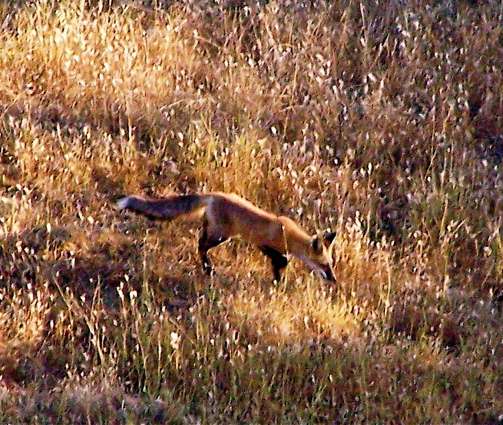
5. Red foxes are far less common than gray foxes in West Marin; however, they are common in the Sierra, Cascade Mountains, and Central Valley, and there have been red foxes on Point Reyes for many decades. Some may be the descendants of foxes that escaped fox hunts in Nicasio during the 1970s.
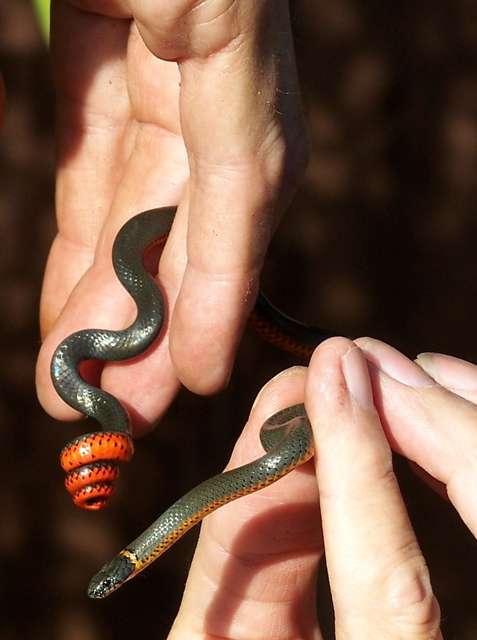
6. I found this Pacific Ring-necked snake in a rotten log while splitting firewood. The snake eats very small critters — tadpoles, insects, and especially salamanders — and it has just enough venom to immobilize them. However, the snake is not dangerous to humans.
 In a facility at her home, Susan Sasso of Olema had raised and rehabilitated the five small bucks and one doe on behalf of WildCare, the San Rafael nonprofit. She does it yearly, and it can be grueling work, feedings every four hours seven days a week when the fawns are newborn — sometimes every two hours when they’re sick. But by last week, the fawns at last were old enough to be released back into nature, and Susan asked me to contact two friends in Chileno Valley. The friends generously agreed to allow the deer to be released on their ranch. They themselves don’t hunt, and their ranch is large enough that the deer can wander over hill and dale without leaving the property. (The ranchers, by the way, have asked me to withhold their names lest I draw hunters to their land.)
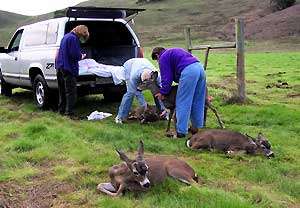 The release itself went amazingly smoothly. Mike drove across a ranch bridge to a pasture bordered by a creek, and there each fawn was lifted gently out of the truck and laid on the grass.
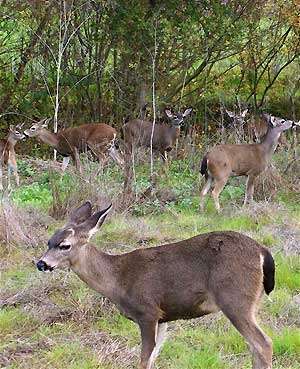 Most of the fawns brought to Susan are too weak to survive, and she loses far more than she saves. Within a year, cars and hunters may kill many of the deer she raises. Nor does West Marin have any shortage of blacktail deer. So why does Susan spend so much time and effort saving the few she can? Susan puts in the long hours simply because she is a humane person. Most of us feel sorry for sick and injured wildlife when we encounter it although we typically don’t see a way to help. Susan has found a way. And lest anyone imagine Susan has some New Age sense of humanity toward sufferers that aren’t human, I should note the “Humane” Society was founded in 1954 and the Society for the Prevention of Cruelty to Animals 130 years earlier


