The new owner of The Point Reyes Light has fabricated so much in court papers and public statements that I feel compelled to respond. Related topics included here: Robert Israel Plotkin and Lys Plotkin found to be frequently filing lawsuits. Robert Plotkin and mother defendants in US bankruptcy court in connection with a $77 million Ponzi scheme. Plotkin’s attorney Robert H. Powsner, 77, blames his own “forgetfulness” as he attempts to explain away a “web of lies” in his court filings.
Here are the facts regarding the litigation filed by The Point Reyes Light’s new owner Robert Israel Plotkin and his wife Lys against me, the former owner, against Joel Hack, owner of The Bodega Bay Navigator website, and against other people. Some of what is here was discovered by people not connected to the case. With a variety of people using the web to follow developments, government records containing surprising revelations of “mopery with intent to creep” * have come to light.
.
1. The most-significant misconception about problems at The Point Reyes Light is that they center on disputes between new publisher Robert Plotkin and me. They don’t. In the first 12 months after he became publisher, 13 staff and contributors were fired, quit, or in various ways shown the door.
Some staff such as Gayanne Enquist of Inverness, Sandy Duveen of Woodacre, Jim Kravets of Fairfax, and Peter Jamison, formerly of Woodacre, did not have jobs lined up when they left. I, at least, am retired.
2. Prior to Robert Plotkin’s and my falling out last February, I had been working diligently to help the paper during its transition to new ownership — as a consultant to the newsroom, a columnist, and a photographer. I have a five-year employment contact with The Light, which cannot be unilaterally terminated, but it pays only $175 per week to be available as a consultant. Nonetheless, I volunteered additional help as needed. Following the New Year’s Eve storm, I spent three days slogging through mud and wading through water to photograph the damage. However, as numerous people who have dealt with the new owner have discovered, he is frequently insulting and abrasive, and when he insulted me, we got into a shouting match in front of The Light.
Plotkin initially told bystanders and a sheriff’s deputy he was a victim of “attempted murder” — that I had tried to strangle him. However, hairdresser Barbara Keady, a witness who spoke with him immediately afterward, and sheriff’s deputy Ted Keehn noted there were no marks on him. “Plotkin had no visible injuries,” deputy Keehn wrote in his incident report. Plotkin then added to his story that I had tried to run him down with my car after he and I started yelling at each other.
But when deputy Keehn interviewed witnesses, that story didn’t hold up either. Realtor Robert Cardwell told the sheriff’s deputy that he saw Plotkin and me arguing in front of Greenbridge Gas & Auto. When Plotkin got out of my car, I made an abrupt U-turn on Mesa Road and stopped in front of The Light with a wheel on the sidewalk, which is flush with the pavement (i.e. there is no curb). “Mitchell got out of the red Acura and ran toward Plotkin,” deputy Keehn quotes the Realtor as saying. The deputy quoted hairdresser Barbara Keady as saying “she saw Mitchell park his vehicle in front of The Point Reyes Light on the sidewalk. Mitchell got out of his vehicle and had a heated verbal argument with Plotkin.” Sandy Duveen, who then sold advertising for The Light, told the deputy that after the Acura stopped abruptly in front of The Light, “she saw Mitchell walk towards Plotkin,” the officer reported.
So there was no attempt to strangle Plotkin or hit him with my car. As for my parking with one wheel on the sidewalk, anyone familiar Point Reyes Station’s old Creamery Building, where The Light is located, has often seen cars with at least one wheel on the sidewalk. Indeed, because there is no curb, vehicles parked halfway on the sidewalk are not uncommon.
3. Represented by Point Reyes Station attorney Robert Powsner, Plotkin then asked for a restraining order and later an injunction that prohibits me from being around him, his family, and his newspaper. Like other staff and contributors who have left, I had by then concluded Plotkin was immature and abrasive, as well as sometimes dishonest, so I had no problem agreeing to stay away from him.
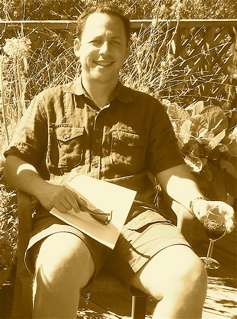 When asking Marin Superior Court to issue a retraining order against me (because we had shouted at each other), Plotkin claimed he needed special protection because of my supposedly immense size. With his irrepressible flair for the dramatic, Plotkin told the court I am 6-foot, 6-inches tall and weigh 225 pounds. Now Plotkin, of course, was writing from the perspective of a short and pudgy (The Marin Independent Journal called him “pear-shaped”) 36 year old. Nonetheless, this 63-year-old retired editor is definitely not larger than pro football’s Terrell Owens, the big wide receiver. In reality, I am 45 pounds lighter and three inches shorter than what Plotlin cavalierly wrote in his sworn statement.
In the last five years, the former lawyer has filed lawsuits against six tenants, one against The Bodega Bay Navigator website and its owner Joel Hack, and two against me. He is also a defendant in US bankruptcy court. Although for a while he was a deputy district attorney in Monterey County, Plotkin is no longer licensed to practice law in California.
 Joining her husband Robert, Lys Plotkin in August filed her own litigation against me, accusing yours truly of causing her “reckless and intentional infliction of fear and anguish and emotional distress.” What was the basis for this bizarre accusation? I’d had that shouting match with her husband six months earlier. Although she was not present for the squabble, Lys Plotkin in her court filing alleges that by shouting back and forth with her husband, I “realized” I would “cause [her] to suffer extreme mental and emotional fear, apprehension, anguish, and distress for the safety of her husband, of herself, of her unborn child, and of her son.” Wow! And despite Ms. Plotkin’s not being around at the time, she alleges I was “certain” I was doing this to her when her husband and I started yelling at each other. Like her husband, it would seem, Ms. Plotkin is willing to offer up absurd fabrications when it suits her purpose. Nor is she any stranger to litigation. Besides signing on as a second plaintiff in her husband’s lawsuit against me, Lys Plotkin has been a second plaintiff in three unlawful detainer lawsuits filed in San Diego County during the past five years to evict tenants.
4. Long before Plotkin and I had our squabble, he had a falling out with The Light’s long-time cartoonist, Kathryn LeMieux of Tomales, who quit contributing. The Bodega Bay Navigator in Sonoma County had just converted from a weekly newspaper to a website, and owner Joel Hack invited LeMieux to post her cartoons on The Navigator site. After I agreed to Plotkin’s injunction, which forbids my even sending him email, Hack invited me to also start posting on his website, which I did. In an Aug. 14 lawsuit filed by Plotkin against Hack and me, he claims I “induced” LeMieux “to become the cartoonist for The Navigator.” (My supposedly recruiting LeMieux, Plotkin suggested, amounted to my unfairly helping a competitor.) But like other things Plotkin has said in his lawsuits, in The Light and to other reporters, this was a total fabrication. LeMieux had agreed to draw for the website before I was involved with it.
5. Attorney Robert Powsner on Plotkin’s behalf then got Judge Jack Sutro to issue a bizarre injunction against my posting on the Bodega Bay website. Plotkin and Powsner had told Judge Sutro that by letting me post writing and photos on The Navigator’s site, Hack was “damaging or destroying” The Light. The judge agreed, and in chambers he told lawyers for both sides that protecting Plotkin’s $500,000 investment in The Light outweighed constitutional prohibitions against censoring free expression.
In making his ruling, Judge Sutro came up with a seemingly illogical interpretation of the sales agreement signed by Plotkin and me when he bought The Light’s stock in November 2005. When I sold the stock to Plotkin, I agreed not to write for another Marin County newspaper. In deciding I was violating that agreement by posting on The Navigator website, Judge Sutro failed to acknowledge there is a difference between a website and a newspaper. Ironically, a Sixth Appellate District court ruling as recently as May in a case involving Apple Computers noted, “The term ‘newspaper’ presents little difficulty; it has always meant, and continues to mean, a regularly appearing publication printed on large format, inexpensive paper.”
In addition to making no distinction between a website and a newspaper, Judge Sutro even more bizarrely failed to distinguish between a business being based in Marin County and a business being based in Sonoma County, where The Bodega Bay Navigator has always been located. The judge apparently accepted Plotkin’s boggling claim that the place of publication depends on what is written about in newspapers and websites, as well as in which communities they can be read.
Perhaps contributing to Judge Sutro’s confusion, Powsner and Plotkin untruthfully told Judge Sutro last August that The Navigator website “has no publishing or production facilities or premises in Sonoma County other than defendant Hack’s computer.” Exposing this fabrication, The Marin Independent Journal subsequently published a photograph of Hack working in The Navigator’s cluttered “shack,” a building located behind Hack’s Bodega Bay home.
 Because Plotkin — in securing an injunction against The Bodega Bay Navigator and me — claimed that competition from The Navigator’s site is “damaging or destroying” The Light, Navigator owner Joel Hack and I as co-defendants are now assembling evidence such as this to demonstrate it is Plotkin himself who is “damaging or destroying” The Light. The injunction is now being appealed, and more litigation is expected. Under Plotkin’s ownership, many readers have complained about Light reporting that is inaccurate, sensationalistic, or inappropriate for a community newspaper. Subscriptions have been dropping, as Plotkin admitted in his Nov. 9 issue. This sign was spotted on the Stinson Beach Village Association bulletin board opposite the front door to the town post office. As co-defendants having to ward off Plotkin, Hack and I would welcome submissions of any legally significant evidence showing that whatever wounds The Light has suffered have been self-inflicted rather than caused by competition from The Navigator website: http://www.bodegabaynavigator.info/interiorpages/WMarinNews/WMarinNews.htm.
6. I am getting excellent legal representation from attorney Ladd Bedford and Arman Javid of the San Francisco law firm McQuaid, Bedford, and VanZandt, and we will appeal Judge Sutro’s injunction, now that he has finally signed it. In addition, retired attorney Judy Teichman of Inverness Park is working as a volunteer on my behalf.
7. In the meantime, some fascinating West Marin stories are being left uncovered. How in the world, for example, did “defendant Robert Israel Plotkin” end up in federal bankruptcy court this fall in connection with a $77 million Ponzi scheme? The case was investigated by the FBI and prosecuted by the US Attorney’s Office.
The ringleaders, Moshe Leichner and Zvi Leichner, are now serving time in prison, a US bankruptcy trustee is trying — so far without success — to get at money the Leichners squirreled away in one Swiss and two Israeli bank accounts, and the Justice Department has warned the ringleaders they may be deported.
A US bankruptcy trustee has reported that last year he “filed over 150 adversary proceedings…. These proceedings seek recovery of funds in excess of $20 million in pre-petition transfers made by [Moshe and Zvi Leichner] to insiders and other parties.”
A federal hearing was held in October, with attorney Powsner representing “defendant Robert Israel Plotkin,” according to court papers. Plotkin’s mother Zaporah Bank of Los Angeles, another defendant, is representing herself.
As explained by CPA Grant Newton, an expert witness hired by the bankruptcy court, the Leichners from 1998 to 2003 “operated a Ponzi scheme: namely, a phony investment arrangement whereby earlier investors are paid fictitious profits from the funds of later investors.”
The Leichners’ Ponzi scheme operated under the name Midland Euro, and the US Justice Department notes, “The Leichners told their investors that Midland Euro would invest their funds in foreign currencies which Midland Euro would then trade on the international currency market for profit. Although the terms of the investments tended to vary slightly among victims, generally, the Leichners claimed Midland Euro would generate guaranteed monthly profits of between 2% and 4%.”
So the question we are left with is: how much did Robert Plotkin know and when did he know it? It may merely be that in contriving to make an unbelievably high “guaranteed” profit in the high-risk, foreign-currency-exchange market, Plotkin got involved with shady characters. However, he can hardly claim to be financially naïve since he is enough of an investor to own or have recently owned — besides The Light —an $840,000 seaside home in Bolinas, another house in Taos, New Mexico, real estate in New York City, and rental homes in San Diego County. I have no idea how much of this he presently owns or whether he will even stick around West Marin too much longer. Although he has by now owned a home in Bolinas for two years, the BMW he drives to work still carries New Mexico license plates.
As for the real estate in San Diego, Robert Plotkin (often with his wife Lys) went into that county’s superior court six times in five years, seeking to have tenants evicted. If you add to those six lawsuits the two Plotkin filed against me this year and the one he filed against Joel Hack, owner of The Bodega Bay Navigator website, you get a sense of just how litigious this former lawyer is.
8. Another curious story not receiving coverage is the role of Point Reyes Station lawyer Robert H. Powsner, who is representing Plotkin against Bodega Bay Navigator owner Joel Hack, the federal bankruptcy trustee, and me.
As it happens, Powsner’s law firm is one of three I had been using, depending on the nature of the issues. My current attorney, Ladd Bedford, who has been a friend since our days together at Stanford, gave my former wife Cathy and me free day-to-day advice during The Light’s Synanon investigation. The Heller Ehrman White & McAuliffe law firm — likewise at no charge — successfully fought off six lawsuits totaling $1.032 billion, which lawyers for the Synanon cult filed against the two of us. One case went all the way to the California Supreme Court, where Heller Ehrman won a major legal precedent that greatly increased California reporters’ right to keep confidential sources confidential in civil cases.
In addition, I had hired attorney Powsner to represent me in a variety of matters, including one out-of-court dispute involving my firing of an intern when he failed to cover a major storm, as assigned. After firing him, I had to stop the intern from running off with the office keys. What I didn’t know until a witness’ sworn statement this year was that the intern had been ripped on cocaine at the time.
Attorney Powsner’s photo
and his description
of his practice can be found at:
lawyers.nolo.com/attorney.cfm?attorneyID=422&LocationID=19&specialtyID
When I hired Bedford and not Powsner to draft the sales agreement for The Light, Powsner went ballistic — perhaps because he owed The Light about $4,000 at the time and would have liked to work off the debt. In any case, when I approached him for help in dealing with Plotkin, Pownser announced he was switching clients and intended to represent Plotkin against me.
Under the California State Bar’s Code of Ethics, Powsner should have refused to fight a former client in court since he has confidential information about that client. The reason for the rule became immediately obvious; Powsner (before finding out that cocaine was the likely cause of the intern’s behavior) repeatedly tried to dig up more information about that dispute to use against me on Plotkin’s behalf.
My attorneys have asked a court commissioner to disqualify attorney Powsner because he had previously represented me. In particular, he had attempted to use information from the intern dispute, against me on behalf of a new client. Powsner, who is 77, responded with a surprising rationalization for his investigating on behalf of Plotkin an out-of-court dispute that he negotiated as my lawyer: it was simply a matter of his “forgetfulness.” That would be an amazing admission for any lawyer to make — and especially one who is still practicing in his seventy-eighth year and would like to continue.
Powsner told the court commissioner that until he read my present lawyers’ motion to disqualify him, “I hadn’t remembered anything about the… [intern] matter (which was in 1998) nor that it existed nor any information about it.”
Powsner apparently also forgot that in the months before the motion to disqualify him was filed, he had talked over the matter with my lawyer and one of my lawyer’s partners, Arman Javid, as well as The Light’s former business manager Don Schinske, The Light’s former typesetter Cat Cowles, The Light’s present front-office manager Missy Patterson, and (as he himself would later acknowledge) his own secretary Susan Cofano and his new client Robert Plotkin.
As my attorneys then pointed out to court commissioner Roy Chernus, “Robert Powsner is caught in a web of lies…. Mr. Powsner’s new declaration not only contradicts his own assertions and the declarations of three witnesses, but it contradicts his own assertions several times within the same document. All the previous untruths prevent Mr. Powsner from keeping his story straight.”
Attorney Powsner has now hired his own attorney, Peter Flaxman of Mill Valley, to help untangle him from his “web of lies.” In the meantime, a complaint has been sent to the State Bar regarding forgetful Bob’s unethical conduct.
*In 1970, in Columbus, Ohio, mopery was defined as “loitering while walking, or walking down the street with no clear destination or purpose”, and was used by police to harass counterculture “hippies” who were regarded as unsavory…. [However] in discussions of law, “mopery” is used as a placeholder name to mean some crime whose nature is not important to the problem at hand. This is sometimes expanded to “mopery with intent to creep.” — Wikipedia






 Here a Great blue heron picks its way through the reeds along the edge of the stockpond.


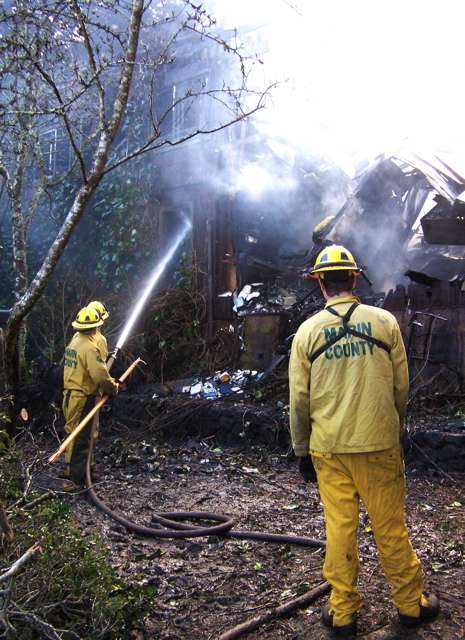
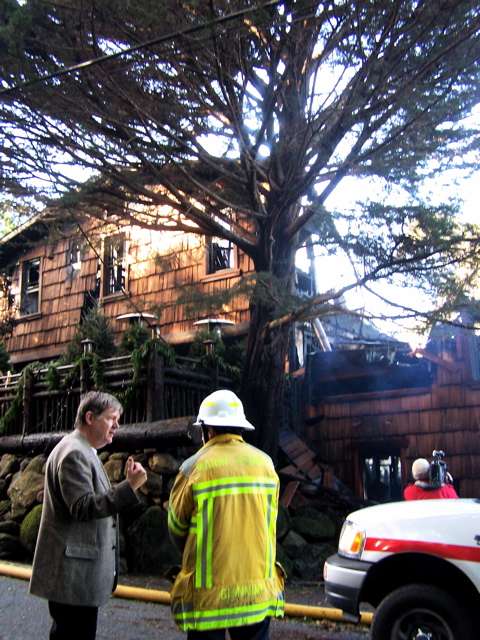 Trapped. A guest who escaped unharmed with his possessions nonetheless found his car stuck for hours in Manka’s parking lot, hemmed in by Inverness and Marin County firetrucks.
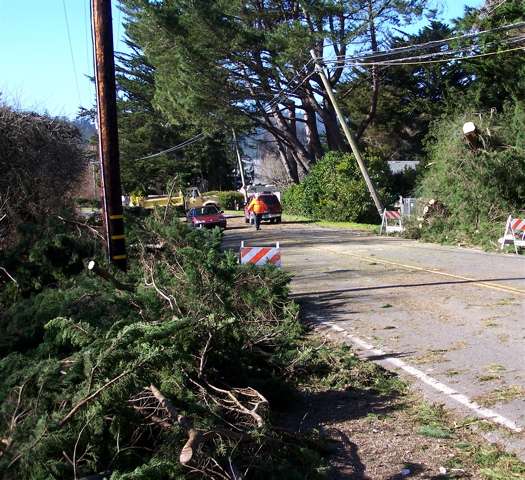 A tree that fell on a utility pole along the levee road in Point Reyes Station forced closure of the road for much of Wednesday.
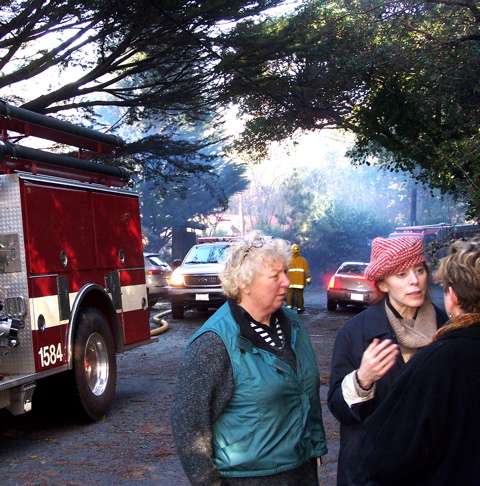 Manka’s owner Margaret Grade (center) herself was one of the chefs, and several of those who worked with her were in tears Wednesday morning. However, when Margaret spotted me taking photos, she might just as easily have been the congenial hostess welcoming guests at the door.
 Only the front wall of Manka’s restaurant remained mostly standing. Sky can be seen through the windows of a guest room whose roof was consumed.

 A dozen wild turkeys forage downhill from my cabin.

 Pacific tree frog hiding out in leaves from my persimmon tree.
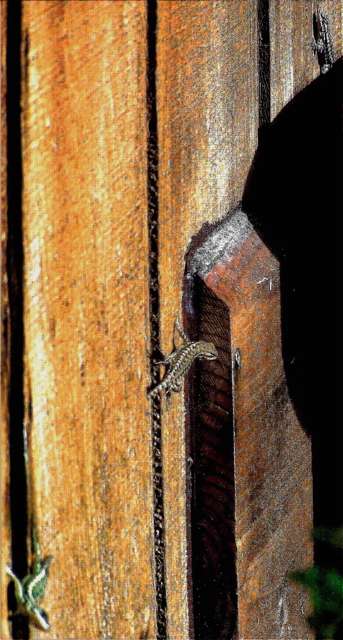 I photographed three lizards on the wall of my cabin and then was unable to find any naturalist either in town or at the Point Reyes National Seashore who could identify the green lizard at lower left.



 And while it’s amusing to talk in terms of “dinosaurs” eating birdseed on my deck, realizing that that they are, in fact, reptilian is illuminating. When a crow lands on a railing, it might as well be a Tyrannosaurus Rex as far as the other dinosaurs are concerned; they scatter in panic.







 In a facility at her home, Susan Sasso of Olema had raised and rehabilitated the five small bucks and one doe on behalf of WildCare, the San Rafael nonprofit. She does it yearly, and it can be grueling work, feedings every four hours seven days a week when the fawns are newborn — sometimes every two hours when they’re sick. But by last week, the fawns at last were old enough to be released back into nature, and Susan asked me to contact two friends in Chileno Valley. The friends generously agreed to allow the deer to be released on their ranch. They themselves don’t hunt, and their ranch is large enough that the deer can wander over hill and dale without leaving the property. (The ranchers, by the way, have asked me to withhold their names lest I draw hunters to their land.)
 The release itself went amazingly smoothly. Mike drove across a ranch bridge to a pasture bordered by a creek, and there each fawn was lifted gently out of the truck and laid on the grass.
 Most of the fawns brought to Susan are too weak to survive, and she loses far more than she saves. Within a year, cars and hunters may kill many of the deer she raises. Nor does West Marin have any shortage of blacktail deer. So why does Susan spend so much time and effort saving the few she can? Susan puts in the long hours simply because she is a humane person. Most of us feel sorry for sick and injured wildlife when we encounter it although we typically don’t see a way to help. Susan has found a way. And lest anyone imagine Susan has some New Age sense of humanity toward sufferers that aren’t human, I should note the “Humane” Society was founded in 1954 and the Society for the Prevention of Cruelty to Animals 130 years earlier


