General News


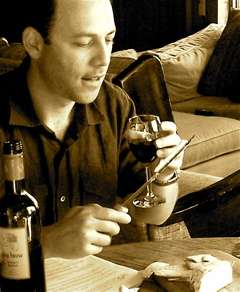
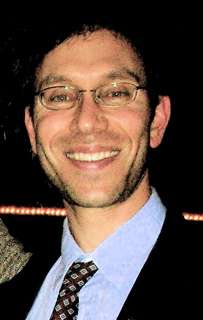
Inverness resident Andrew M. Schultz died on Monday, June 18, at the age of 58 from complications related to small-cell lung cancer.

His death will inevitably be described by those who knew him as “The Death of a Salesman,” and Andrew would be the first to agree, as evidenced by his personalized license plates, “AD SPACE.”

100_3194_1.jpgAndrew’s specialty was selling newspaper classified advertising to automobile dealerships, which he did almost continually for more than 30 years.

Born in Manhattan, New York, on July 27, 1948, to Fran and Leon Schultz, he attended public schools in the Bronx, Plainview, and Long Island, as well as Hofstra University on Long Island for two years.

For two years he studied to become a chef only to switch courses and attend two more years of classes at the New York Institute of Photography.

Andrew moved to California in 1971. “I had been wanting to get out of New York. I felt trapped,” he explained in an interview last winter. “I felt nothing was happening for me there.”

He arrived in Marin hoping to work as a photographer. Given his choice, he said during the interview, “I would have been a magazine photographer doing cover shots for magazines such as Glamour, Time, and US News and World Report — mainstream magazines.”

Many may have sent or received the composite postcard from Inverness with photos of downtown, a friendly pelican and the famous beached boatwreck. All those photos were taken by Andrew Schultz.

Another of Andrew’s favorite photo assignments has been the annual Disaster Council pancake breakfast at the Point Reyes Station firehouse. Andrew said he enjoyed capturing on film the pillars of the community stuffing their faces with pancakes.

“In 1972,” he recounted, “I went to work for The Funfinder as a photographer but quickly became a salesman. In those days, The Funfinder was an entertainment periodical the size of TV Guide, boasting a circulation of 20,000 in San Francisco and Marin counties.

When The Marin Independent Journal bought The Funfinder in 1975, Andrew went to work for The Independent Journal. “The most fun I’ve ever had was selling automotive classified when I moved from The Funfinder to The IJ,” he recalled. “It was one of the most interesting changes I made in my work life. It clicked, and I just loved it.

“With the majority of the people that I meet, I discovered that there are three stages. First, they don’t like me at all. Then it’s, ‘Let’s give this guy some time.’ Then, I really win them over. You always know when you’ve broken through to the customer.”

Andrew said he genuinely liked his customers. “About six times… dealers offered me jobs, but I didn’t want to sell cars. Whenever a dealership offered me a job selling their product, I knew I had them right where I wanted them… that they trusted me and we had built a strong professional relationship. Contrary to what most people think, business relationships are really personal relationships.”

Andrew worked at The Independent Journal until 1987, when he moved to Monterey County and began selling automotive classified adds for the Santa Cruz Sentinel. “Nine months after I got there, I won salesman of the year,” he recalled with pride. I left Santa Cruz a month before the Loma Prieta earthquake. I had been living in Soquel, two to three miles away from the epicenter in Aptos.”

After moving back to Marin County, Andrew sold advertising at The Point Reyes Light for a year, at the Petaluma office of a free “pennysaver” owned by newspaper chain publisher Dean Lesher, at The Petaluma Argus Courier, The Cotati Times, The Press Democrat in Santa Rosa, and Auto Trader in Petaluma.

Indeed, Andrew sold advertising space wherever he could find it, whether it was on cash register tapes or the community-access channel of Horizon Cable. In 1999 after public-utility deregulation, he even tried to sell electricity and was hopeful of signing up most of California’s schools. However, the company he was working for collapsed.

Many West Marin residents knew Andrew as an advertising salesman and operator of Horizon Cable’s community channel, Channel 47. As such, Andrew donated a good portion of his time to helping the local nonprofits with their fundraising.

West Marin had enjoyed good television reception until 1973 when Bay Area channels stopped transmitting from Mount San Bruno and began using the newly constructed Sutro Tower. TV signals to this stretch of coast were then blocked by Mount Tamalpais. Among those unhappy with the resulting poor reception was Andrew. The poor reception also prompted John Robbins, formerly of Inverness, to build the West Marin Cable system, starting in 1983; he sold it to Horizon Cable in 1991.

Robbins, who had employed Andrew part time, recalled in an interview last January, “The first time I met him, I was at the White House Pool building the cable system. He stops his car right on the corner of Sir Francis Drake Boulevard and Balboa Avenue and wants to know when he’ll get hooked up.”

When Robbins was building the Stinson Beach part of the cable system, he hired Andrew to line up customers. “I let him go there and knock on doors.”

Even after the cable system was built and sold to Horizon, Andrew continued in his spare time to sell advertising for its community-access channel, which was then Channel 11 and 13 and is now Channel 47. Only recently did he finally relinquish that responsibility to Horizon owner Susan Daniels.

“He’s a wonderful, pushy, in-your-face salesman, and he aims to leave you feeling good about the conversation,” Robbins said. “You always knew when Andrew was coming. His voice was a big as he was [6-foot, 3-inches and more than 250 pounds].”

“Sometimes I’m insensitive in realizing that I’m a very big guy,” Andrew acknowledged. “I’ve been told at times I’m disruptive… I’m definitely noticed. I’m good at parties, but I don’t care to go to them very often. I come home at night and the mask comes off.”
andrew-schultz.gif

©Art Rogers/Point Reyes

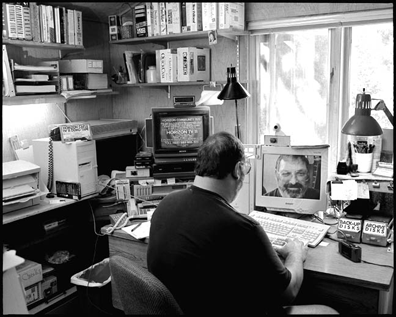
Rather than socializing, “Andrew’s life revolved around his computer and movies,” Robbins noted. “At times, I am nearly a hermit,” Andrew confirmed.

“Yet I feel as if I have lots of good friends. I have loved many in my life. I have a hard time understanding jealous people. They don’t seem to realize that you can’t take love from others. Love is only given.”

Surviving Andrew are his brothers Billy, Nathan, and Barry Schultz. His father Leon Schultz died in 1990 and his mother Fran in 2000.

Andrew is also survived by his former partner, Daniel Medina. Andrew also leaves a long list of people he has loved and who have loved him, commenting several weeks ago, “They will all know who they are…”

At his request, Andrew will be cremated. Adobe Creek Funeral Home in Petaluma is handling arrangements. A memorial service will be held on Limantour Beach at 10 a.m. Saturday, June 23. Before he died, Andrew asked that in lieu of flowers, contributions be made to Hospice by the Bay and West Marin Senior Services — “please.”

Editor’s note: At Andrew Schultz’s request, several of us combined efforts to write this piece before he died.


In contrast to the controversy raging in town and in the press this week over the sorry state of The Point Reyes Light under its new publisher, life has remained fairly bucolic at my cabin.

100_4638_1.jpg

In preparation for the fire season, tractor operator Gary Titus from Tomales on Saturday mowed my pasture and that of my neighbors Dan and Mary Huntsman.

Homes uphill from fields of dry grass are particularly vulnerable to wildfires, county firefighters remind West Marin residents each summer.

Titus, who mows our pastures annually, told me that ours — like other fields he’s mowed this year — were faster to cut than usual even though the grass was higher. It apparently has to do with which types of grass grow best as the timing and amount of rainfall vary.

The mowing provides quite a show, for crows continually fly in circles around the tractor looking for insects, snakes, and other small creatures killed — or at least stirred up — by the mowing. It is not uncommon for West Marin’s ubiquitous gopher snakes to get chopped up by mowers, but Titus was happy to report that this year he hasn’t killed a single snake.

Most of the wildlife around my cabin have, of course, not been affected by the mowing.

100_4200.jpg

Possums at night still climb lattice to drink from the birdbath on my railing.

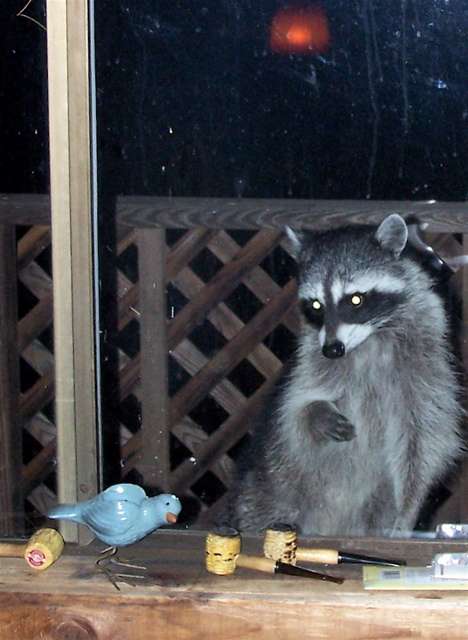
And the raccoon that my stepdaughter Anika photographed last month peering in my dining-room window is back at it. Standing on my firewood box outside, the raccoon (which appears earlier on this blog) initially seemed to be merely checking on what those of us inside were doing.

100_4602_1.jpg

This week when I spotted her again, however, the raccoon had more on her mind. On my window ledge is a ceramic candlestick with the lifelike shape of a small bird. The raccoon obviously wanted to grab it, but there was a pane of glass in the way.

In contrast to the rural tranquility around my cabin, protesters in Point Reyes Station milled around in front of The Point Reyes Light Monday morning. Some were upset by the paper’s sensationalism, which which under publisher Robert Plotkin has been heavy on gratuitous gore. Others complained that the newspaper no longer provides West Marin with the coverage it needs. “It’s lost connection to the community,” protest organizer Elizabeth Whitney of Inverness told the press.

The demonstration, which got advance coverage in Saturday’s San Francisco Chronicle and by the Associated Press, was covered live on Monday by Sonoma County public radio and the Santa Rosa Press Democrat.

In a lengthy article by Paul Payne, The Press Democrat quoted Plotkin as calling the demonstration a “march to mediocrity, a protest against excellence. I bought the newspaper to make something extraordinary.”

Payne also interviewed Joel Hack, owner of The Bodega Bay Navigator website, who plans to launch a competing weekly newspaper in West Marin on July 5.

Hack told The Press Democrat and The Chronicle that his newspaper would cover school board and other public meetings (as The Light did before Plotkin bought it in November 2005). He also promised to also cover the special accomplishments of everyday residents, such as “aunt Mabel’s prize-winning raspberry jam.”

The new paper has been temporarily dubbed The West Marin Pilot until readers chose a final name, and Hack last week told The Chronicle that scores of people have begun subscribing before the paper even exists or has a definite name. He has also reported significant success in lining up advertisers.

Editing the new newspaper will be former Light editor Jim Kravets. In Saturday’s Chronicle, Kravets is quoted as saying, “It’s a journalist’s dream to work in a community where people don’t just pick up the paper out of rote, but run to it.”

Kravets has called for a community meeting at 7 p.m. Monday, June 18, in the Dance Palace “to tell editors and staff of the West Marin community newspaper what they want and don’t want in their newspaper.” He described the meeting as a chance for West Marin residents to ensure the “paper is not merely relevant but essential for the enlightened practice of West Marin citizenship.”

Notwithstanding the protest and a new competitor, The Light itself got some good news this week.

Missy Patterson, who runs the paper’s front office, has changed her mind and will not work for the new newspaper, Hack reported. He said Patterson did not explain her reasons in detail, mentioning only that she was uncomfortable with her earlier decision to jump ship.

And on Wednesday, The Independent Journal reported that former Light bookkeeper LaShanda Goldstein has pled guilty to embezzling $62,000 from the weekly.

Goldstein, 29, of Santa Rosa remains in Marin County Jail in lieu of $62,000 bail, The Independent Journal added.

On Monday, she pled guilty to “one count of embezzlement with an enhancement for stealing more than $50,000,” the paper reported. “She could face a maximum sentence of four years in state prison, but Deputy District Attorney Rosemary Slote said Goldstein may be sentenced to probation because she has no prior record.”

100_4616.jpg

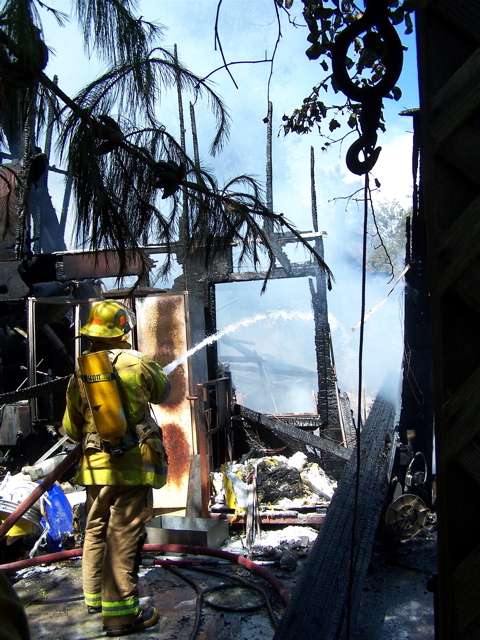
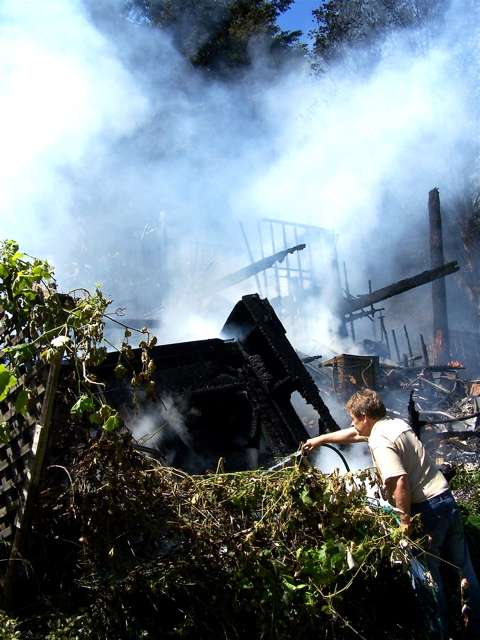
A 2,000-square-foot art studio at 80 Blackberry Way in Inverness Park burned to the ground Friday afternoon. The owner, Sherburne Slack, whose home is next to the studio, told me while the fire was still burning that he had “no clue” as to what started it.

Slack noted he gone to the studio half an hour before the fire broke out and had seen nothing amiss.
100_4614.jpg

There are no fire hydrants on Blackberry Way although there is one not far away at the foot of Balboa Avenue where tanker trunks refilled. Slack (above) has a 3,000-gallon tank at his house, from which both he and firefighters also drew water.

burnt-by-the-sun-kissed-by.jpgThe studio was being used for sculpting and had previously been used for blowing glass, but none of the glass furnaces had been turned on in a year and a half, Slack said. The artist explained he had developed a bad back and could no longer handle the heavy lifting glass blowing requires.
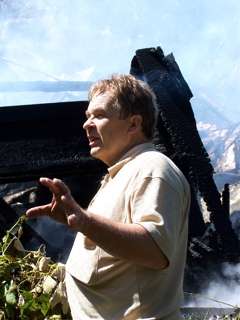
Slack said he lost $50,000 to $60,000 (wholesale price) of art in the blaze. Slack’s art (left) has been exhibited worldwide. Some of it is currently in an exhibition in New York, he noted.

The artist said he had been working at a computer in his house and waiting for someone with a brush chipper when he heard noises and went outside expecting to see the chipper.

Instead he found smoke billowing from his multi-level studio less than a block from Balboa Avenue.

100_4625.jpgSlack (at right) said he immediately called the 911 emergency number but was kept on hold for six minutes.
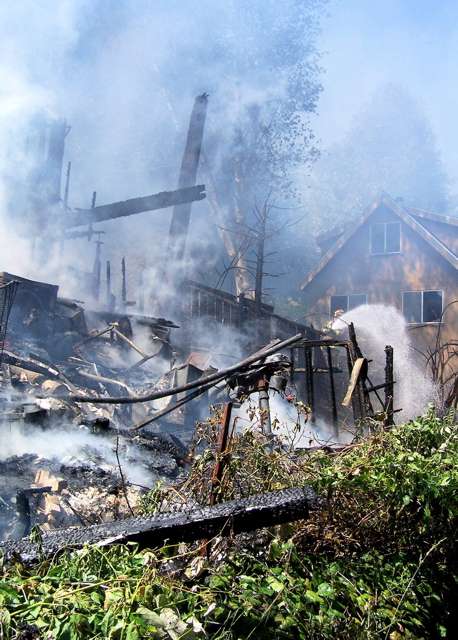

Meanwhile neighbors called the Point Reyes Station firehouse directly, and one person drove into town to alert firefighters.

Firefighters were called out at 2:18 p.m. County firefighters from Point Reyes Station, Woodacre, and Tomales responded, as did the Inverness Volunteer Fire Department.

When firefighters arrived on the scene, a prime concern was preventing the blaze from spreading to a house next door owned by Bolinas School teacher Don Jolley.

.

100_4622.jpg

.
vase-beauty-amethyst-gold-r.jpgAlthough the Jolley house (above) did not catch fire, heat from the blaze blew out windows facing the studio.


As of this posting, the county Fire Department was preparing to look for clues as to what started the fire.

Slack told me the studio was uninsured, adding that he does not have enough income to rebuild it. However, he said, the loss was just “stuff” and that it was more important that no one was hurt.

This vase from Sherburne Glass Studio is titled “Beauty” and contains “amethyst and gold ripple.”

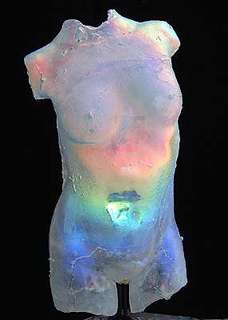
The glass torso above, which also comes from the studio, is titled “Resurection.” Both pictures of Slack’s art were taken from sherb.com where more of his work can be seen.

Immediately after Saturday’s Western Weekend livestock show and immediately after Sunday’s parade, I published unscheduled postings on the events. Also covered were the contemporaneous debut of The West Marin Pilot and The Point Reyes Light’s reporting that it had lost $62,000 to an allegedly embezzling bookkeeper.

As always, there were photos for which there was no room and stories that could wait until the dust cleared. First a look at some more of Sunday’s parade:

100_4552_1.jpg

The Inverness Garden Club as always was one of the more colorful entries in Sunday’s parade.

100_4553.jpgWhat made the entry particularly unusual this year was the driver of the motorcycle with sidecart that typically is part of the entry. This year the driver, Terry Aleshire of Inverness, wore a gorilla suit although his motorcycle was decked out in flowers. The incongruity was pure theater, and spectators loved it.


.

.

.

100_4584.jpg

A stilt-walker from Circus Finelli managed to gracefully navigate Point Reyes Station’s main street during Sunday’s parade. After the parade (and without stilts) she, along with the rest of the circus, entertained guests with comic gymnastics at the Farm Bureau Barbecue in the yard of Toby’s Feed Barn.

100_4595.jpg
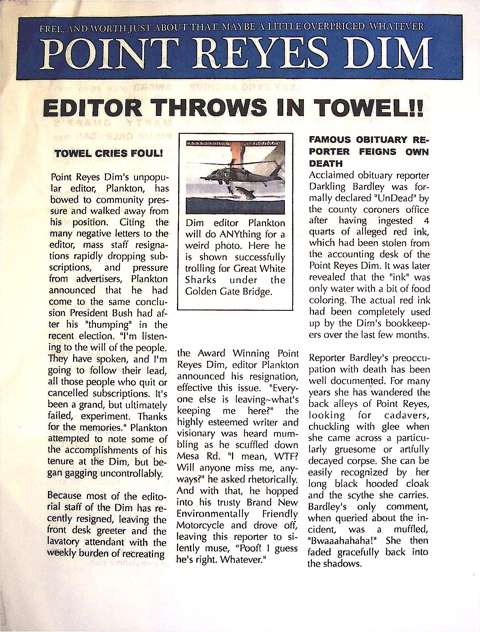
A satire of The Point Reyes Light was distributed to spectators during Sunday’s parade. Although stacks of the spoofs were on store counters around town, nobody seemed to know who produced it.

The four-page Point Reyes Dim was in the style of The San Francisco Chronicle cartoonist Don Asmussen’s “Bad Reporter” parodies of the press. For example, The Dim’s banner headline proclaimed “Editor Throws in Towel: Towel Cries Foul.” The accompanying story reported “Point Reyes Dim’s unpopular editor Plankton has walked away from his position…. Because most of the editorial staff of The Dim has recently resigned, leaving the front-desk greeter and the lavatory attendant with the weekly burden of recreating the award-winning Point Reyes Dim, editor Plankton announced his resignation, effective this issue. ‘Everyone else is leaving — what’s keeping me here?’ the highly esteemed writer and visionary was heard mumbling as he scuffled [sic] down Mesa Road.”

Many others of us around town were also lampooned. Publisher Plankton’s paper includes a photo of a chimpanzee and tells readers it’s a picture of me. Inverness artist Andrew Romanoff, grandnephew of the last tsar of Russia, is referred to as Prince Stroganoff. Historian Dewey Livingston is listed as Dewy Lovesbeingstoned. Someone, by implication from Spirit Rock Meditation Center, supposedly sent a disapproving, albeit somewhat meditative, letter to the editor: “Dear Editor, Mmmmmmmmmmmm, mmmmmmmmm, m m m m m,” and signed it “Valley Dharma, Woodacre.”

Light publisher Robert Plotkin no doubt can handle the ridicule. He’s probably getting used to it by now. A more significant problem for him was revealed in the May 27 issue of The San Francisco Chronicle.

Plotkin has been recruiting unpaid interns to cover the news of West Marin, East Marin, San Francisco, and Sonoma County. In fact, if The Light keeps adding to the number of communities it covers, it may soon try assigning interns to Vallejo, Hercules, and Pinole, possibly along with Milpitas, Coalinga, Brisbane, and “parts” of Tehama County.

Chronicle reporter Kathleen Pender, however, warned last week: “What many students and employers do not realize is that federal and state labor laws require for-profit employers to pay interns at least minimum wage unless the job meets specific requirements.”

The California Department of Labor has announced that an unpaid internship must “be an essential part of an established course of an accredited school or of an institution approved by a public agency to provide training for licensure or to qualify for a skilled profession. The program may not be for the benefit of any one employer, a regular employee may not be displaced by the trainee, and the training must be supervised by the school or a disinterested agency.”

Under federal law, for-profit employers must pay workers unless the position meets six criteria. One says the employer “derives no immediate advantage from the activities of the trainees or students.”

The Chronicle also noted, “Students who work in unpaid private-sector internships that should have been paid can file a federal or state wage claim and could receive back wages even if they had agreed to work for free.”

When I owned The Light, interns were required to live in West Marin during their internships, were paid (typically well above minimum wage), and received gasoline expenses — if they worked three or more days a week. The few one- or two-day-a-week interns we ever used received gasoline expenses but were not paid. It would now appear they should have been paid or — more likely — not used at all since a legitimate internship involves many hours of coaching.

.
100_4486.jpg

But getting back to Western Weekend, here judge Kelsey Cheda of Petaluma FFA appraises junior heifer calves, awarding first place to Elyassa McClure (left), second to Janelle Kehoe, and third to Ben Ielmorini during Saturday’s livestock show.

.
100_4540.jpg

More on dairy cows. Chileno Valley journalist Ivan Gale, who now is a business writer for The Gulf News in Dubai, passed through West Marin last week en route to an airline conference in Vancouver, British Columbia. When I caught up with Ivan, he appeared to be spraying graffiti on a cow at the ranch of his parents, Mike and Sally Gale. In fact, another rancher recently gave the Gales the cow after it fell into a ditch. The cow had been slightly injured when it was stuck in the ditch for several hours before being found, and Ivan turned out to be spraying antiseptic on some scrapes.

100_4569.jpg

With the traditional lasso twirling and the Coast Guard color guard’s precision marching, Sunday’s Western Weekend parade drew roughly 2,000 spectators, who lined the sidewalks of Point Reyes Station’s three-block long main street.

100_4573.jpg

Of course, back in 1980 and 81, the parade drew crowds of 10,000 people, largely because participating groups came from all over the San Francisco Bay Area. But that large a multitude in a town which then had about 600 residents was overwhelming. Rowdy motorcyclists roared up and down the main street when the parade ended. Beer flowed in the gutters.

The chaos prompted the West Marin Lion’s Club, which then sponsored virtually all of Western Weekend, to call off the parade for two years while retaining the weekend’s Junior Livestock Show. (”Junior” in the sense that all the contestants exhibiting animals were youths from 4-H and FFA clubs.)

100_4546.jpgWhen parades resumed in 1984, they were smaller, home-grown affairs. Which from a spectator’s point of view, not to mention public order, is far more comfortable. Of course, there’s still plenty of spit and polish, for Point Reyes is a parttime home for the US Coast Guard Communications Station crew and for Marin County firefighters (seen at rear).


.

.

100_4591.jpg

One of the odder entries (last seen heading toward the Old Western Saloon) was dubbed “Light ‘em if you got ‘em.” The bizarre contraption featured a spinning rack of antlers on the front and belched fire from it’s chimney. At times, the “devil” at left would turn up the gas, and fire would shoot higher into the air. Nervous spectactors were relieved when “the devil” — despite his legendary propensity for mischief — did not turn up the gas while passing under any overhead lines.

100_4582.jpg

Cowgirls for Peace were followed by protesters with a banner: “Stop Bushwhacking the Planet.”

100_4564.jpg

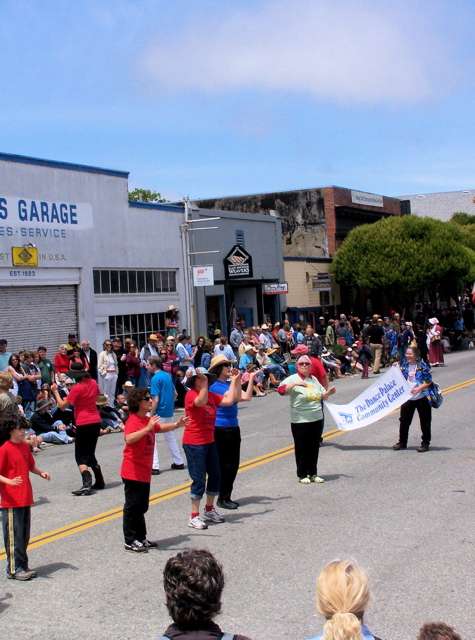
A group from the Dance Palace Community Center danced its way down the parade route.

100_4594.jpg

The Western Weekend barbecue, which followed the noontime parade, was sponsored by the Farm Bureau this year and was held at Toby’s Feed Barn instead of at the Red Barn where it traditionally was held. Also moved from the Red Barn this year was the livestock show, and attendance was sparse Saturday. A spot check around town found most people didn’t know it was being held in rancher Rich Giacomini’s corral next to the Dance Palace.

100_4432.jpg
I ran into a snake near the foot of my driveway last Thursday. Or, to be more precise, I managed to avoid running over it.

A Pacific gopher snake three to four feet long was warming itself on sunny patch of Campolindo Drive near the ends of Skip and Renée Shannon’s driveway, Jay Haas and Didi Thompson’s driveway, and my driveway.

100_4423.jpg

Two other neighbors, George and Earlene Grimm, walked up when they saw me taking the snake’s picture, and Earlene told me she and George have counted as many as 15 gopher snakes in their yard.

Another neighbor, George Stamoulis, later told me he had picked up a gopher snake a few days earlier and found its scales to be pleasantly smooth as it wiggled around in his hands before he set it back down.

Gopher snakes are found coast to coast from southern Canada to the central Mexican state of Sinaloa. They are non-venomous although they don’t want you to know this.

100_4434.jpg

“When disturbed, the gopher snake will rise to a striking position, flatten its head into a triangular shape, hiss loudly and shake its tail at the intruder,” the Arizona-Sonora Desert Museum reports. “These defensive behaviors, along with its body markings, frequently cause the gopher snake to be mistaken for a rattlesnake.”

However, the museum adds, “the tapered tail, the absence of a rattle, the lack of a facial pit, and the round pupils all distinguish the gopher snake from the rattlesnake.”

The gopher snake is a constrictor, and it plays an important role in keeping my hill’s rodent population under control. However, it can also climb trees, and it will eat birds and eggs when the opportunity arises.

100_4372.jpg

With all the birds, people, and snakes on my hill, this is sometimes a busy neighborhood. My stepdaughter Anika Zappa, who just visited me for a week, spotted a female raccoon on my firewood box looking in the dining-room window one evening and shot this photo.

.
No sooner had Anika departed than former Point Reyes Light reporter Janine Warner and her husband Dave LaFontaine showed up for a four-day stay. They had been here only a couple of days when Janine looked out my kitchen window and saw a blacktail doe looking back at her.

100_4447.jpg

Like the raccoon, the deer was unfazed at being able to see humans just inside the window. However, were I to open an outside door, the wildlife would quickly back off.

Apparently, the wildlife on my hill have come to consider my cabin a cage. As long as my doors to the outdoors are closed, they presume I’m safely locked inside, leaving them free to wander wherever they please. When my cage door opens, however, they act as if we on the inside may be on the verge of escaping.

ivan_1_1.jpgFew Point Reyes Light reporters have received as many awards as Ivan Gale (upper left) of Chileno Valley, winning five state and national journalism awards in 2004 alone. The Light’s new owner, Robert Plotkin, on May 3 announced he will no longer display the awards won over the years by Gale and other Light staff. Gale left The Light to earn two master’s degrees from the Graduate School of Journalism at Columbia University. He is now a business writer for the Gulf News in Dubai, the rapidly growing financial and tourist center in the United Arab Emirates. Here he attends a press conference where Shaikh Ahmed bin Saeed al Maktoum, the uncle of the ruler of Dubai, talks about Emirates airline’s annual results.
When I sold The Point Reyes Light to Robert Israel Plotkin in November 2005, San Francisco Chronicle reporter Jesse Hamlin asked me how I felt about leaving the paper in new hands.

“One thing that gives me confidence,” I replied, “is that the citizens of West Marin know what they want in a newspaper. And if you’re not giving it to ‘em, they’ll let you know.”

100_0459.jpg Eighteen months have now past, and West Marin residents have repeatedly let Plotkin (at right) know he is not providing the community newspaper they need and expect. How much longer The Light can survive in its present form is now a topic of much speculation around the community.
Nor is The Light the newspaper it appears to be. Some merchants have been mistakenly billed for ads that had been canceled, and Plotkin’s former printer Scot Caldwell has told others and me that a number of merchants are refusing to pay for these and other ads. Innumerable people have stopped subscribing to The Light — some as long ago as last year, but they have kept receiving the paper each week, Caldwell added. I have heard the same thing from dozens of readers who stopped subscribing to The Light months ago but continue to get it free in the mail.

Meanwhile, with financial help from his landlord, Plotkin is in the midst of refurbishing his office while also publishing dozens of vapid, but relatively expensive, color photos and not paying off creditors to whom he owes significant amounts of money.
.
When Plotkin’s debt to Caldwell’s Marin Sun Printing reached $11,000, the printer told me, Plotkin changed printers. Plotkin has now paid off $4,000 of that debt, but the damage has been done, and Caldwell will soon be part owner of a new weekly newspaper based in Point Reyes Station. More about that in a moment.

• Last year, Plotkin’s inaccurate reporting so offended the Stinson Beach Volunteer Fire Department that Chief Kenny Stephens had t-shirts and bumper stickers printed that say: “Put out The Light until he gets it right.”

100_1667.jpg• Three weeks ago former Light publisher Michael Gahagan, who sold the paper to me in 1975, described one of Plotkin’s self-promotions as “meglomaniacal,” adding: “It saddens me that [Plotkin has] so mistakenly misunderstood, dishonored, and continue[s] to defile a community legacy.”
Part of the legacy that Plotkin has taken off The Light’s walls are state and national honors won by Victoria Schlesinger (at left), who like Gale left The Light to earn two master’s degrees in Journalism from Columbia University. The May issue of Harper’s magazine published a whopping nine-page exposé by Schlesinger of the so-called Millenium Villages Project that is supposed to lead the Third World out of poverty. Ironically, Columbia’s Journalism Department paid her way to Kenya to investigate a pilot project run by the director of Columbia’s Earth Institute, Jeffrey Sachs. The former Light reporter revealed Sach’s project is a poorly administered fiasco which is trying to replicate a failed experiment from a quarter century ago.

Meanwhile, journalist Elizabeth Whitney of Inverness, who last December organized a community meeting to discuss The Light’s inadequate coverage of local news, is now organizing a public protest. “I think it is time to TAKE BACK THE LIGHT,” Whitney wrote in an announcement she began circulating last week.

“I am now initiating a focused protest on Monday, June 11, as TAKE BACK THE LIGHT DAY. If you have strong opinions about the Point Reyes Light, take your paper back to the editor at the office in Point Reyes Station and communicate verbally or in writing why you feel as you do. You can also mail your paper back with your comments to Box 210, Point Reyes Station 94956, if you find this easier.”

• On Monday of this week, San Francisco Chronicle columnist Jon Carroll wrote that the redesigned Light, which is heavy on color and light on local news, “looks like an alumni bulletin… The writing is terrible, but Plotkin is apparently not a words guy. Plotkin is a Plotkin guy.”

Plotkin’s malicious coverage of a deputy’s taking me into custody a year ago and having the county psych ward check to see if I was suicidal was “sleazy,” Carroll wrote in Monday’s Chronicle.

(In fact, as soon as county staff talked to me, they determined I was not suicidal, had no signs of emerging psychological problems, and should be immediately sent home in a taxi, which I was at county expense.)

Light reporter Micah Maidenberg, who wrote the story under Plotkin’s direction, knew all this from the public record, for I had emailed him copies. Maidenberg also knew the deputy went to my house after Plotkin made a bogus claim that I was suicidal. In addition, Maidenberg interviewed me, and I gave him straightforward answers.

However, neither the facts contained in the public record, nor my answers to his questions, nor his boss’ involvement were included in Maidenberg’s story, which instead lumped me in with a violent man from Bolinas who was taken to the psych ward and attacked a doctor.

• Maidenberg, by the way, is the same reporter who in March wrote the story identifying various Latino residents of West Marin as documented or undocumented immigrants.

Community leaders including Sacred Heart Church’s Father Jack O’Neill, Toby’s Feed Barn owner Chris Giacomini and his manager Oscar Gamez, Marin Community Foundation director Carlos Porrata and his wife Rebecca, Point Reyes Books owner Steve Costa, Cabaline Saddlery owner Vicki Leeds, 13 prominent Latinos, and a number of other well-known townspeople have publicly questioned Plotkin’s “journalistic ethics” in publishing Maidenberg’s story.

Not surprisingly, Maidenberg has given notice he’s leaving as of the end of this week. Maidenberg’s departure, however, is the least of The Light’s problems.

• Don Deane, publisher of The Coastal Post in Bolinas, has brought in Jeanette Pontacq of Point Reyes Station as editor. Under her, The Coastal Post has introduced color photos, is covering more West Marin news, and is picking up more advertisers.

On Wednesday, Deane told me he and Pontacq are also discussing publishing twice as often, fortnightly instead of monthly. However, he noted, no final decision has been made.

• One decision that is final was made by Joel Hack, owner of The Bodega Bay Navigator website, and Caldwell of Marin Sun Printing. They are about to start a new weekly newspaper in West Marin.

Debuting Friday, June 1, will be The West Marin Pilot. At least that is its tentative name. The public will be asked to submit suggestions for the final name. Hack said the first issue will be an eight-page introductory copy. Each week from July 1 on, it will be published full size and sell for $1 a copy.

dscn2329_1.jpgFormer Light editor Jim Kravets of Fairfax (left) will edit the weekly. Former Light advertising representative Sandy Duveen of Woodacre will sell advertisng.

Caldwell told me Kravets and Duveen will both share in the ownership. Like Caldwell, both of them have had a hard time collecting thousands of dollars Plotkin owes them.

As for The Navigator’s Hack, Plotkin is suing him and me for Hack’s letting me post items on his Sonoma County website. Plotkin has claimed that the postings violated The Light’s sales agreement in which I agreed not to work for another Marin County newspaper.

In a ruling that defies common sense — and presumably the law — Marin Superior Court Judge Jack Sutro last fall ruled a Sonoma County website is the same as a Marin County newspaper and ordered me to stop posting on it. That ruling is now before an appeals court.

img_3174_1.jpgAlso planning to work for The Pilot are: Missy Patterson of Point Reyes Station, who for 25 years has handled the front desk at The Light; former Light historian Dewey Livingston of Inverness, who used to contribute West Marin’s Past; feature writer Ellen Shehadeh of Inverness, who had been a frequent contributor to The Light; obituary writer Larken Bradley of San Rafael, who had won a variety of state and national journalism awards while at The Light; and Charlie Morgan of Inverness Park, who covers sports events for KWMR, will be the sports writer.

.
Caldwell told me The Pilot is still deciding where to have its office and might even move into the Creamery Building, where The Light is also located. As Duveen (right) remarked with a laugh: “That would be a hoot.”

moon-over-tomales_2.jpg Tomales cartoonist Kathryn LeMieux drew an enthusiastic crowd to Bodega Landmark Gallery in the town of Bodega Saturday when she opened a two-week exhibit of her surrealistic and often-whimsical oil paintings.


The final days are this Friday through Monday.

Not surprisingly, two of her favorite subjects — cows (such as Moonrise Over Tomales seen here, copyright K. LeMieux) and the California Mermaids — not only attracted the most attention but also the most buyers.

West Marin residents who read Feral West on The Bodega Bay Navigator website or read it for 10 years in The Point Reyes Light are familiar with two of her California Mermaids, Fera with her pet shark Fluffy, and Lana with her cigar and cocktail glass.

california-mermaid-2_1.jpg

copyright K. LeMieux

For this exhibit, Kathryn added some unfamiliar and even more voluptuous mermaids, rendering them in a painterly, rather than cartoon, style.

golden-gate-cows_1.jpg

Although Mavis the cow was missing, Kathryn’s paintings of cows jamming the north end of the Golden Gate Bridge (copyright K. LeMieux) and grazing around Point Reyes Station’s old, brick Grandi Building were on display and selling.

Kathryn claims Mavis the cow is her alter ego in Feral West, but many of us, including her husband Don Armstrong, believe she’s really a California Mermaid — as the photo below, which I took of her at the Marshall Store, would tend to confirm.

100_1796.jpgKathryn, along with five other women cartoonists, also draws the nationally syndicated cartoon Six Chix for King Features. The strip formerly appeared in The Press Democrat and now appears on SFGate.com if you go to this link.

Other websites around the country also buy Six Chix from King Features, which has created a subscriber service “with perks,” Kathryn noted. One of the perquisites is that readers who miss seeing the cartoon in print can have it delivered by email to their computer daily. In addition, they can call up past installments of the cartoon.

Since the cartoonists get a cut of what King Features sells, drawing for online readers is becoming an increasingly significant part of their income, Kathryn told me.

100_4300_1.jpgMore Internet news: Horizon Cable, which provides television, FM radio, and Internet service to more than 1,200 homes and businesses in Point Reyes Station and Olema, Inverness and Inverness Park, Dillon Beach and Stinson Beach (as well as roughly 375 customers in Novato) has moved its headquarters from Novato to the Farm Bureau building in Point Reyes Station.

Like many other Horizon customers, I was without Internet service for extended periods last week, but the outages were not related to the move. Susan Daniels of Fairfax, who with her husband Kevin owns Horizon, on Tuesday told me Horizon is in the midst of a major upgrade. “Every active component in the system will be changed,” she said, explaining this will increase the system’s bandwidth. Along with this will come improved Internet service, high-definition television, and more channels, she added.

This being West Marin, however, not everything that recently interrupted Horizon’s Internet service can be blamed on its being upgraded. On Monday night, a PG&E transformer exploded near the Red Barn in Point Reyes Station. Only a handful of nearby customers lost power, but one of them happened to be the Horizon cable system headquartered next door. It was down for several hours.

Indeed, there has always been a wild-west aspect to providing West Marin with a cable system. The original system, West Marin Cable, was created strictly to improve television reception. John Robbins, then of Inverness, began the system in 1983 and sold it to Kevin and Susan in 1991. John’s was not an entirely conventional system.

Creating a viable cable system for such sparsely populated towns as West Marin’s was daunting. Sometimes John had to string cable on power poles for more than a mile to reach just one ranch. In awkward locations, John had to string his cable on barbed-wire fences.

100_4299.jpg

Horizon Cable office manager Andrea Clark fields the calls when customers need help. Her motherly manner makes it difficult for most of us, even when frustrated, to get annoyed with her. Owner Susan Daniels and system technician Jim Townsend standing behind behind Andrea say major improvements to Horizon’s television and Internet services are being implemented now that the company has relocated its office to Point Reyes Station in the center of its service area.

.
John had been building the Stinson Beach part of his system when he sold West Marin Cable to Horizon. As it happened, county supervisors had issued John a cable franchise for Stinson Beach, but Seadrift subdivision developer Don Beacock had his own deal with Wonder Cable, which at the time served Bolinas.

Horizon had no sooner taken over the system when something like the Oklahoma Land Rush began on Seadrift Spit. Within the subdivision, cables had to be buried. Both Horizon and Wonder showed up with trenching equipment, and “it was a race for the spit,” Susan recalled, with each company trying to lay claim to the land first. With two cable companies digging parallel trenches on opposite sides of Seadrift’s roads, county supervisors intervened and ruled that Horizon’s franchise for Stinson Beach was communitywide.

That sort of cable conflict, however, pales in comparison to what is currently happening in the former Soviet Republic of Estonia.

For those of you who don’t follow politics in the Baltics, you should realize that at this moment a new and economically crippling form of warfare is being waged by Russia. It’s serious enough that the May 12-18 Economist warns that stopping the assault “is not yet NATO’s job, but it may be soon.”

As Britain’s Economist explains, “For a small, high-tech country such as Estonia, the Internet is vital. But for the past two weeks, Estonia’s state websites (and some private ones) have been hit by ‘denial of service’ attacks, in which a target site is bombarded with so many bogus requests for information that it crashes.

“The Internet warfare broke out … amid a furious row between Estonia and Russia over the removal of a Soviet war monument from the centre of the capital, Tallinn, to a military cemetery.

100_1771.jpg“The move sparked rioting and looting by several thousand protesters from large population of ethnic Russians, who tend to see the statue as a cherished memorial to a wartime sacrifice. Estonians mostly see it rather as a symbol of a hated foreign occupation.”


The attack, which is sabotaging Estonia’s Internet commerce, as well as government operations, was initially launched by computers traceable to the government of (Ras?)Putin (seen here in an Economist photo). But the assault has now been taken over by sympathetic supporters, some of whom plant viruses in other people’s computers so that innocent users unknowingly help sabotage Estonian institutions.

The assault would be called an “act of war” if carried out with a missile instead with computers, one senior NATO official told The Economist. NATO and the US have rushed observers to Estonia to figure out how a country can fend off such an attack.

In the meantime, “the best defence is to have strong networks of servers in many countries,” a Finnish expert is quoted as saying.

100_4255_1.jpg

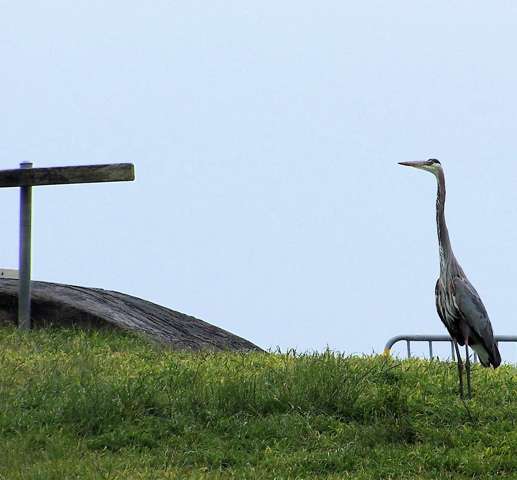
“Nature has wit humor, fantasy etc.,” wrote Novalis (1772-1801). “Among animals and plants, one finds natural caricatures.” His observation came to mind last week when I photographed this great blue heron standing watch over a World War II army bunker at the Muir Beach Overlook.

Novalis, by the way, was the nom de plume of Baron Frederich von Hardenberg, who was “one of the greatest early German romantic poets,” to quote The Encyclopedia Americana, and “exerted a strong influence on 19th century romanticism and the neo-romantics of the 20th century.”

In The Novices of Sais (a city in ancient Egypt), Novalis wrote (using the encyclopedia’s translation) that “the secret of nature is to be the fulfilled longing of a loving heart.”

I was reminded of Novalis’ second observation last weekend when I spotted a possum near one of my trees in broad daylight. Possums are mostly nocturnal, and I typically notice them around my cabin long after sunset.

100_4261_1.jpg
Peeking possum

This possum soon hid behind the tree and began peeking around the trunk at something under my deck. I was naturally curious what that was but didn’t want to disturb the scene.

So I stayed inside, and presently a small, female possum came waddling onto my deck. I immediately recognized her, for most nights she checks my deck for scraps and birdseed, often climbing a lattice in order to drink from a birdbath on my railing.

100_3289.jpg
Sorry, not interested!

The male hesitantly joined her on my deck, but there was nothing to eat and she showed little interest in him, so the timid male sadly waddled back into the grass. Courtship in nature — as among us humans — is seldom easy.

100_1384.jpgAlso like us humans, much of the animal world in West Marin was sweltering in this week’s “heat wave.”



Whenever the days get as hot as they did Monday and Tuesday, the horses in Toby Giacomini’s pasture next to mine go splashing in his stockpond.

But to repeat Novalis’ observation, “Among animals … one finds natural caricatures,” and I occasionally see a horse immerse itself in the stockpond as if for a baptism.

Nor is that comparison as far-fetched as it may sound.

100_1372_1.jpg

“If … horses … had hands or were able to draw with their feet and produce the works which men do,” wrote the Greek philosopher Xenophanes (570-475 BC), “horses would draw the forms of gods like horses.”

100_0142_1.jpg

Despite not holding the reins on his team, the ever-political Sheriff Bob Doyle takes part in the Western Weekend Parade.

.
As some of you no doubt read in The Marin Independent Journal, atty. Ladd Bedford on April 12 filed on my behalf a false-imprisonment lawsuit against the County of Marin and sheriff’s deputy Josh Todt.

The lawsuit also lists as defendants “DOEs One through Five” to be identified by “their true names [and] capacities when ascertained.”

In an incident which Sheriff Bob Doyle later blamed on my talking over the head of a “beat deputy,” I was chained and handcuffed on March 1 a year ago and taken to the psych ward at Marin General Hospital as supposedly being at risk of suicide.

Atty. Bedford in presenting a claim against county, which was routinely rejected, described what happened to me on that Wednesday morning while I was reading that day’s Chronicle and finishing breakfast:

“Without warning, a deputy from the Marin County Sheriff’s Department appeared at Mitchell’s home and asked to enter the residence. The deputy questioned him at length about his mental state and suicidal tendencies.

“Mitchell cooperated with the deputy and explained that he did not intend to commit suicide anytime in the near future and that he was not a danger to himself or anyone else.”

In fact, as atty. Bedford’s claim notes, I “was busy at home preparing for a court hearing scheduled for the following morning involving a civil matter and was preparing to receive two major achievement awards.”

dscn2326_1.jpg

The Society of Professional Journalists Northern California Chapter was about to present me with a “lifetime achievement” award during a ceremony in San Francisco, and I was in the midst of lining up rides for friends attending from West Marin. Presenting the award would be KQED radio host Michael Krasny (to my left above) and CBS-Channel 5 news anchor Ken Bastida (to my right).

.
The second award was a Resolution of Commendation from the Marin Board of Supervisors on the occasion of my retirement. During the presentation ceremony, I would also receive US House of Representatives honors thanks to Congresswoman Lynn Woolsey.

I was hosting a reception in a Civic Center garden following the ceremony, and that week, I was working out the details with a caterer. Ironically, among the guests I had invited was Sheriff Bob Doyle, but after I asked him how it happened that I was mistakenly taken into custody, Doyle chose not to attend.

“Furthermore,” atty. Bedford noted, a windstorm Sunday night-Monday morning had ripped shingles off my roof, and I “had scheduled roofers to come and fix [my] roof in two days.”

After receiving my awards, I planned to spend much of the rest of the year taking “victory lap” to see cousins elsewhere in the United States and in Canada, I told deputy Todt. And, in fact, I subsequently did.

Well, what about next year — after my “victory lap?” Todt asked. Would I commit suicide then? I laughed and told the deputy it was a ridiculous question, mentioning a character in French literature who was about to commit suicide, but the national elections were that day, and he wanted to know who would win. By the time the results were in, I told the deputy, the guy was no longer interested in suicide.

You can’t predict how anyone will feel about much of anything in a year, five years, or 20 years, I pointed out with good humor. And if I were to someday kill myself, I twice told deputy Todt, “it would almost certainly take the form of smoking myself to death.”

Deputy Todt, who presented himself as having developed expertise in dealing with people in crisis, asked me a few more questions about suicide in general. Because of the generality of the questions, I told him what some important thinkers had written about it. Having taught college World Literature, I was familiar with, for example, what Herman Hesse in Steppenwolf and Albert Camus in The Myth of Sisyphus had to say about suicide.

.
The opening sentence of Camus’ famous essay, I told Todt, is: “There is but one truly serious philosophical problem, and that is suicide.” However, I stressed that Camus also wrote that even if one decides life isn’t worth living, that doesn’t mean he will, or should, commit suicide. I quoted Camus as pointing out, “The body’s judgment is as good as the mind’s, and the body shrinks from annihilation.”

.
The fact that I was conversant on a topic Camus considered the “one truly serious philosophical problem” apparently caused deputy Todt to assume I must be ready to commit suicide. I was then handcuffed, chained, and hauled off in the cage of a patrolcar to the psych ward. I didn’t resist; there was no point; but I was mortified.

“Mitchell suffered much of the day in an austere sitting room with drunks and mentally disabled people,” atty. Bedford’s claim noted. “Later that day, Mitchell was eventually examined by personnel at the hospital. Those personnel determined that Mitchell was not suicidal, that he had no emergent psychiatric issues, and that he should be released to go home….

“The personnel at the hospital called a taxi for Mitchell and arranged for payment of the $70 cab fare from the hospital back to Mitchell’s residence in Point Reyes. Mitchell gave the cab driver a $10 tip.”

I later complained to Sheriff Doyle that I apparently was taken into custody for merely giving straightforward answers to an unsophisticated deputy who was posing as sophisticated in such matters. “What got you into trouble,” the sheriff responded, “was answering the door.”

Wow! I had always considered the sheriff’s deputies my friends, and now the sheriff himself was telling me I was putting myself at risk by answering their knock at the door. “Unless they have a warrant,” atty. Bedford has since added. Doyle’s response was as threatening as Todt’s had been humiliating.

Doyle bristled when I pointed out that the timing of the deputy’s arrival that Wednesday morning was suspicious and that perhaps his deputies had been deliberately misled.

As it happened, I had learned at midday Tuesday that I had a court hearing with the new owner of The Point Reyes Light, Robert Plotkin, Thursday morning. After talking with atty. Bedford, I discovered I had only a few hours to collect witnesses’ statements against Plotkin and had begun doing so. Todt’s action effectively sabotaged my ability to adequately present my side of the case.

100_0461.jpgSo why did deputy Todt come to the door that morning? Supervisor Steve Kinsey told me that, according to the Sheriff’s Office, Lt. Scott Anderson, commander of the West Marin substation, sent Todt to my home in response to statements from Plotkin and “others.” I wouldn’t be surprised if that turned out to be someone associated with him. We’ll just have to wait and see.

The new owner of The Light Robert Plotkin lives well but currently owes me and others thousands of dollars.

Before my lawsuit was filed, I told Supervisor Kinsey my main concern was to have government records cleared of my having been mistakenly taken into custody as supposedly on the verge of suicide.

In this age of Homeland Security checks and a few officers, such as Todt, who sometimes don’t exercise common sense, having a Sheriff’s Department blunder on my record could come back to haunt me.

Kinsey did his best to intercede on my behalf but got nowhere. Doyle and the County Counsel seemed to think I wouldn’t risk the embarrassment of publicly admitting what happened to me. That’s the way rape victims were intimidated from pressing charges until the courts stopped identifying them by name.

Because Sheriff Doyle refused to take an administrative action to clear my name, we now have a lawsuit that will set the record straight, inevitably cost county government thousands of dollars to defend — and quite possibly cost the county a substantial jury award.

And thanks to the sheriff’s Bush-like, “stay-the-course”-no-matter-how-misguided policy, five defendants still to be named also face legal liability.

« Previous PageNext Page »