General News


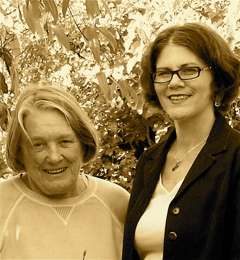
100_0267.jpgSparselySageAndTimely.com extends a warm “Happy Birthday!” to restaurateur Pat Healy of Point Reyes Station (left), who topped 80 on Wednesday.

Pat operated the Station House Café for 30 years, during which time she turned the former hamburger shop into a restaurant praised in Gourmet and other food-and-drink publications.

Pat in June 2005 sold the café to its manager Sheryl Cahill (right), and as of this writing, Sheryl was planning a party with no-host bar for Pat this Thursday (March 29) from 5 to 8 p.m. in the Station House.

100_0272.jpgAlso celebrating her 80th birthday is Missy Patterson of Point Reyes Station, who will turn 80 on Sunday. For 24 years, Missy has run the front office of The Point Reyes Light, where she is circulation manager.

While the job requires dealing with all manner of people, Missy is never overwhelmed, having raised 11 children of her own, the youngest of whom, Duncan, drowned in Papermill Creek while still in his teens.

More than once Missy regaled the old Light’s staff with an account of the time her former husband, Realtor Donald “Pat” Patterson, needed to stop by the Inverness home of Professor and Mrs. Seth Benson on business. The professor taught Zoology at UC Berkeley, and he and his wife (both now deceased) were part of the Zero Population Growth movement.

While the men discussed business, Mrs. Benson invited Missy to chat in the kitchen, quickly turning the conversation to ZPG. “And how many children do you have?” she asked Missy.

“Eleven,”Missy answered, and Mrs. Benson began shouting at her, “Out! Out of this house!” True to form, Missy left feeling amused rather than insulted.

She was my wonderful colleague for 21 years, and SparselySageAndTimely.com sends her a sincere Happy 80th Birthday wish too.

Missy’s real name, by the way, is Rosalie, but nobody around here calls here that. Which gets us to the nature of nicknames.

100_3262_1.jpg.

Not long ago I hired Nick Whitney of Inverness Park, one of the members of Pacific Slope tree trimming services, to cut down two Monterey pines that had died near my parking area.

If the trees had fallen in a windstorm, the worst damage would probably have been to neighbor Toby Giacomini’s barbed-wire fence, but that was enough for me to want them out.

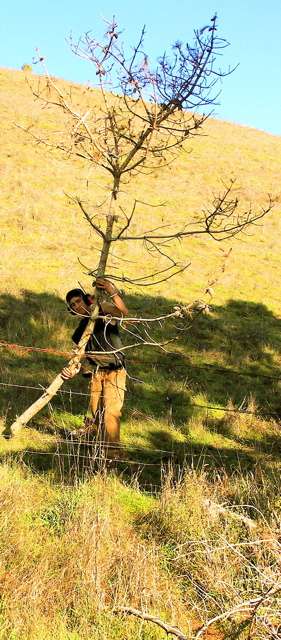
In addition, I wanted a large limb growing over my roof removed from another pine, so Nick sent over a crew consisting of Brian Arnold (seen above), Pepe Franco, and Nacho Franco.

100_3271.jpg.

Brian and Pepe (seen above) have trimmed trees at my cabin previously, so I expected — and got — a good job from the crew. Not having to worry about their work, I found myself instead wondering about their names.

I had to do a bit of research, but it turns out Brian is an Irish name meaning “high or “noble,” which should please him. After seeing Brian dangling from the top of a pine tree while avoiding large limbs falling from his chainsaw, both Gaelic meanings seemed appropriate.

100_3272_1.jpgThe common Spanish nickname “Nacho” (at right) was easy for me to check on. It’s merely a shortened form of “Ignacio,” sort of like “Robert” shortened to “Bob.”

In some recent years, the most common name of male babies born in the US was “José,” so it’s not surprising that many guys named José opt to use its nickname “Pepe.” Sort of like fellows named “John” using the nickname “Jack.”

But how in the world did “Pepe” become the nickname for “José?” When I finally found the answer, it surprised even my Spanish-speaking friends.

“José” is derived from the old Spanish equivalents to Joseph: “Josep” and “Josepe.” (In Italian, the name would be “Giuseppe.”) Because the final syllable of Josepe is stressed, it was a short step to “Pepe.” So, Joe, now we all know.

100_37421.jpg
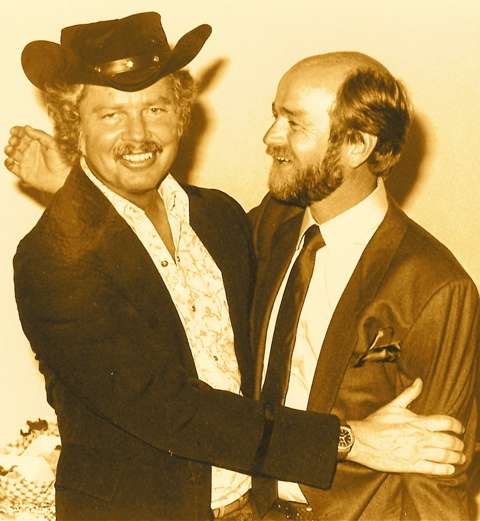
Writer John Grissim (left), formerly of West Marin, with the late pornographic filmmaker and theater owner Artie Mitchell (no relation) 22 years ago. The occasion was a gala party for the opening of The Grafenberg Spot. Grissim wrote the screenplay.

For eight years, The Point Reyes Light carried a column called West Marin Diary by John Grissim, who wrote from a wine-barrel studio above Stinson Beach, where he was a volunteer firefighter for 12 years, 2.5 years of that as head of the fire department’s ambulance corps. As a columnist, his topics ranged from running on the beach to watching Behind the Green Door star Marilyn Chambers use an Uzi to shred paper targets in Nevada.

John eventually married therapist Susan Robinson, and the couple lived in Point Reyes Station along the levee road in one of those houses where every time Papermill Creek flooded, they needed a rowboat to reach their front steps. Luckily, the main part of their house was on the second floor and didn’t get wet.

In 2000, John and Susan moved to Sequim near Port Angeles on Washington’s Olympic Peninsula. After much shopping, they bought a manufactured home, and John — as is his wont — turned the search into yet another book: The Complete Buyer’s Guide to Manufactured Homes and Land – How to Find a Reputable Dealer and Negotiate a Fair Price on the Best-kept Secret in American Housing. The book has turned out to be a best seller and John is in demand on the speakers’ circuit.

In previous incarnations, John wrote eight books on topics as varied as surfing and billiards, was an editor of Rolling Stone magazine, and wrote articles for publications as diverse as Playboy, Smithsonian, Sports Afield, Surfer, and National Fisherman. In his younger days, he was a communications officer on a Navy fleet oiler and later was on the dive team that discovered the $20 million Spanish treasure galleon Concepcion off of the Dominican Republic.

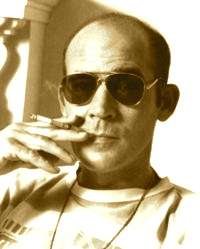
200px-10504755110907657454.jpgHe also snorted cocaine with gonzo journalist Hunter Thompson, the basis for the character Duke in Doonesbury. Seen here in a Wikipedia photo by Allen G. Arpadi, Thompson had gained widespread literary recognition in 1971 with his book Fear and Loathing in Las Vegas.

In a facetious column for the old San Francisco Examiner, Thompson in 1986 described a party in Burbank’s Sheraton-Premier Hotel where “a man named Grissim tried to jump off a fifth floor balcony with a bottle of gin, but he was restrained by police, then forced under a cold shower in the hospitality lounge. His friends and associates laughed as he was taken away in a neck hold.”

.
John answered in his own column that while he was complimented at rating a mention from (now deceased) Hunter Thompson, “I rarely drink gin, and there are no balconies at the Sheraton-Premier.” As for the neck hold, “that lithe arm around my neck belonged to my dear friend Seka, the ash-blonde superstar who at that moment was whispering to me some small confidence. All I remember is the heat of her breath in my ear as [the then-porno actress] confessed she too was into TM — tan maintenance.”

For seven years, John was executive director of the Environmental Action Committee of West Marin. For two more years, he published a lively quarterly titled Marine Watch. And in 1985, he wrote the screenplay for Jim and Artie Mitchells’ pornographic comedy The Grafenberg Spot.

100_3740.jpgIn March 1985, the film premiered at “a gala opening party,” in the words of the invitations we in the press received.

It was a media event I wouldn’t have missed.

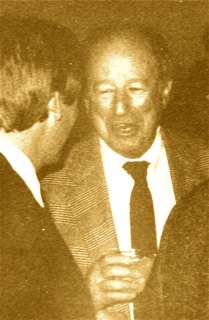
Searchlights lit the sky in front of the O’Farrell Theater while guests inside, such as the late Chronicle columnist Herb Caen (seen at right during the gala), the old San Francisco Examiner’s columnist Warren Hinkle, and writer Hunter Thompson mingled with porno stars Annette Haven and Juliet (Aunt Peg) Anderson, as well as the men and women of San Francisco’s liberal establishment.

This debut of Grissim’s film parodying the G-spot was meant to be the ultimate in porno chic. The Mitchell brothers served champagne, cracked crab, calamari cocktails, and endless mixed drinks.

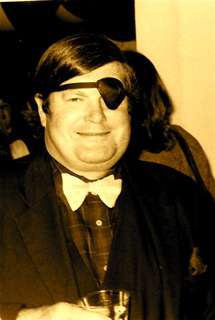
100_3748.jpg

Examiner columnist Warren Hinkle at the gala for The Grafenberg Spot. The G-spot is named after German gynaecologist Ernst Gräfenberg, who in 1950 claimed to have discovered it.

Of course, things went downhill from there. In a move to rein in his brother Artie, who had become addicted to cocaine and was drinking heavily, Jim in 1991 went to Artie’s house one night armed with a rifle (supposedly for his own protection) to have a talk. Instead he ended up shooting his brother. A jury convicted Jim of voluntary manslaughter, but he served only a three-year sentence in San Quentin after San Francisco’s Mayor Frank Jordan, Sheriff Michael Hennessey, and former Police Chief Richard Hongisto all urged leniency for the prominent pornographer.

Artie, sadly, is dead, but as John Grissim wrote me this week, “The G-spot lives.” His comment came in response to a March 17 Economist article on President Bush’s week-long tour of Latin America:

“Mr. Bush and Brazil’s president, Luiz Inácio Lula da Silva [seen below in a UN photo], agreed to promote ethanol production and use across the region, and to cooperate on research. By fixing purity standards, they hope to make ethanol a globally tradable commodity. But Mr. Bush refused to talk about the high tariff that protects American corn farmers, whose ethanol is more costly and carbon-emitting to produce than Brazil’s.

38602_3.jpg

“There was no visible progress on the Doha round of world trade talks [aimed at lowering trade barriers between countries of different wealth], though the American trade representative, Susan Schwab, spent an extra day in São Paulo to talk to Brazilian officials and industrialists. And Lula, somewhat mystifyingly, insisted that ‘we’re going firmly toward finding the so-called G-spot for making a deal.’”

The Brazilian president’s startling comment prompted Janine Warner, a former reporter at The Light, to write from Los Angeles, “To see the term G-spot used in the vernacular like that shows how far that concept has come.” To which she added, “No, I didn’t mean a pun there, really.”

100_3510_2.jpg

With my neighbor’s housecat keeping them company, eight blacktail deer spent Wednesday afternoon grazing and chewing their cud in the fields around my cabin.

Housecats don’t bother blacktails, unlike the coyote that crawled through my fence in January and caused the deer to immediately scatter.

100_1080_1.jpg

A blacktail doe watches a housecat on a woodpile washing itself.


Before we go any further with this, however, let’s get our terms straight, for the word “deer” is constantly evolving. Our word “deer” comes from the Old English word “deor,” which referred to animals in general, of course, including deer. In Middle English, the language of Chaucer (c.1343-1400), the word was spelled “der,” and The American Heritage Dictionary notes it could refer to all manner of creatures, including “a fish, an ant, or a fox.”

.100_2952.jpg

Even in the plays of Shakespeare (1564-1616), who wrote in Modern English (albeit of the Elizabethan variety), the meaning of the word remains uncertain. In King Lear, Act III, scene iv, the Earl of Gloucester’s much-abused son Tom ‘o Bedlam (disguised as Edgar) laments, “Mice and rats, and such small deer,/ Have been Tom’s food for seven long year.”

What does all this mean? “Deer is a commonly cited example of a semantic process called specialization, by which the range of meaning of a word is narrowed or restricted [over time],” the dictionary explains.

100_0620.jpg

Male North American blacktail, white tail, and mule deer are ‘bucks’ while male European red deer are ’stags.’

Had Shakespeare lived 10 million years earlier, however, Edgar’s lament might have made more sense. As Bruce Morris writes for Bay Nature, “All three major deer species native to North America (blacktail, whitetail, and mule) trace their ancestry back to a primordial, rabbit-size Odocoileus, which had fangs and no antlers and lived around the Arctic Circle some 10 million years ago.”

Based on DNA tests, Morris adds, “researchers theorized that whitetails (Odocoileus viginianus) emerged as a separate species on the East Coast about 3.5 million years ago.

100_2200_1.jpg

A blacktail buck, characteristically stretching his neck low to the ground, sniffs for a doe in estrus.

“They apparently expanded their range down the East Coast and then westward across the continent until reaching the Pacific Ocean in what is now California some 1.5 million years ago. Moving north up the coast, they evolved into blacktails….

“Columbian blacktail deer (Odocoileus hemionus columbianus) are the subspecies of blacktails native to the Bay Area…. According to the California Department of Fish and Game, there are now approximately 560,000 deer in all California, about 320,000 of which are Columbian blacktails….”

100_2203_1.jpg

A seemingly perplexed fawn watches as the doe runs away from the buck, who licks his nose in to help pick up her scent.

Morris reports that “blacktails have a typical lifespan in the wild of seven to 10 years, but they can survive in suburban habitat for as long as 17 to 20 years if unmolested….

100_1650.jpg

The breeding season is in November, notes Mary Ann Thomas writing about West Coast blacktails from Southern Arkansas University. Gestation lasts about 200 days with typically two fawns born. The fawns’ camouflage spots begin to fade after a month.

“Suburban deer have minuscule home ranges, measuring three or four blocks for females,” Morris notes in Bay Nature, “whereas wild deer inhabit territories that extend for several miles.”

While mountain lions, and occasionally bobcats and coyotes, prey on deer, the biggest threat to West Marin’s blacktails are motor vehicles. In fact, being struck by automobiles is the biggest killer of deer nationwide: more than one million a year.

Connecticut alone reported that between 1995 and 2000, the number of deer struck by cars in that state tripled while the number struck by airplanes nationwide has averaged almost one a week for the past 10 years. Or so says Benner’s Gardens, which makes deer-fencing systems.

.
100_3089_1.jpg

A young buck on his hind legs nibbles on my honeysuckle while his mother watches.


Here’s a final bit of deer nomenclature for those still puzzled by the Golden Hind. The Encyclopedia Americana notes, “The male deer is usually called buck, but the male red deer of Europe is a stag, or when mature a hart. The female is called a hind or doe.”

“Good evening Mr. and Mrs. America and all the ships at sea,” as Walter Winchell led off his World War II radio broadcasts. “Let’s go to press…”

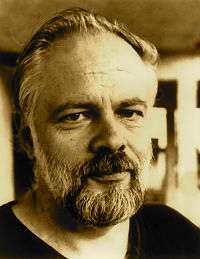
Topping the news… A film is due out shortly titled The Penultimate Truth about Philip K. Dick, the late science-fiction writer who once lived in Point Reyes Station. You can see a trailer for the film at http://www.youtube.com/watch?v=c_VgXuYvzfU.

philipdick.jpgThe stories of Philip K. Dick (1928-1982) inspired the movies Bladerunner, Total Recall, and Minority Report, among others. “Philip K. Dick was known as the most brilliant sci-fi writer on earth,” the trailer to Penultimate Truth proclaims. Although a drug addict, paranoid, and (as he sometimes thought) possibly schizophrenic, Dick wrote 50 books and many more short stories.

As for his paranoia, Dick suspected the KGB and or the FBI was out to get him. In the movie’s trailer he tells an interviewer, “Anyone who grew up within the Berkeley counterculture [as he partly did] became a marked man. My house was broken into. My files were blown open. My papers were stolen.” The author admits to not being certain the federal government was responsible but notes his lawyers believed that’s what happened. Dick, however, later wondered if he had done the deed himself and just forgotten about it.

As for his drug addiction (especially amphetamine use during all-night writing): Point Reyes Station innkeeper and jewelry maker Anne Dick, to whom he was married from 1959 to 1964, acknowledges in the movie’s trailer, “Towards the end of our marriage, he was taking tons of stuff.”

Ironically, as Wikipedia notes, during Philip K. Dick’s life, he was “highly regarded in France, [but he] received little public recognition in America until after his death.”

Walking onto the silver screen… The Los Angeles Times on Jan. 23 published a lengthy account of the life of Planetwalker John Francis, 60, of Point Reyes Station.

100_1151_1.jpgMost of us in West Marin know Dr. Francis’ story: how he stopped talking from 1973 to 1990 and refused to ride in motorized vehicles from 1972 to 1994. His self-published book Planetwalker: How to Change Your World One Step at a Time tells the story, and a feature-length film based on the book is now “in the works,” Times reporter John Glionna notes.

Overheard… An item by Point Reyes Light obituary writer Larken Bradley was picked up by San Francisco Chronicle columnist Leah Garchik for her Feb. 13 “Public Eavesdropping” list: “I’ve had enough hippie guys. I need more superficial, materialistic guys.” (Forty-ish woman to another, overheard at Tabla Café in Larkspur.)

I forget, therefore, I did… A writer friend in Los Angeles this week called me with an item of his own. Having overheard a passing guest at a party ask, “Did I finish that joint?” he quipped that merely asking the question provided the answer. Sort of like Decartes’ “Cognito ergo sum” taken to a higher level: “No memeni ergo feci.”

Rumblings south of the border…
Accompanying me on a weeklong trip to Mexico earlier this month was a retired Economics professor from the University of Hawaii, Mac Williams. Mac and I attended high school and Stanford University together, and in 1963, we spent two and a half months driving all over Europe in a VW bug I bought in Brussels.

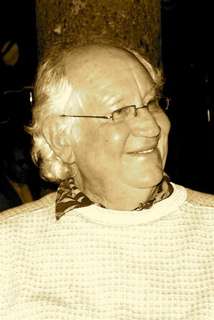
100_3378_1.jpgMac went on to get his doctorate from the University of Chicago where he studied under famed monetary theorist Milton Friedman.

On our trip to San Miguel de Allende, Mac as always was a great traveling companion — even though I’d never before heard anyone who could match the decibel level of his snoring.

He and I shared a second-floor hotel room hotel overlooking a narrow street in San Miguel’s historic downtown. After returning to the hotel following a night on the town, Mac would go to sleep with his iPod playing music in his ears as his snoring gradually built to the level of our old rooting section in Stanford stadium.

To my astonishment, it was virtually impossible to waken him once he had fallen asleep. Our hotel room shared a common wall with a bar, which had a live band that on weekends played till 4 a.m. The music was loud enough in our room to sometimes disrupt conversations, but once Mac was asleep, he didn’t hear it.

100_3357.jpg
As it happened, immediately across our narrow street was San Miguel’s main cathedral, and its bells chimed loudly and at length every 15 minutes day and night, but that didn’t wake him either.

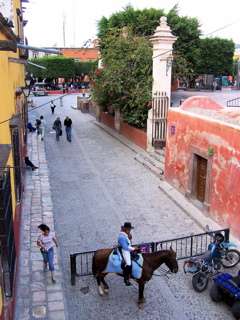
Only once did a disturbance break his slumbers — although it was subsequently repeated almost every night. The Jardin, San Miguel’s central square, was less than a block from our hotel, and the roads around the square were closed to traffic during the day. However, a second-story roof of the towering cathedral was under repair, and workers were allowed to drive into the square at night to haul away debris.

100_3346_1.jpgDuring the day, workers (such as those seen here at right) would pile broken bricks and cement blocks at the edge of one nearby roof of the cathedral. At 3:30 a.m., other workers would show up and from the second floor start dropping the discarded masonry into a steel dumptruck parked below our hotel window. The impact of each chunk sounded like an explosion and actually awakened Mac the night it all began. He rushed to the window to see if our hotel were under attack. When he saw it wasn’t, Mac went back to sleep, and the clamor never bothered him again.

The cacophony reached its peak the night we had a lightning storm. The band was rocking, the cathedral bells were chiming, workers were hurling cement blocks from the church roof into their dumptruck outside our window, thunder claps rattled windows, but at least in our room, Mac’s snoring was loudest of all.

I couldn’t shout at Mac to awaken him because others in the hotel would probably think there was a fight going on, so I tried barking and growling in his ear, hoping that anyone who heard me would think there was a street dog outside; however, that didn’t work either.

But, as I said, Mac and I are good friends, so I was able to laugh as the pandemonium built to a roar each night — although I did tend to sleep late each morning.

100_33293.jpg

Former West Marin resident Dee Goodman now lives in San Miguel de Allende, Mexico, which was founded by the Spanish in 1542.

This past week, an old friend, Mac Williams, and I traveled to San Miguel de Allende, Mexico, and ended up spending several days with a former West Marin resident now living there, Dolores (Dee) Goodman. Dee lives in one of the many colonias (small, semi-rural communities) that surround downtown and are part of the Allende municipality of 139,000 people.

For years, Dee lived in Nicasio and later operated Casa Mexicana bed-and-breakfast inn in Point Reyes Station. Her late husband John spent most of his career working for Marin County Mental Health but after his retirement was in continual demand as a stand-up bass player in San Francisco jazz bands. He was also one of the musicians to regularly play with guitarist Bart Hopkin at the Station House Café. If you ever saw him perform there, you’ll remember him even if you didn’t know his name; for when he was paired with Bart in the Station House, John, a tall black man, played the not-so-common pizzicato (plucked) cello, which was strung like a bass.

Dee, his widow, is now living with a working-class family in a colonia that at first glance might strike West Marin residents as a rural slum. The streets are unpaved and littered with trash. Despite high walls, which hide the residents’ small homes and gardens, families keep dogs on the roof to ward off burglars.

But outward appearances can be deceiving, and Dee has managed to find a bit of paradise where I never would have expected it. Here is her story:

By Dolores Lara Goodman

My husband John died of lung cancer in December 2000, and my loss was enormous. He was the love of my life. We had been together only 10 years, but those were worth a lifetime. He felt the same way about us.

I hadn’t readjusted well to the change and drifted emotionally, feeling lonely among my friends and family. After a year or so, I moved from Point Reyes Station to Petaluma to help my stepfather care for my mother during her terminal illness. My brother Dan lived with me in a manufactured home I had purchased in the same park as Mom and Bill.

With no children of my own, I had given some thought to long-term planning. Assisted-living residences were popping up all over, and they seemed a likely option for me. I calculated what assets I would have and what my fixed income would be and what type of place I would be able to afford so that I wouldn’t become a burden to my family. I was still relatively young, 60, so I wasn’t making any firm plans.

In December 2004, my friend Lana and I took what was supposed to be a two-week vacation to Puerto Vallarta; however, I had a feeling that I would not be returning to the US with Lana. I had, for some time, wanted to stay in Mexico for an extended time. (Two of my grandparents were born in Mexico but were forced to flee to Texas during the 1910 revolution, and I was brought up in Daly City.)

As it happened, I ended up in San Miguel de Allende, which is roughly in the geographical center of Mexico, about 200 miles northwest of Mexico City. San Miguel is a destination for many US and Canadian retirees; our dollars go twice as far here, and we can live more comfortably on our retirement income.

100_33512.jpg
Imaginative, 60-year-old mural in one of San Miguel de Allende’s art schools.

Gringos have been coming to San Miguel for about 50 years. It started with a group who formed an art colony, and San Miguel now has numerous art schools, galleries etc. The gringo community does a lot for the locals: establishing libraries, scholarships and other helpful projects. And because they help with public matters, along with providing jobs and advancement opportunities, the expatriates are well received by the locals.

100_33672.jpgThe Spanish-colonial downtown — with its park-like square, majestic cathedral, and narrow, cobbled streets — bustles with good restaurants, theatre, music festivals, and barely marked hotel entrances that open into courtyard gardens.

At an elevation of 6,000 feet, San Miguel de Allende has a desert landscape. During winter, middays are warm, and nights are cold. I like the climate.

When I first moved to San Miguel de Allende, I rented in the Los Frailes community at the edge of town. A woman in her 30s named Alicia Gonzalez was the housekeeper at the apartment, and a couple of times I drove her to her home in the Colonia Palmita de Landeta.

The first few times, I met her children in front of their house where they huddled shyly, laughing. They were very curious about me, this Señora Dolores from California. Around the third time I took Alicia to her house, her husband Antonio had just arrived home from work and told Alicia to invite me in. I was led to a front bedroom of their very modest house and was invited to sit on one of the beds.

The visit is still clear in my memory. I remember thinking, “What a beautiful family!” At the time, all five of the family’s children were living at home. (The oldest, Valentina, now 19, has since gone to live nearby with her husband Manuel and his family.)

100_34001.jpg

Dining outdoors under a tarpaulin (from left): Ernesto, Claudia, Marco, Manuel, and Valentina. She and Manuel, who assembles furniture for a living, are expecting their first child in June.

I subsequently moved from Los Frailes to Calle Recreo in the central part of the San Miguel near Parque Juarez. Alicia and Valentina helped me pack and move. Valentina would spend some nights with me at Recreo, especially when I was sick with a cold or something. And they would all worry about my wellbeing, comfort, and safety.

Unfortunately, the Recreo apartment was intolerably hot, so I moved to a two-bedroom apartment on Calle Agua in the Colonia Atascadero closer to their house. The whole family helped me pack, move, and unpack, the five kids and Mom trekking up and down the path to move my stuff.

If they had their way, I would have just sat back and watched the move go on. After all, I am grande now — that’s when you’re older — like into your sixties (I’m now 66).

100_3371_11.jpgI did a bit of packing but not much moving. Picture the little one, Rosario, five years old, (seen here a year later with her mother Alicia) insisting she be allowed to help carry stuff to the car. Ernesto was eight; Marco, 10; Claudia, 12; and Valentina, 18.

Even before that move, Valentina began to tell her mother and me that I should move in with them, that they could make me a room. The seed was planted, and I didn’t even consider saying no when the Gonzalezes in 2005 invited me to live with them.

In October 2005, I bought a terreno (lot) next to the family for $10,000. In February 2006, I moved into my almost-completed casita, which was built by Antonio, an accomplished maestro albanil (construction worker), and a crew of four. Antonio is incredibly creative and meticulous, and I enjoyed seeing the building materials used here: basically brick, stone, rebar, and concrete. I was able to suggest what I would like to have done and then see it accomplished.

I had initially planned to have a large living area, one bedroom, and bathroom in my casita, but I convinced Alicia and Antonio to accept half the living-room space to make a bedroom for themselves. They had always had their bed in a common part of their house — in the kitchen or living area. We put up a wall to split my living room into their bedroom and a sitting room for me.

100_34012.jpg

Surrounded by building materials for the completion of their dwellings, Dee dines on the Gonzalezes’ patio with Rosario, Antonio, and Alicia.

Antonio opened up a door in the wall of their house to my casita at their kitchen. I don’t have a kitchen – it’s our kitchen. Alicia is a marvelous cook and for me, eating with the family is better than going to my favorite Mexican restaurant every day.

I participate in the preparation of meals as much as I can and as much as they’ll let me. I’m learning more as time goes by. I also help with the marketing. We go to the plazita market every Saturday, and while Alicia shops for veggies, I shop for fruit: mangos, guayavas, dried Jamaica blossoms etc. I love it! It’s our tradition on shopping days to buy fresh carnitas, bolillos, tortillas, and salsa to eat when we get home.

The daily giving is as important as the receiving. I think the key is being able to share and actually being a member of the family unit — watching the kids get off to school and waiting for them to come home. It’s something I missed out on, not having had children, and it’s a blessing to have been given the opportunity now that I’m grande.

I’m referred to by the family as Tia (Aunt) Lolita and am usually addressed as “Tia.” The parents have given me a grandmother’s authority over the children and have instilled in them a kind respect for me. I love feeling a grandmotherly cariño (affection) for the kids.

Rosario and Ernesto, the youngest two, and I are particularly attached. Mi sombra (shadow), Ernesto, doesn’t let me leave the house alone. When I leave the house to walk Omar, my dog, Ernesto always accompanies me.

100_3377_11.jpgI think the kids were initially told by Mom and Dad to accompany me whenever I went out, and Ernesto (at right with his brother Marco) has taken charge. He says he’ll protect me from aggressive dogs and picks up rocks to throw in the event we run into any, which does happen. He’s my little angel.

I’m glad I said “yes” when the Gonzalez family invited me to live them. We’re a great match. All of us can’t believe our good fortune. I was able to make the move and provide my own space, but had I not been able to do that, had I been totally without financial means, they would have gladly made room for me in their home, and we would all be just as happy, I’m sure.

That’s the way it’s done in the Mexican culture and many other cultures of the world. Older folks don’t have to move someplace with strangers their own age and be cared for by other strangers. There is always room for them in a family member’s home and daily life… until their dying day. I’m still young enough to foresee more changes in my life, and this may not be my “journey’s end.” But it just may be, and that’s great.

After three decades of generally good relations between West Marin residents and the Point Reyes National Seashore, how did we end up with a park administration better suited to an autocracy than a democracy? Why does the general public now have only a perfunctory say when major park policies are set?

Frankly, the answer is politics, both Republican and Democratic.

Back in the 1970s, when the former program for managing the exotic-deer herds through culling was established, the public debated the alternatives, experts of various points of view spoke, and a consensus was reached to maintain the herds at 350 each. And where did all this happen? In public sessions of the Citizens Advisory Commission to the Golden Gate National Recreation Area and Point Reyes National Seashore.

Recognizing that the National Seashore and GGNRA were established to serve an urban population, Congress provided for local governments around the Bay Area to nominate most members of the commission, who then were appointed by the US Secretary of the Interior.

The commission required Congressional reauthorization every few years, and for almost three decades, Congress approved it. However, in 2002, its term expired, and with Republicans in charge of Congress and the White House, the commission was allowed to die.

160px-gale_norton.jpg“This time [then-Interior Secretary] Gale Norton (at right) and the Park Service said, ‘It’s been a very good commission for 29 years, but we don’t need it anymore,’” noted former Commissioner Amy Meyer in an interview I conducted for Marinwatch.

Meyer of San Francisco and Ed Wayburn spearheaded creation of the GGNRA during the Nixon Administration and served throughout the commission’s existence, along with Richard Bartke of El Cerrito, representative of the Association of Bay Area Governments.

“We had moved toward the sunset clause several times before,” Meyer noted. Each time the commission was about to expire, Congressman Phil Burton or his widow Sala, who replaced him in the House, would extend it for three to five years, she said. They “wanted to have an advisory commission.”

National Seashore Supt. Don Neubacher, however, did not want one. As park spokesman John Dell’Osso acknowledged to me in 2004, the park administration had found the commission sometimes interfering with what park staff felt should be done. The Neubacher administration has further argued that local residents don’t speak for all Americans. It’s a specious argument since most park visitors are from the nine-county Bay Area and because people here are far more familiar with the park than people in other parts of the country, who typically know little or nothing about it.

lynnpic.jpgCongresswoman Lynn Woolsey (at right), who represents West Marin, did introduce legislation to resurrect the commission, and it was attached to a House bill being pushed by now-Speaker Nancy Pelosi and others to acquire land in San Mateo County for the GGNRA.

The bill passed in 2005, but when it did, the rider resurrecting the commission was gone. What happened?

mlkwilliams.jpgMeyer said she and other people went to Congresswomen Pelosi (at left) and Woolsey and asked that they drop the advisory-commission legislation.

They feared, Meyer explained, that the Bush Administration would pack the advisory commission with people who share his ideology.

“Having no advisory commission is better than having a bad one,” Meyer added. “Gale Norton [who resigned last March] was a terrible Secretary of the Interior. No one wants to bring the commission back until ‘W’ is out of office.

Throughout its existence, Meyer said, the advisory commission was seldom politicized. When it comes to advising the Park Service, she said, “there is nothing worse than a politicized commission in being able to [fairly sort through] public desires.”

Former Commissioner Meyer isn’t necessarily against Neubacher’s plan to eliminate non-indigenous deer, but she said that in deciding what to do about the deer, or a ranger’s 2004 pepper-spraying scandal, or other matters, the commissioners could have been — as they once were — a crucial interface between the public and the Park Service.

While the commission was only “advisory,” commissioners’ decisions carried weight. “The advice they could give the Park Service,” Meyer noted, “could modify a policy.”

The local citizens advisory commission to the national parks was not the only one that has not been reauthorized despite the fact that “to make a park responsible to the people is very important,” she added. “It’s happening all over…. We have an administration that doesn’t believe in participatory democracy.

“We’re all sitting here waiting for 2008 [to see] if we have the right president who is going to appoint the right Interior Secretary. The president could be a Republican,” Meyer stressed. “Even Nixon had two of the best in history.”

In short, thanks to the power struggle in Washington, residents of West Marin and the rest of the Bay Area must remain frustrated for two more years.

For now, there is no effective forum for influencing National Seashore policy:

• When rangers run amok (e.g. extensively pepper-spraying innocent people who not surprisingly sue the Park Service and collect $50,000).

• When the National Seashore decides there’s money to be saved by slaughtering majestic deer that have long been a part of Point Reyes and are beloved by much of the public. Ironically, settling with the pepper-spray victims cost the Park Service far more than a year’s culling once did.

• When environmentally responsible mariculture is treated like a pariah.

100_2346_1_1.jpg

Better days no doubt are coming to Point Reyes. In the meantime, here’s a Valentine’s Day heart from SparselySageAndTimely.com and a flock of Canada geese between my cabin and Inverness Ridge.

peak-a-boo.jpg

Fallow deer in the Point Reyes National Seashore range from white to spotted to black. Naturally gentle, they are among the few deer that can be easily domesticated, and they are widely raised for meat. The fallow herd was periodically culled by the park until Don Neubacher became superintendent in 1994. He stopped the culling and now claims the herd is becoming too large and must be totally eliminated. (Photo by Janine Warner)

West Marin residents need to start paying attention to how much the administration of the Point Reyes National Seashore has come to reflect ideologically rigid policies of the Bush Administration Park Service
, not to mention the Bush Administration’s belligerent approach to Homeland Security.

Combativeness, ideological zeal, and indifference to public opinion are the hallmarks of this approach. At the National Seashore, it is taking the form of:

• A widely criticized program to slaughter the long-resident white and spotted deer from Asia, which much of the public finds enchanting, on grounds it would be cheaper to eliminate them than to control herd sizes with culling or contraception.

The only public hearing on the pogrom before the National Seashore administration last year approved it was so tightly controlled as to be meaningless. No general discussion, with public debate, was allowed. Supt. Don Neubacher assembled a panel of like-minded folks to present the administration’s point of view. Respected organizations that oppose slaughtering the deer, such as the Humane Society, were noticeably left off his panel.

fawn-follows2.jpg
These fallow deer (originally from the Near East) and axis deer (originally from India and Sri Lanka) have been a part of the Point Reyes ecosystem for 60 years, far longer than the Park Service. (Photo by Janine Warner)

Yet the Neubacher administration talks about the fallow deer as if the growth of its herd is out of control. No it isn’t. The Neubacher administration in 1994 merely stopped the park’s periodic culling.

The park administration in trying to rationalize the pogrom claims that because non-indigenous deer eat acorns and so do indigenous blacktail deer, the wellbeing of the blacktail is being threatened. The claim is typical of the pseudo-environmental malarkey we’ve come to expect from the Bush Interior Department that also claims opening up the Artic National Wildlife Refuge to oil drilling is environmentally necessary.

100_3096.jpg
Blacktail deer are abundant throughout West Marin as this herd, including a doe who’s found one of my persimmons, bears witness.

There’s no shortage of blacktail deer in and around the park. Yes, a lot of them are dying on and off parkland here. And whose fault is that? Almost entirely motorists, many of whom are among two million visitors a year drawn to West Marin by the Point Reyes National Seashore.

• National Seashore Supt. Don Neubacher’s announced intention to close down the venerable Drake’s Bay Oyster Company when its lease expires in five years.

There may be ranches, not to mention a Coast Guard station, next door, but Neubacher claims the land around the oyster company’s waters is “potential” wilderness and that it would take an act of Congress to keep the oyster company open. If that’s true — and county officials are skeptical — then it’s Congresswoman Lynn Woolsey’s responsibility to take action in Congress.

Like the exotic deer, the oyster company has been on Point Reyes far longer than the park, which opened in 1965. Oyster growing has become part of the Drakes Estero ecoystem, and oysterman Kevin Lunny notes that because oysters filter water, the water is cleaner in his part of the estuary than where oyster growing has ended.

For many visitors to the National Seashore, buying oysters at the oyster company brings them far more pleasure than visitor centers, sandcastle contests, boarded-up ranch buildings, and the Morgan horse stable — not to denigrate any of them but merely to take note of the obvious.

100_944.jpgI’ve never heard Lunny himself say this, but some ranchers on Point Reyes see Supt. Neubacher’s plans to close the oyster company as “payback time.”

They believe that Lunny, who is also a beef rancher, roused the superintendent’s ire two years ago when he helped organize the Point Reyes Seashore Ranchers Association so that ranchers in the park can collectively negotiate their leases with the National Seashore administration. Ranchers I’ve talked with say Neubacher (pictured) reacted bitterly to formation of their association.

One indication of the park administration’s attitude toward the association occurred a year ago when the National Seashore hired a “range ecologist.” No sooner had he arrived than he showed up at an association meeting to introduce himself, say he’d noticed some ranches had fences in need of repair, warned that he would give ranchers one notice to make repairs, and said if they didn’t then hop to it, he would seek to have their leases revoked. Dick Cheney couldn’t have said it better.

(Ironically the Jan. 30 San Francisco Chronicle described in detail the sorry state of Golden Gate National Recreation Area fencing at Crissy Beach. Neubacher administers, along with the National Seashore, part of the GGNRA but not the beach in San Francisco.)

One rancher, who doesn’t agree with the “payback” theory, instead believes the oyster grower’s problems began when Gordon Bennett, chairman of the Marin Unit of the San Francisco Bay Chapter of the national Sierra Club, got Neubacher’s ear by becoming part of the park superintendent’s kitchen cabinet. *

With Congress stalling on reviving the Citizens Advisory Commission to the Golden Gate National Recreation Area and Point Reyes National Seashore, the park superintendent has been able to cherry pick whom he listens to. Sometimes the arrangement reminds me of our government’s unstated alliance with the Taliban during the Soviet occupation of Afghanistan.
An environmental fundamentalist, Bennett is the loudest critic of Drakes Bay Oyster Company, which he considers equivalent to a 165-foot-high old Buddha in potentially Taliban-pure wilderness. The opposition of Bennett, who lives in Paradise Ranch Estates, to a popular oyster farm founded more than a century ago is perfectly in character.

100_2010.jpg

A major stopover for birds migrating on the Pacific Flyway and a haven for harbor seals, seabirds, and long-legged wading birds, Bolinas Lagoon may completely fill with silt if its channel isn’t dredged and tidal circulation restored. The chairman of the Marin Unit of the San Francisco Bay Chapter of the Sierra Club opposes the necessary dredging.

When the nonprofit Marine Mammal Center needed to upgrade its treatment facilities on the Marin Headlands or when people around Bolinas Lagoon hoped to dredge silt from its channel before the lagoon becomes a meadow, Bennett was always there to lend a criticism.

* The term “kitchen cabinet” in its political sense originated in the 1820s during the presidency of Andrew Jackson. Jackson abandoned official cabinet meetings and instead took his advice from an informal, kitchen-table cabinet more to his liking. A number of these advisors, such as influential newspaper editors, were chosen because they had a pulpit for defending his policies.

Next week: Bringing the voice of democracy back to the Point Reyes National Seashore delayed by congressional Democrats’ distrust of Bush Administration.

100_2915_12.jpg

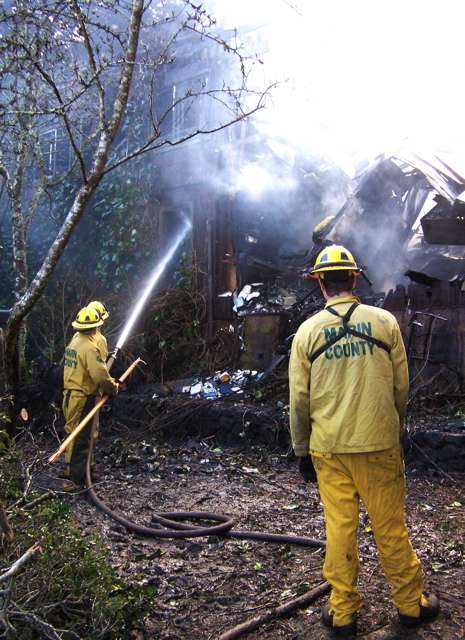
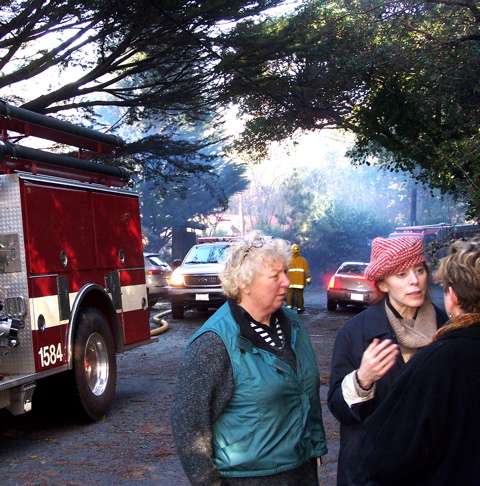
Hot spots at the rear of Manka’s restaurant continued to flare up for hours after the fire had been contained.

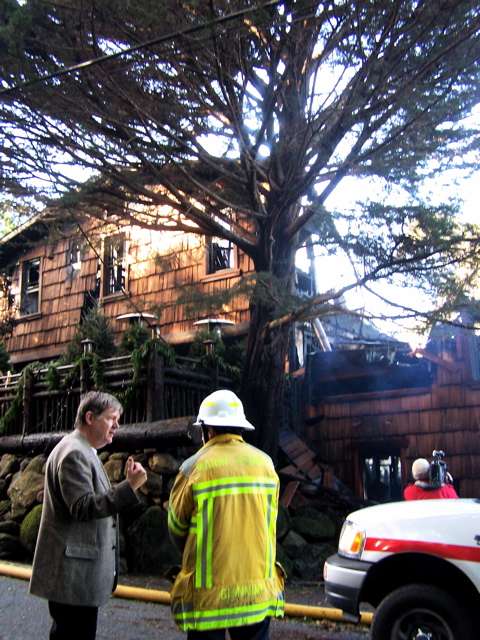
Winds that gusted to hurricane force toppled a tree onto Manka’s Inverness Lodge and Restaurant early Wednesday, breaking a gas line and starting a fire that gutted the 81-year-old wooden building.

100_2906_2.jpgTrapped. A guest who escaped unharmed with his possessions nonetheless found his car stuck for hours in Manka’s parking lot, hemmed in by Inverness and Marin County firetrucks.

The tree fell onto Guest Room 7 and went through it into Room 4 where it hit a hotwater heater and broke the gas line. All of those in the building escaped unharmed, including overnight guest Jake Gyllenhaal, who starred in the movie Brokeback Mountain, and his actress sister Maggie.

Daniel DeLong, chef and co-owner with his partner, Margaret Grade, later told The Independent Journal, “Jake was helping me pull things out of the fire.”

Inverness and county firefighters were called out at 2:43 a.m., and by the time the first firetrucks arrived, “it was going pretty good,” one Inverness fireman told me, so there was little that could be done except keep the fire from spreading. Firefighters did manage to save the original building on the property, a 106-year-old cottage.

Referring to the inn itself, the fireman remarked, “When it’s all wood, it isn’t easy to get inside and get [the fire] out.” This is a particular problem with historic buildings, he said, adding with a grimace, “It sucks.”

Heavy rain and Arctic wind (which gusted to 100 mph atop Mount Tamalpais, county firefighters were told) not only sent the tree crashing onto Manka’s, it did less-severe damage throughout West Marin. Falling trees blacked out much of West Marin most of the night.

100_29411.jpgA tree that fell on a utility pole along the levee road in Point Reyes Station forced closure of the road for much of Wednesday.

Sections of Highway 1 between Point Reyes Station and Olema were flooded during the night.

Manka’s under its former owners, the Prokupeks, was known for decades as a Czech restaurant. Current owner Margaret Grade bought Manka’s in 1992, refurbished the building, and developed a cuisine around wild game, locally grown organic meat and produce, seafood and elegant desserts.

In recent years, Food and Wine magazine repeatedly rated Manka’s as among the top 50 hotel restaurants in America while The San Francisco Chronicle called it one of the top 100 restaurants in the nine-county Bay Area.

When Prince Charles and Camilla, the duchess of Cornwall, visited West Marin a year ago, they stayed in Manka’s. Marin County Supervisor Steve Kinsey later told The Independent Journal the prince told him they “had a good night’s sleep” and found Manka’s fare “really outstanding.”

100_2928.jpgManka’s owner Margaret Grade (center) herself was one of the chefs, and several of those who worked with her were in tears Wednesday morning. However, when Margaret spotted me taking photos, she might just as easily have been the congenial hostess welcoming guests at the door.

“Good to see you, Dave,” she called to me. “I haven’t seen you in a while.”

“It’s good to see you too,” I responded, “but not under these circumstances.”

100_2908_3.jpgOnly the front wall of Manka’s restaurant remained mostly standing. Sky can be seen through the windows of a guest room whose roof was consumed.

Despite the circumstances, however, Margaret remained the upbeat person I’d always known her to be, and before the fire was out, she had begun talking about rebuilding. Responding in kind, I asked her if she already had a contractor in mind.

Alluding to restaurant designer Pat Kuletto, who is restoring Nick’s Cove restaurant in Marshall after numerous permit hassles, Margaret joked, “I hope Kuletto has paved the way for us at the county.”

Then recalling how much work Manka’s needed when she bought the restaurant and inn in 1992, Margaret said to me with a laugh, “Look at what a disaster the place was. This takes us to a different level.”

The new owner of The Point Reyes Light has fabricated so much in court papers and public statements that I feel compelled to respond. Related topics included here: Robert Israel Plotkin and Lys Plotkin found to be frequently filing lawsuits. Robert Plotkin and mother defendants in US bankruptcy court in connection with a $77 million Ponzi scheme. Plotkin’s attorney Robert H. Powsner, 77, blames his own “forgetfulness” as he attempts to explain away a “web of lies” in his court filings.

Here are the facts regarding the litigation filed by The Point Reyes Light’s new owner Robert Israel Plotkin and his wife Lys against me, the former owner, against Joel Hack, owner of The Bodega Bay Navigator website, and against other people. Some of what is here was discovered by people not connected to the case. With a variety of people using the web to follow developments, government records containing surprising revelations of “mopery with intent to creep” * have come to light.

.
1. The most-significant misconception about problems at The Point Reyes Light is that they center on disputes between new publisher Robert Plotkin and me. They don’t. In the first 12 months after he became publisher, 13 staff and contributors were fired, quit, or in various ways shown the door.

Some staff such as Gayanne Enquist of Inverness, Sandy Duveen of Woodacre, Jim Kravets of Fairfax, and Peter Jamison, formerly of Woodacre, did not have jobs lined up when they left. I, at least, am retired.

2. Prior to Robert Plotkin’s and my falling out last February, I had been working diligently to help the paper during its transition to new ownership — as a consultant to the newsroom, a columnist, and a photographer. I have a five-year employment contact with The Light, which cannot be unilaterally terminated, but it pays only $175 per week to be available as a consultant. Nonetheless, I volunteered additional help as needed. Following the New Year’s Eve storm, I spent three days slogging through mud and wading through water to photograph the damage. However, as numerous people who have dealt with the new owner have discovered, he is frequently insulting and abrasive, and when he insulted me, we got into a shouting match in front of The Light.

Plotkin initially told bystanders and a sheriff’s deputy he was a victim of “attempted murder” — that I had tried to strangle him. However, hairdresser Barbara Keady, a witness who spoke with him immediately afterward, and sheriff’s deputy Ted Keehn noted there were no marks on him. “Plotkin had no visible injuries,” deputy Keehn wrote in his incident report. Plotkin then added to his story that I had tried to run him down with my car after he and I started yelling at each other.

But when deputy Keehn interviewed witnesses, that story didn’t hold up either. Realtor Robert Cardwell told the sheriff’s deputy that he saw Plotkin and me arguing in front of Greenbridge Gas & Auto. When Plotkin got out of my car, I made an abrupt U-turn on Mesa Road and stopped in front of The Light with a wheel on the sidewalk, which is flush with the pavement (i.e. there is no curb). “Mitchell got out of the red Acura and ran toward Plotkin,” deputy Keehn quotes the Realtor as saying. The deputy quoted hairdresser Barbara Keady as saying “she saw Mitchell park his vehicle in front of The Point Reyes Light on the sidewalk. Mitchell got out of his vehicle and had a heated verbal argument with Plotkin.” Sandy Duveen, who then sold advertising for The Light, told the deputy that after the Acura stopped abruptly in front of The Light, “she saw Mitchell walk towards Plotkin,” the officer reported.

So there was no attempt to strangle Plotkin or hit him with my car. As for my parking with one wheel on the sidewalk, anyone familiar Point Reyes Station’s old Creamery Building, where The Light is located, has often seen cars with at least one wheel on the sidewalk. Indeed, because there is no curb, vehicles parked halfway on the sidewalk are not uncommon.

3. Represented by Point Reyes Station attorney Robert Powsner, Plotkin then asked for a restraining order and later an injunction that prohibits me from being around him, his family, and his newspaper. Like other staff and contributors who have left, I had by then concluded Plotkin was immature and abrasive, as well as sometimes dishonest, so I had no problem agreeing to stay away from him.
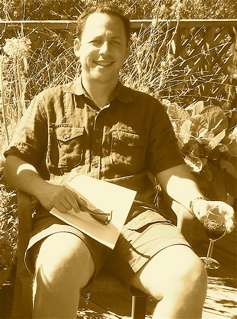
100_0468_2.jpgWhen asking Marin Superior Court to issue a retraining order against me (because we had shouted at each other), Plotkin claimed he needed special protection because of my supposedly immense size. With his irrepressible flair for the dramatic, Plotkin told the court I am 6-foot, 6-inches tall and weigh 225 pounds. Now Plotkin, of course, was writing from the perspective of a short and pudgy (The Marin Independent Journal called him “pear-shaped”) 36 year old. Nonetheless, this 63-year-old retired editor is definitely not larger than pro football’s Terrell Owens, the big wide receiver. In reality, I am 45 pounds lighter and three inches shorter than what Plotlin cavalierly wrote in his sworn statement.

In the last five years, the former lawyer has filed lawsuits against six tenants, one against The Bodega Bay Navigator website and its owner Joel Hack, and two against me. He is also a defendant in US bankruptcy court. Although for a while he was a deputy district attorney in Monterey County, Plotkin is no longer licensed to practice law in California.

100_0468_1_1.jpgJoining her husband Robert, Lys Plotkin in August filed her own litigation against me, accusing yours truly of causing her “reckless and intentional infliction of fear and anguish and emotional distress.” What was the basis for this bizarre accusation? I’d had that shouting match with her husband six months earlier. Although she was not present for the squabble, Lys Plotkin in her court filing alleges that by shouting back and forth with her husband, I “realized” I would “cause [her] to suffer extreme mental and emotional fear, apprehension, anguish, and distress for the safety of her husband, of herself, of her unborn child, and of her son.” Wow! And despite Ms. Plotkin’s not being around at the time, she alleges I was “certain” I was doing this to her when her husband and I started yelling at each other. Like her husband, it would seem, Ms. Plotkin is willing to offer up absurd fabrications when it suits her purpose. Nor is she any stranger to litigation. Besides signing on as a second plaintiff in her husband’s lawsuit against me, Lys Plotkin has been a second plaintiff in three unlawful detainer lawsuits filed in San Diego County during the past five years to evict tenants.

4. Long before Plotkin and I had our squabble, he had a falling out with The Light’s long-time cartoonist, Kathryn LeMieux of Tomales, who quit contributing. The Bodega Bay Navigator in Sonoma County had just converted from a weekly newspaper to a website, and owner Joel Hack invited LeMieux to post her cartoons on The Navigator site. After I agreed to Plotkin’s injunction, which forbids my even sending him email, Hack invited me to also start posting on his website, which I did. In an Aug. 14 lawsuit filed by Plotkin against Hack and me, he claims I “induced” LeMieux “to become the cartoonist for The Navigator.” (My supposedly recruiting LeMieux, Plotkin suggested, amounted to my unfairly helping a competitor.) But like other things Plotkin has said in his lawsuits, in The Light and to other reporters, this was a total fabrication. LeMieux had agreed to draw for the website before I was involved with it.

5. Attorney Robert Powsner on Plotkin’s behalf then got Judge Jack Sutro to issue a bizarre injunction against my posting on the Bodega Bay website. Plotkin and Powsner had told Judge Sutro that by letting me post writing and photos on The Navigator’s site, Hack was “damaging or destroying” The Light. The judge agreed, and in chambers he told lawyers for both sides that protecting Plotkin’s $500,000 investment in The Light outweighed constitutional prohibitions against censoring free expression.

In making his ruling, Judge Sutro came up with a seemingly illogical interpretation of the sales agreement signed by Plotkin and me when he bought The Light’s stock in November 2005. When I sold the stock to Plotkin, I agreed not to write for another Marin County newspaper. In deciding I was violating that agreement by posting on The Navigator website, Judge Sutro failed to acknowledge there is a difference between a website and a newspaper. Ironically, a Sixth Appellate District court ruling as recently as May in a case involving Apple Computers noted, “The term ‘newspaper’ presents little difficulty; it has always meant, and continues to mean, a regularly appearing publication printed on large format, inexpensive paper.”

In addition to making no distinction between a website and a newspaper, Judge Sutro even more bizarrely failed to distinguish between a business being based in Marin County and a business being based in Sonoma County, where The Bodega Bay Navigator has always been located. The judge apparently accepted Plotkin’s boggling claim that the place of publication depends on what is written about in newspapers and websites, as well as in which communities they can be read.

Perhaps contributing to Judge Sutro’s confusion, Powsner and Plotkin untruthfully told Judge Sutro last August that The Navigator website “has no publishing or production facilities or premises in Sonoma County other than defendant Hack’s computer.” Exposing this fabrication, The Marin Independent Journal subsequently published a photograph of Hack working in The Navigator’s cluttered “shack,” a building located behind Hack’s Bodega Bay home.

100_2413.jpgBecause Plotkin — in securing an injunction against The Bodega Bay Navigator and me — claimed that competition from The Navigator’s site is “damaging or destroying” The Light, Navigator owner Joel Hack and I as co-defendants are now assembling evidence such as this to demonstrate it is Plotkin himself who is “damaging or destroying” The Light. The injunction is now being appealed, and more litigation is expected. Under Plotkin’s ownership, many readers have complained about Light reporting that is inaccurate, sensationalistic, or inappropriate for a community newspaper. Subscriptions have been dropping, as Plotkin admitted in his Nov. 9 issue. This sign was spotted on the Stinson Beach Village Association bulletin board opposite the front door to the town post office. As co-defendants having to ward off Plotkin, Hack and I would welcome submissions of any legally significant evidence showing that whatever wounds The Light has suffered have been self-inflicted rather than caused by competition from The Navigator website: http://www.bodegabaynavigator.info/interiorpages/WMarinNews/WMarinNews.htm.

6. I am getting excellent legal representation from attorney Ladd Bedford and Arman Javid of the San Francisco law firm McQuaid, Bedford, and VanZandt, and we will appeal Judge Sutro’s injunction, now that he has finally signed it. In addition, retired attorney Judy Teichman of Inverness Park is working as a volunteer on my behalf.

7. In the meantime, some fascinating West Marin stories are being left uncovered. How in the world, for example, did “defendant Robert Israel Plotkin” end up in federal bankruptcy court this fall in connection with a $77 million Ponzi scheme? The case was investigated by the FBI and prosecuted by the US Attorney’s Office.

The ringleaders, Moshe Leichner and Zvi Leichner, are now serving time in prison, a US bankruptcy trustee is trying — so far without success — to get at money the Leichners squirreled away in one Swiss and two Israeli bank accounts, and the Justice Department has warned the ringleaders they may be deported.

A US bankruptcy trustee has reported that last year he “filed over 150 adversary proceedings…. These proceedings seek recovery of funds in excess of $20 million in pre-petition transfers made by [Moshe and Zvi Leichner] to insiders and other parties.”

A federal hearing was held in October, with attorney Powsner representing “defendant Robert Israel Plotkin,” according to court papers. Plotkin’s mother Zaporah Bank of Los Angeles, another defendant, is representing herself.

As explained by CPA Grant Newton, an expert witness hired by the bankruptcy court, the Leichners from 1998 to 2003 “operated a Ponzi scheme: namely, a phony investment arrangement whereby earlier investors are paid fictitious profits from the funds of later investors.”

The Leichners’ Ponzi scheme operated under the name Midland Euro, and the US Justice Department notes, “The Leichners told their investors that Midland Euro would invest their funds in foreign currencies which Midland Euro would then trade on the international currency market for profit. Although the terms of the investments tended to vary slightly among victims, generally, the Leichners claimed Midland Euro would generate guaranteed monthly profits of between 2% and 4%.”

So the question we are left with is: how much did Robert Plotkin know and when did he know it? It may merely be that in contriving to make an unbelievably high “guaranteed” profit in the high-risk, foreign-currency-exchange market, Plotkin got involved with shady characters. However, he can hardly claim to be financially naïve since he is enough of an investor to own or have recently owned — besides The Light —an $840,000 seaside home in Bolinas, another house in Taos, New Mexico, real estate in New York City, and rental homes in San Diego County. I have no idea how much of this he presently owns or whether he will even stick around West Marin too much longer. Although he has by now owned a home in Bolinas for two years, the BMW he drives to work still carries New Mexico license plates.

As for the real estate in San Diego, Robert Plotkin (often with his wife Lys) went into that county’s superior court six times in five years, seeking to have tenants evicted. If you add to those six lawsuits the two Plotkin filed against me this year and the one he filed against Joel Hack, owner of The Bodega Bay Navigator website, you get a sense of just how litigious this former lawyer is.

8. Another curious story not receiving coverage is the role of Point Reyes Station lawyer Robert H. Powsner, who is representing Plotkin against Bodega Bay Navigator owner Joel Hack, the federal bankruptcy trustee, and me.

As it happens, Powsner’s law firm is one of three I had been using, depending on the nature of the issues. My current attorney, Ladd Bedford, who has been a friend since our days together at Stanford, gave my former wife Cathy and me free day-to-day advice during The Light’s Synanon investigation. The Heller Ehrman White & McAuliffe law firm — likewise at no charge — successfully fought off six lawsuits totaling $1.032 billion, which lawyers for the Synanon cult filed against the two of us. One case went all the way to the California Supreme Court, where Heller Ehrman won a major legal precedent that greatly increased California reporters’ right to keep confidential sources confidential in civil cases.

In addition, I had hired attorney Powsner to represent me in a variety of matters, including one out-of-court dispute involving my firing of an intern when he failed to cover a major storm, as assigned. After firing him, I had to stop the intern from running off with the office keys. What I didn’t know until a witness’ sworn statement this year was that the intern had been ripped on cocaine at the time.

Attorney Powsner’s photo
and his description
of his practice can be found at:
lawyers.nolo.com/attorney.cfm?attorneyID=422&LocationID=19&specialtyID

When I hired Bedford and not Powsner to draft the sales agreement for The Light, Powsner went ballistic — perhaps because he owed The Light about $4,000 at the time and would have liked to work off the debt. In any case, when I approached him for help in dealing with Plotkin, Pownser announced he was switching clients and intended to represent Plotkin against me.

Under the California State Bar’s Code of Ethics, Powsner should have refused to fight a former client in court since he has confidential information about that client. The reason for the rule became immediately obvious; Powsner (before finding out that cocaine was the likely cause of the intern’s behavior) repeatedly tried to dig up more information about that dispute to use against me on Plotkin’s behalf.

My attorneys have asked a court commissioner to disqualify attorney Powsner because he had previously represented me. In particular, he had attempted to use information from the intern dispute, against me on behalf of a new client. Powsner, who is 77, responded with a surprising rationalization for his investigating on behalf of Plotkin an out-of-court dispute that he negotiated as my lawyer: it was simply a matter of his “forgetfulness.” That would be an amazing admission for any lawyer to make — and especially one who is still practicing in his seventy-eighth year and would like to continue.

Powsner told the court commissioner that until he read my present lawyers’ motion to disqualify him, “I hadn’t remembered anything about the… [intern] matter (which was in 1998) nor that it existed nor any information about it.”

Powsner apparently also forgot that in the months before the motion to disqualify him was filed, he had talked over the matter with my lawyer and one of my lawyer’s partners, Arman Javid, as well as The Light’s former business manager Don Schinske, The Light’s former typesetter Cat Cowles, The Light’s present front-office manager Missy Patterson, and (as he himself would later acknowledge) his own secretary Susan Cofano and his new client Robert Plotkin.

As my attorneys then pointed out to court commissioner Roy Chernus, “Robert Powsner is caught in a web of lies…. Mr. Powsner’s new declaration not only contradicts his own assertions and the declarations of three witnesses, but it contradicts his own assertions several times within the same document. All the previous untruths prevent Mr. Powsner from keeping his story straight.”

Attorney Powsner has now hired his own attorney, Peter Flaxman of Mill Valley, to help untangle him from his “web of lies.” In the meantime, a complaint has been sent to the State Bar regarding forgetful Bob’s unethical conduct.

*In 1970, in Columbus, Ohio, mopery was defined as “loitering while walking, or walking down the street with no clear destination or purpose”, and was used by police to harass counterculture “hippies” who were regarded as unsavory…. [However] in discussions of law, “mopery” is used as a placeholder name to mean some crime whose nature is not important to the problem at hand. This is sometimes expanded to “mopery with intent to creep.” Wikipedia

So you managed to find your way down here. Come on in. Welcome to my digs.

Keeping a log on the web (i.e. a blog) is a bit like keeping a log on a ship. It includes both a journal of one’s trip through life and reports on significant events along the way.

How a web log came to be called a blog, by the way, reflects the whimsy that has long characterized those who gambol on the World Wide Web of the Internet. A blogger named Jorn Barger coined the term in a Dec. 17, 1997, entry on his site, jokingly turning “web log” into “we blog.” And who is Jorn Barger? Wikipedia reports he is editor of “Robot Wisdom,” has taught at Northwestern, once lived at The Farm (Stephen Gaskin’s commune in Tennessee), has written articles criticized as anti-Semitic, and as far back as 1994 offered us bloggers the cautionary observation: “The more interesting your life becomes, the less you post… and vice versa.”

If Barger is right, however, blogging is unique among all the forms of storytelling. When most of us encounter something interesting, we can’t wait to tell others about it.

And that’s what this blog will mostly consist of: stories, comments, and photography that reflect my life and interests as a resident of Point Reyes Station. The purpose of this site is not to be an alternative to The Point Reyes Light, which I formerly owned, although it will periodically comment on the newspaper since I am contending with a series of lawsuits its new owner has filed against me. The new owner Robert Israel Plotkin has repeatedly made public statements about me that are demonstrably false or misleading, and this blog will, among other things, allow me to set the record straight.

But basically I’m more interested in events such as occurred Tuesday morning, Nov. 21, in Chileno Valley. As it happened, I was called upon to be a liaison between six orphaned fawns and two ranchers.

Releasing the FawnsIn a facility at her home, Susan Sasso of Olema had raised and rehabilitated the five small bucks and one doe on behalf of WildCare, the San Rafael nonprofit. She does it yearly, and it can be grueling work, feedings every four hours seven days a week when the fawns are newborn — sometimes every two hours when they’re sick. But by last week, the fawns at last were old enough to be released back into nature, and Susan asked me to contact two friends in Chileno Valley. The friends generously agreed to allow the deer to be released on their ranch. They themselves don’t hunt, and their ranch is large enough that the deer can wander over hill and dale without leaving the property. (The ranchers, by the way, have asked me to withhold their names lest I draw hunters to their land.)
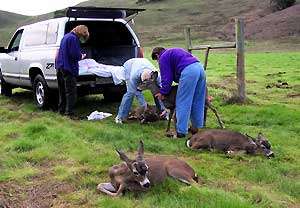
The trick was getting the fawns from Olema to Chileno Valley. Early that Tuesday, Susan and another WildCare volunteer, Cindy Dicke also of Olema, gave the fawns injections to sedate them. Mike Vincilione of Point Reyes Station arrived in a pickup truck with camper shell, and the sleeping deer were loaded onto mats and towels in the truckbed. The drive to Chileno Valley took about 40 minutes, with Cindy riding among the deer.

fawns.jpgThe release itself went amazingly smoothly. Mike drove across a ranch bridge to a pasture bordered by a creek, and there each fawn was lifted gently out of the truck and laid on the grass.

Cindy then gave them all wake-up shots, and the fawns quickly revived. Some were wobbly enough when they first tried to stand that they had to be steadied lest they fall and injure themselves, but this lasted only for a minute or two.

Within roughly 10 minutes, five of the fawns were grazing while one of the bucks kept trying to mount another. It’s not about sex; it’s about domination, Susan explained. (“Just like they say about prison,” remarked computer guru Keith Matthews of Point Reyes Station when I recounted the incident.)

The fawns have now been on the ranch a week and appear to feel at home — to the point where the domineering buck tried to mount one of the ranchers. “When that happens,” Susan told her, “just slap him.” The other fawns are more leery of humans, and after a few more slaps, the lecherous buck probably will be too.

fawns2.jpgMost of the fawns brought to Susan are too weak to survive, and she loses far more than she saves. Within a year, cars and hunters may kill many of the deer she raises. Nor does West Marin have any shortage of blacktail deer. So why does Susan spend so much time and effort saving the few she can? Susan puts in the long hours simply because she is a humane person. Most of us feel sorry for sick and injured wildlife when we encounter it although we typically don’t see a way to help. Susan has found a way. And lest anyone imagine Susan has some New Age sense of humanity toward sufferers that aren’t human, I should note the “Humane” Society was founded in 1954 and the Society for the Prevention of Cruelty to Animals 130 years earlier

« Previous Page