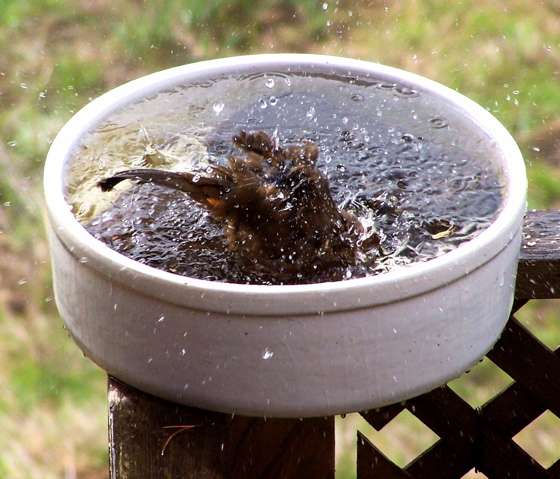
“Good evening Mr. and Mrs. America and all the ships at sea,” as Walter Winchell led off his World War II radio broadcasts. “Let’s go to press…”

Topping the news… A film is due out shortly titled The Penultimate Truth about Philip K. Dick, the late science-fiction writer who once lived in Point Reyes Station. You can see a trailer for the film at http://www.youtube.com/watch?v=c_VgXuYvzfU.

philipdick.jpgThe stories of Philip K. Dick (1928-1982) inspired the movies Bladerunner, Total Recall, and Minority Report, among others. “Philip K. Dick was known as the most brilliant sci-fi writer on earth,” the trailer to Penultimate Truth proclaims. Although a drug addict, paranoid, and (as he sometimes thought) possibly schizophrenic, Dick wrote 50 books and many more short stories.

As for his paranoia, Dick suspected the KGB and or the FBI was out to get him. In the movie’s trailer he tells an interviewer, “Anyone who grew up within the Berkeley counterculture [as he partly did] became a marked man. My house was broken into. My files were blown open. My papers were stolen.” The author admits to not being certain the federal government was responsible but notes his lawyers believed that’s what happened. Dick, however, later wondered if he had done the deed himself and just forgotten about it.

As for his drug addiction (especially amphetamine use during all-night writing): Point Reyes Station innkeeper and jewelry maker Anne Dick, to whom he was married from 1959 to 1964, acknowledges in the movie’s trailer, “Towards the end of our marriage, he was taking tons of stuff.”

Ironically, as Wikipedia notes, during Philip K. Dick’s life, he was “highly regarded in France, [but he] received little public recognition in America until after his death.”

Walking onto the silver screen… The Los Angeles Times on Jan. 23 published a lengthy account of the life of Planetwalker John Francis, 60, of Point Reyes Station.

100_1151_1.jpgMost of us in West Marin know Dr. Francis’ story: how he stopped talking from 1973 to 1990 and refused to ride in motorized vehicles from 1972 to 1994. His self-published book Planetwalker: How to Change Your World One Step at a Time tells the story, and a feature-length film based on the book is now “in the works,” Times reporter John Glionna notes.

Overheard… An item by Point Reyes Light obituary writer Larken Bradley was picked up by San Francisco Chronicle columnist Leah Garchik for her Feb. 13 “Public Eavesdropping” list: “I’ve had enough hippie guys. I need more superficial, materialistic guys.” (Forty-ish woman to another, overheard at Tabla Café in Larkspur.)

I forget, therefore, I did… A writer friend in Los Angeles this week called me with an item of his own. Having overheard a passing guest at a party ask, “Did I finish that joint?” he quipped that merely asking the question provided the answer. Sort of like Decartes’ “Cognito ergo sum” taken to a higher level: “No memeni ergo feci.”

Rumblings south of the border…
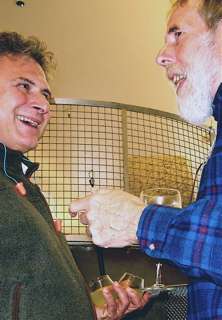
Accompanying me on a weeklong trip to Mexico earlier this month was a retired Economics professor from the University of Hawaii, Mac Williams. Mac and I attended high school and Stanford University together, and in 1963, we spent two and a half months driving all over Europe in a VW bug I bought in Brussels.
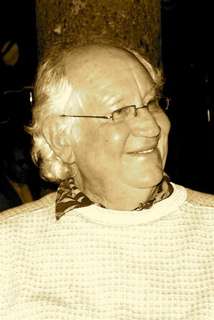
100_3378_1.jpgMac went on to get his doctorate from the University of Chicago where he studied under famed monetary theorist Milton Friedman.

On our trip to San Miguel de Allende, Mac as always was a great traveling companion — even though I’d never before heard anyone who could match the decibel level of his snoring.

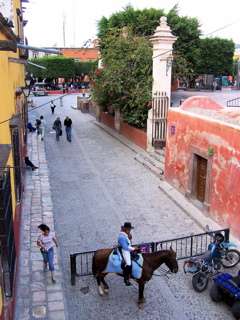
He and I shared a second-floor hotel room hotel overlooking a narrow street in San Miguel’s historic downtown. After returning to the hotel following a night on the town, Mac would go to sleep with his iPod playing music in his ears as his snoring gradually built to the level of our old rooting section in Stanford stadium.

To my astonishment, it was virtually impossible to waken him once he had fallen asleep. Our hotel room shared a common wall with a bar, which had a live band that on weekends played till 4 a.m. The music was loud enough in our room to sometimes disrupt conversations, but once Mac was asleep, he didn’t hear it.

100_3357.jpg
As it happened, immediately across our narrow street was San Miguel’s main cathedral, and its bells chimed loudly and at length every 15 minutes day and night, but that didn’t wake him either.

Only once did a disturbance break his slumbers — although it was subsequently repeated almost every night. The Jardin, San Miguel’s central square, was less than a block from our hotel, and the roads around the square were closed to traffic during the day. However, a second-story roof of the towering cathedral was under repair, and workers were allowed to drive into the square at night to haul away debris.
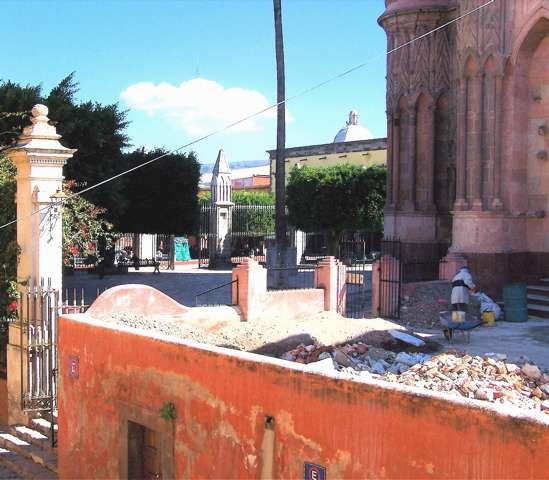
100_3346_1.jpgDuring the day, workers (such as those seen here at right) would pile broken bricks and cement blocks at the edge of one nearby roof of the cathedral. At 3:30 a.m., other workers would show up and from the second floor start dropping the discarded masonry into a steel dumptruck parked below our hotel window. The impact of each chunk sounded like an explosion and actually awakened Mac the night it all began. He rushed to the window to see if our hotel were under attack. When he saw it wasn’t, Mac went back to sleep, and the clamor never bothered him again.

The cacophony reached its peak the night we had a lightning storm. The band was rocking, the cathedral bells were chiming, workers were hurling cement blocks from the church roof into their dumptruck outside our window, thunder claps rattled windows, but at least in our room, Mac’s snoring was loudest of all.

I couldn’t shout at Mac to awaken him because others in the hotel would probably think there was a fight going on, so I tried barking and growling in his ear, hoping that anyone who heard me would think there was a street dog outside; however, that didn’t work either.

But, as I said, Mac and I are good friends, so I was able to laugh as the pandemonium built to a roar each night — although I did tend to sleep late each morning.


100_33293.jpg

Former West Marin resident Dee Goodman now lives in San Miguel de Allende, Mexico, which was founded by the Spanish in 1542.

This past week, an old friend, Mac Williams, and I traveled to San Miguel de Allende, Mexico, and ended up spending several days with a former West Marin resident now living there, Dolores (Dee) Goodman. Dee lives in one of the many colonias (small, semi-rural communities) that surround downtown and are part of the Allende municipality of 139,000 people.

For years, Dee lived in Nicasio and later operated Casa Mexicana bed-and-breakfast inn in Point Reyes Station. Her late husband John spent most of his career working for Marin County Mental Health but after his retirement was in continual demand as a stand-up bass player in San Francisco jazz bands. He was also one of the musicians to regularly play with guitarist Bart Hopkin at the Station House Café. If you ever saw him perform there, you’ll remember him even if you didn’t know his name; for when he was paired with Bart in the Station House, John, a tall black man, played the not-so-common pizzicato (plucked) cello, which was strung like a bass.

Dee, his widow, is now living with a working-class family in a colonia that at first glance might strike West Marin residents as a rural slum. The streets are unpaved and littered with trash. Despite high walls, which hide the residents’ small homes and gardens, families keep dogs on the roof to ward off burglars.

But outward appearances can be deceiving, and Dee has managed to find a bit of paradise where I never would have expected it. Here is her story:

By Dolores Lara Goodman

My husband John died of lung cancer in December 2000, and my loss was enormous. He was the love of my life. We had been together only 10 years, but those were worth a lifetime. He felt the same way about us.

I hadn’t readjusted well to the change and drifted emotionally, feeling lonely among my friends and family. After a year or so, I moved from Point Reyes Station to Petaluma to help my stepfather care for my mother during her terminal illness. My brother Dan lived with me in a manufactured home I had purchased in the same park as Mom and Bill.

With no children of my own, I had given some thought to long-term planning. Assisted-living residences were popping up all over, and they seemed a likely option for me. I calculated what assets I would have and what my fixed income would be and what type of place I would be able to afford so that I wouldn’t become a burden to my family. I was still relatively young, 60, so I wasn’t making any firm plans.

In December 2004, my friend Lana and I took what was supposed to be a two-week vacation to Puerto Vallarta; however, I had a feeling that I would not be returning to the US with Lana. I had, for some time, wanted to stay in Mexico for an extended time. (Two of my grandparents were born in Mexico but were forced to flee to Texas during the 1910 revolution, and I was brought up in Daly City.)

As it happened, I ended up in San Miguel de Allende, which is roughly in the geographical center of Mexico, about 200 miles northwest of Mexico City. San Miguel is a destination for many US and Canadian retirees; our dollars go twice as far here, and we can live more comfortably on our retirement income.

100_33512.jpg
Imaginative, 60-year-old mural in one of San Miguel de Allende’s art schools.

Gringos have been coming to San Miguel for about 50 years. It started with a group who formed an art colony, and San Miguel now has numerous art schools, galleries etc. The gringo community does a lot for the locals: establishing libraries, scholarships and other helpful projects. And because they help with public matters, along with providing jobs and advancement opportunities, the expatriates are well received by the locals.

100_33672.jpgThe Spanish-colonial downtown — with its park-like square, majestic cathedral, and narrow, cobbled streets — bustles with good restaurants, theatre, music festivals, and barely marked hotel entrances that open into courtyard gardens.


At an elevation of 6,000 feet, San Miguel de Allende has a desert landscape. During winter, middays are warm, and nights are cold. I like the climate.

When I first moved to San Miguel de Allende, I rented in the Los Frailes community at the edge of town. A woman in her 30s named Alicia Gonzalez was the housekeeper at the apartment, and a couple of times I drove her to her home in the Colonia Palmita de Landeta.

The first few times, I met her children in front of their house where they huddled shyly, laughing. They were very curious about me, this Señora Dolores from California. Around the third time I took Alicia to her house, her husband Antonio had just arrived home from work and told Alicia to invite me in. I was led to a front bedroom of their very modest house and was invited to sit on one of the beds.

The visit is still clear in my memory. I remember thinking, “What a beautiful family!” At the time, all five of the family’s children were living at home. (The oldest, Valentina, now 19, has since gone to live nearby with her husband Manuel and his family.)

100_34001.jpg

Dining outdoors under a tarpaulin (from left): Ernesto, Claudia, Marco, Manuel, and Valentina. She and Manuel, who assembles furniture for a living, are expecting their first child in June.

I subsequently moved from Los Frailes to Calle Recreo in the central part of the San Miguel near Parque Juarez. Alicia and Valentina helped me pack and move. Valentina would spend some nights with me at Recreo, especially when I was sick with a cold or something. And they would all worry about my wellbeing, comfort, and safety.

Unfortunately, the Recreo apartment was intolerably hot, so I moved to a two-bedroom apartment on Calle Agua in the Colonia Atascadero closer to their house. The whole family helped me pack, move, and unpack, the five kids and Mom trekking up and down the path to move my stuff.

If they had their way, I would have just sat back and watched the move go on. After all, I am grande now — that’s when you’re older — like into your sixties (I’m now 66).

100_3371_11.jpgI did a bit of packing but not much moving. Picture the little one, Rosario, five years old, (seen here a year later with her mother Alicia) insisting she be allowed to help carry stuff to the car. Ernesto was eight; Marco, 10; Claudia, 12; and Valentina, 18.


Even before that move, Valentina began to tell her mother and me that I should move in with them, that they could make me a room. The seed was planted, and I didn’t even consider saying no when the Gonzalezes in 2005 invited me to live with them.

In October 2005, I bought a terreno (lot) next to the family for $10,000. In February 2006, I moved into my almost-completed casita, which was built by Antonio, an accomplished maestro albanil (construction worker), and a crew of four. Antonio is incredibly creative and meticulous, and I enjoyed seeing the building materials used here: basically brick, stone, rebar, and concrete. I was able to suggest what I would like to have done and then see it accomplished.

I had initially planned to have a large living area, one bedroom, and bathroom in my casita, but I convinced Alicia and Antonio to accept half the living-room space to make a bedroom for themselves. They had always had their bed in a common part of their house — in the kitchen or living area. We put up a wall to split my living room into their bedroom and a sitting room for me.

100_34012.jpg

Surrounded by building materials for the completion of their dwellings, Dee dines on the Gonzalezes’ patio with Rosario, Antonio, and Alicia.

Antonio opened up a door in the wall of their house to my casita at their kitchen. I don’t have a kitchen – it’s our kitchen. Alicia is a marvelous cook and for me, eating with the family is better than going to my favorite Mexican restaurant every day.

I participate in the preparation of meals as much as I can and as much as they’ll let me. I’m learning more as time goes by. I also help with the marketing. We go to the plazita market every Saturday, and while Alicia shops for veggies, I shop for fruit: mangos, guayavas, dried Jamaica blossoms etc. I love it! It’s our tradition on shopping days to buy fresh carnitas, bolillos, tortillas, and salsa to eat when we get home.

The daily giving is as important as the receiving. I think the key is being able to share and actually being a member of the family unit — watching the kids get off to school and waiting for them to come home. It’s something I missed out on, not having had children, and it’s a blessing to have been given the opportunity now that I’m grande.

I’m referred to by the family as Tia (Aunt) Lolita and am usually addressed as “Tia.” The parents have given me a grandmother’s authority over the children and have instilled in them a kind respect for me. I love feeling a grandmotherly cariño (affection) for the kids.

Rosario and Ernesto, the youngest two, and I are particularly attached. Mi sombra (shadow), Ernesto, doesn’t let me leave the house alone. When I leave the house to walk Omar, my dog, Ernesto always accompanies me.

100_3377_11.jpgI think the kids were initially told by Mom and Dad to accompany me whenever I went out, and Ernesto (at right with his brother Marco) has taken charge. He says he’ll protect me from aggressive dogs and picks up rocks to throw in the event we run into any, which does happen. He’s my little angel.

I’m glad I said “yes” when the Gonzalez family invited me to live them. We’re a great match. All of us can’t believe our good fortune. I was able to make the move and provide my own space, but had I not been able to do that, had I been totally without financial means, they would have gladly made room for me in their home, and we would all be just as happy, I’m sure.

That’s the way it’s done in the Mexican culture and many other cultures of the world. Older folks don’t have to move someplace with strangers their own age and be cared for by other strangers. There is always room for them in a family member’s home and daily life… until their dying day. I’m still young enough to foresee more changes in my life, and this may not be my “journey’s end.” But it just may be, and that’s great.

After three decades of generally good relations between West Marin residents and the Point Reyes National Seashore, how did we end up with a park administration better suited to an autocracy than a democracy? Why does the general public now have only a perfunctory say when major park policies are set?

Frankly, the answer is politics, both Republican and Democratic.

Back in the 1970s, when the former program for managing the exotic-deer herds through culling was established, the public debated the alternatives, experts of various points of view spoke, and a consensus was reached to maintain the herds at 350 each. And where did all this happen? In public sessions of the Citizens Advisory Commission to the Golden Gate National Recreation Area and Point Reyes National Seashore.

Recognizing that the National Seashore and GGNRA were established to serve an urban population, Congress provided for local governments around the Bay Area to nominate most members of the commission, who then were appointed by the US Secretary of the Interior.

The commission required Congressional reauthorization every few years, and for almost three decades, Congress approved it. However, in 2002, its term expired, and with Republicans in charge of Congress and the White House, the commission was allowed to die.

160px-gale_norton.jpg“This time [then-Interior Secretary] Gale Norton (at right) and the Park Service said, ‘It’s been a very good commission for 29 years, but we don’t need it anymore,’” noted former Commissioner Amy Meyer in an interview I conducted for Marinwatch.

Meyer of San Francisco and Ed Wayburn spearheaded creation of the GGNRA during the Nixon Administration and served throughout the commission’s existence, along with Richard Bartke of El Cerrito, representative of the Association of Bay Area Governments.

“We had moved toward the sunset clause several times before,” Meyer noted. Each time the commission was about to expire, Congressman Phil Burton or his widow Sala, who replaced him in the House, would extend it for three to five years, she said. They “wanted to have an advisory commission.”

National Seashore Supt. Don Neubacher, however, did not want one. As park spokesman John Dell’Osso acknowledged to me in 2004, the park administration had found the commission sometimes interfering with what park staff felt should be done. The Neubacher administration has further argued that local residents don’t speak for all Americans. It’s a specious argument since most park visitors are from the nine-county Bay Area and because people here are far more familiar with the park than people in other parts of the country, who typically know little or nothing about it.

lynnpic.jpgCongresswoman Lynn Woolsey (at right), who represents West Marin, did introduce legislation to resurrect the commission, and it was attached to a House bill being pushed by now-Speaker Nancy Pelosi and others to acquire land in San Mateo County for the GGNRA.

The bill passed in 2005, but when it did, the rider resurrecting the commission was gone. What happened?

mlkwilliams.jpgMeyer said she and other people went to Congresswomen Pelosi (at left) and Woolsey and asked that they drop the advisory-commission legislation.


They feared, Meyer explained, that the Bush Administration would pack the advisory commission with people who share his ideology.

“Having no advisory commission is better than having a bad one,” Meyer added. “Gale Norton [who resigned last March] was a terrible Secretary of the Interior. No one wants to bring the commission back until ‘W’ is out of office.

Throughout its existence, Meyer said, the advisory commission was seldom politicized. When it comes to advising the Park Service, she said, “there is nothing worse than a politicized commission in being able to [fairly sort through] public desires.”

Former Commissioner Meyer isn’t necessarily against Neubacher’s plan to eliminate non-indigenous deer, but she said that in deciding what to do about the deer, or a ranger’s 2004 pepper-spraying scandal, or other matters, the commissioners could have been — as they once were — a crucial interface between the public and the Park Service.

While the commission was only “advisory,” commissioners’ decisions carried weight. “The advice they could give the Park Service,” Meyer noted, “could modify a policy.”

The local citizens advisory commission to the national parks was not the only one that has not been reauthorized despite the fact that “to make a park responsible to the people is very important,” she added. “It’s happening all over…. We have an administration that doesn’t believe in participatory democracy.

“We’re all sitting here waiting for 2008 [to see] if we have the right president who is going to appoint the right Interior Secretary. The president could be a Republican,” Meyer stressed. “Even Nixon had two of the best in history.”

In short, thanks to the power struggle in Washington, residents of West Marin and the rest of the Bay Area must remain frustrated for two more years.

For now, there is no effective forum for influencing National Seashore policy:

• When rangers run amok (e.g. extensively pepper-spraying innocent people who not surprisingly sue the Park Service and collect $50,000).

• When the National Seashore decides there’s money to be saved by slaughtering majestic deer that have long been a part of Point Reyes and are beloved by much of the public. Ironically, settling with the pepper-spray victims cost the Park Service far more than a year’s culling once did.

• When environmentally responsible mariculture is treated like a pariah.

100_2346_1_1.jpg

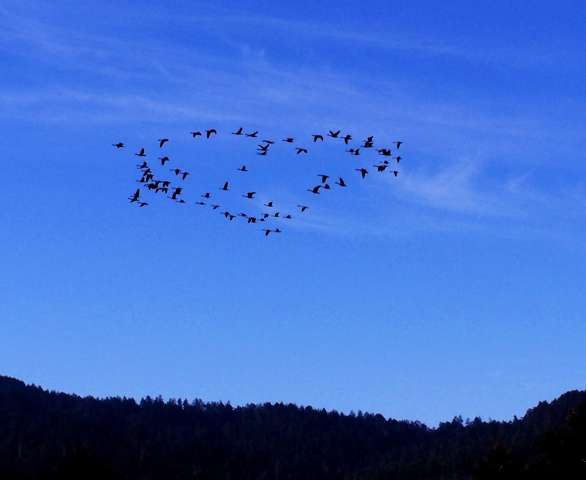
Better days no doubt are coming to Point Reyes. In the meantime, here’s a Valentine’s Day heart from SparselySageAndTimely.com and a flock of Canada geese between my cabin and Inverness Ridge.

peak-a-boo.jpg

Fallow deer in the Point Reyes National Seashore range from white to spotted to black. Naturally gentle, they are among the few deer that can be easily domesticated, and they are widely raised for meat. The fallow herd was periodically culled by the park until Don Neubacher became superintendent in 1994. He stopped the culling and now claims the herd is becoming too large and must be totally eliminated. (Photo by Janine Warner)

West Marin residents need to start paying attention to how much the administration of the Point Reyes National Seashore has come to reflect ideologically rigid policies of the Bush Administration Park Service
, not to mention the Bush Administration’s belligerent approach to Homeland Security.

Combativeness, ideological zeal, and indifference to public opinion are the hallmarks of this approach. At the National Seashore, it is taking the form of:

• A widely criticized program to slaughter the long-resident white and spotted deer from Asia, which much of the public finds enchanting, on grounds it would be cheaper to eliminate them than to control herd sizes with culling or contraception.

The only public hearing on the pogrom before the National Seashore administration last year approved it was so tightly controlled as to be meaningless. No general discussion, with public debate, was allowed. Supt. Don Neubacher assembled a panel of like-minded folks to present the administration’s point of view. Respected organizations that oppose slaughtering the deer, such as the Humane Society, were noticeably left off his panel.

fawn-follows2.jpg
These fallow deer (originally from the Near East) and axis deer (originally from India and Sri Lanka) have been a part of the Point Reyes ecosystem for 60 years, far longer than the Park Service. (Photo by Janine Warner)

Yet the Neubacher administration talks about the fallow deer as if the growth of its herd is out of control. No it isn’t. The Neubacher administration in 1994 merely stopped the park’s periodic culling.

The park administration in trying to rationalize the pogrom claims that because non-indigenous deer eat acorns and so do indigenous blacktail deer, the wellbeing of the blacktail is being threatened. The claim is typical of the pseudo-environmental malarkey we’ve come to expect from the Bush Interior Department that also claims opening up the Artic National Wildlife Refuge to oil drilling is environmentally necessary.

100_3096.jpg
Blacktail deer are abundant throughout West Marin as this herd, including a doe who’s found one of my persimmons, bears witness.

There’s no shortage of blacktail deer in and around the park. Yes, a lot of them are dying on and off parkland here. And whose fault is that? Almost entirely motorists, many of whom are among two million visitors a year drawn to West Marin by the Point Reyes National Seashore.

• National Seashore Supt. Don Neubacher’s announced intention to close down the venerable Drake’s Bay Oyster Company when its lease expires in five years.

There may be ranches, not to mention a Coast Guard station, next door, but Neubacher claims the land around the oyster company’s waters is “potential” wilderness and that it would take an act of Congress to keep the oyster company open. If that’s true — and county officials are skeptical — then it’s Congresswoman Lynn Woolsey’s responsibility to take action in Congress.

Like the exotic deer, the oyster company has been on Point Reyes far longer than the park, which opened in 1965. Oyster growing has become part of the Drakes Estero ecoystem, and oysterman Kevin Lunny notes that because oysters filter water, the water is cleaner in his part of the estuary than where oyster growing has ended.

For many visitors to the National Seashore, buying oysters at the oyster company brings them far more pleasure than visitor centers, sandcastle contests, boarded-up ranch buildings, and the Morgan horse stable — not to denigrate any of them but merely to take note of the obvious.

100_944.jpgI’ve never heard Lunny himself say this, but some ranchers on Point Reyes see Supt. Neubacher’s plans to close the oyster company as “payback time.”
They believe that Lunny, who is also a beef rancher, roused the superintendent’s ire two years ago when he helped organize the Point Reyes Seashore Ranchers Association so that ranchers in the park can collectively negotiate their leases with the National Seashore administration. Ranchers I’ve talked with say Neubacher (pictured) reacted bitterly to formation of their association.

One indication of the park administration’s attitude toward the association occurred a year ago when the National Seashore hired a “range ecologist.” No sooner had he arrived than he showed up at an association meeting to introduce himself, say he’d noticed some ranches had fences in need of repair, warned that he would give ranchers one notice to make repairs, and said if they didn’t then hop to it, he would seek to have their leases revoked. Dick Cheney couldn’t have said it better.

(Ironically the Jan. 30 San Francisco Chronicle described in detail the sorry state of Golden Gate National Recreation Area fencing at Crissy Beach. Neubacher administers, along with the National Seashore, part of the GGNRA but not the beach in San Francisco.)

One rancher, who doesn’t agree with the “payback” theory, instead believes the oyster grower’s problems began when Gordon Bennett, chairman of the Marin Unit of the San Francisco Bay Chapter of the national Sierra Club, got Neubacher’s ear by becoming part of the park superintendent’s kitchen cabinet. *

With Congress stalling on reviving the Citizens Advisory Commission to the Golden Gate National Recreation Area and Point Reyes National Seashore, the park superintendent has been able to cherry pick whom he listens to. Sometimes the arrangement reminds me of our government’s unstated alliance with the Taliban during the Soviet occupation of Afghanistan.
An environmental fundamentalist, Bennett is the loudest critic of Drakes Bay Oyster Company, which he considers equivalent to a 165-foot-high old Buddha in potentially Taliban-pure wilderness. The opposition of Bennett, who lives in Paradise Ranch Estates, to a popular oyster farm founded more than a century ago is perfectly in character.

100_2010.jpg

A major stopover for birds migrating on the Pacific Flyway and a haven for harbor seals, seabirds, and long-legged wading birds, Bolinas Lagoon may completely fill with silt if its channel isn’t dredged and tidal circulation restored. The chairman of the Marin Unit of the San Francisco Bay Chapter of the Sierra Club opposes the necessary dredging.

When the nonprofit Marine Mammal Center needed to upgrade its treatment facilities on the Marin Headlands or when people around Bolinas Lagoon hoped to dredge silt from its channel before the lagoon becomes a meadow, Bennett was always there to lend a criticism.

* The term “kitchen cabinet” in its political sense originated in the 1820s during the presidency of Andrew Jackson. Jackson abandoned official cabinet meetings and instead took his advice from an informal, kitchen-table cabinet more to his liking. A number of these advisors, such as influential newspaper editors, were chosen because they had a pulpit for defending his policies.

Next week: Bringing the voice of democracy back to the Point Reyes National Seashore delayed by congressional Democrats’ distrust of Bush Administration.

ek_3_1_1.jpg

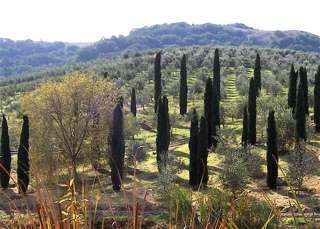
Nan McEvoy’s olive groves on Red Hill. (Photo by Jim Kravets)


It took 3.5 years of permit hassles, but Marin County supervisors Tuesday finally told Nan McEvoy she can erect a 149-foot-high wind turbine at her olive-oil-producing ranch along the Point Reyes-Petaluma Road.

County planning commissioners had previously rejected the windmill proposal in a 6-to-1 vote. The supervisors, in contrast, unanimously approved it in a modified form.

McEvoy has had to contend with a chorus of neighbors who didn’t like the proposed location (so she moved it) and the proposed height (so she repeatedly lowered it, from 246 feet to 210 to 189 to 149). Ironically, they simultaneously warned about windmills killing raptors. That has been a problem with small wind turbines. The blades spin so fast the birds don’t always see them. A longer blade, which requires a taller tower, spins much slower, making it easy for to birds to see it. Unfortunately, the neighbors didn’t want to see it themselves, and McEvoy agreed to monitor for three years the windmill’s effects on birds.

McEvoy plans to use the 660-killowatt wind turbine to power its oil-pressing plant. [Update, Marin Planning Commission Chairman Wade Holland of Inverness this week said the “sad” fact is that the turbine’s output was ultimately reduced to 250 killowatts. Please see his comment.]

As it happened, one of the times I interviewed McEvoy was back in 1996 just before the County of Marin issued a permit for the plant.

100_07111.jpg
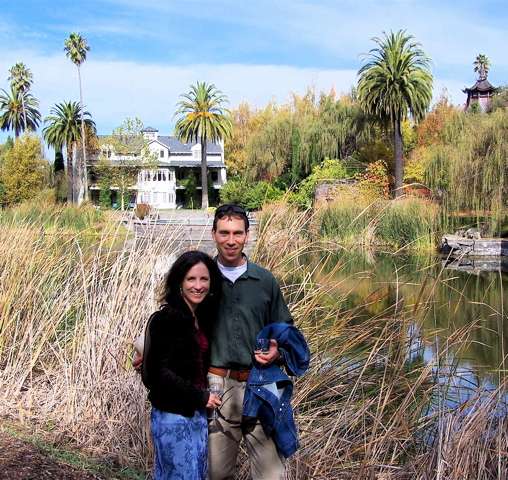
Former Point Reyes Light editor Jim Kravets and his wife Kristan at McEvoy’s Victorian house and its pond during a harvest party. The pagoda at right (with a palm tree behind it) is part of the ranch’s dining room. For her to create this estate in agricultural zoning, the County of Marin required McEvoy to come up with a viable farm operation. She ended up pioneering olive-oil production in the county, exactly the type of result for which the zoning was enacted.


McEvoy, who formerly chaired the board of The San Francisco Chronicle Publishing Company, had bought the 552-acre ranch in 1990 with plans to make it into a country estate.

“I bought this place because I thought it was very pretty,” she told me during an interview at a long table in her immense kitchen, which stands alone as a single building. “The county would not help me [get permits to improve the buildings] unless there was an agricultural purpose. It was then I came up with olives.”

Her parents had raised cows, she said, “and I knew I didn’t want cows. I thought of fruit trees, and from there almost immediately of olives. I had in my head always that an olive tree is a very handsome thing. They have very few pests; they’re very good for cooking; they’re useful.”

“I had been to Italy for cooking classes, and I didn’t think there was much good olive oil around [here].” Having read a cookbook called The Feast of the Olive, McEvoy contacted the author, Maggie Klein, who turned out to live in Oakland.

Klein said that much of the book’s technical information about olive-oil production came from an Italian named Maurizio Castelli, and she arranged for McEvoy (accompanied by an interpreter) to meet him.

ek_1.jpgBefore flying to Italy, however, McEvoy sent Castelli water and soil samples from her ranch, along with weather records, and “he decided, yes, we could do it,” she said.

With a stone wheel of the olive press in the background, ranch consultant Maurizio Castelli shows me his magician’s skills, appearing to hold two cups of olive oil in his hand while balancing a wine glass on one finger. (Photo by Jim Kravets)


The UC Extension Service and others were initially skeptical, fearing the ranch would prove to be too cool, foggy, and windy, but McEvoy demonstrated that not only would olive trees grow well on her Red Hill property, they could produce award-winning olive oil.

By now she has 18,000 olive trees growing on her hills. McEvoy’s success has encouraged other owners of West Marin agricultural land to plant olive trees, and they too use her press.

For several years, I have attended harvest parties at the ranch, hosted by her and (in recent years) her son Nion, chairman and CEO of Chronicle books. The guests have typically been a mix of politicos, ranchers, and members of the press. To say McEvoy has always been “well connected” would be an understatement. Many years ago, it was not uncommon to see her on the arm of Adlai Stevenson.

At a harvest party five or six years ago, I found myself seated next to Congresswoman Nancy Pelosi, who two weeks go became the first woman (not to mention the first Californian and the first Italian-American) Speaker of the House of Representatives. Our conversation alternated between her impressions of Congress, which were pretty dreary at the time, and her husband’s reminiscences of spending time as a youth on Steve and Sharon Doughty’s ranch in Point Reyes Station. Family members then owned the ranch.

McEvoy not so long ago was a director of the American Farmland Trust, a nationwide nonprofit which tries to keep agricultural land in agriculture despite the financial pressures on ranchers and farmers. As most environmentalists here realize, reining in the conversion of agricultural land to residential and commercial development also preserves open space.

The hassles McEvoy just endured to get permission to use alternative energy are symptomatic of the obstacles society puts in the way of all agriculture — even organic, sustainable agriculture.

100_3107_11.jpg
Exotic rat at Point Reyes

This week I shot a rat. With my camera, that is. To be precise, I photographed a roof rat foraging under a flowerpot for stray birdseed. It was a lucky shot, for an instant after I snapped the picture, the rat was gone.

For 30 years, I have been aware of roof rats on this hill, for they have sometimes made themselves known in a particularly disruptive fashion.

It typically happens this way; every few years, a resident of Campolindo Drive turns on the dishwasher only to have soapy water spread across the kitchen floor. (If memory serves, it happened to my late neighbors Ben and Charlotte Glading twice, to my neighbors Dan and Mary Huntsman once, and to me twice.)

Inverness applicance repairman Dave Brast this week explained what’s been going on: “There’s one hose that drains a dishwasher, and usually it goes through a hole in the cabinet wall that separates the dishwasher nook from the space under the kitchen sink. If the sink drain goes through the wall under and behind the sink and if that hole is overly large for the drainpipe (thereby leaving a gap), a rodent can crawl from inside the wall through the gap into the under-sink space and then through the hole in the cabinet wall over to the dishwasher nook…”

(For roof rats to “enter homes and buildings,” The New York Times-owned website About.com notes, “they only need a hole the size of a quarter.”)

Brast further explained, “To do damage by gnawing through the dishwasher drain hose, the rodent can gnaw the portion of the hose under the sink or under or behind the dishwasher.

“I think the hose in the nook is the favorite target because there the rodent is completely protected from being disturbed by cats, dogs and humans….

“In the last few weeks I’ve had to repair two rat-gnawed dishwasher-drain hoses in Bolinas, one at the home of Aggie Murch and the other at the home of Charles and Veronique Fox. The two houses are on opposite sides of the road just a few hundred yards apart. The first gnawing was in the Murch house and days later in the Fox house.

“This made us wonder if it wasn’t the same rat doing the gnawing. After it gnawed through the first hose, it thought, “Well, no more to gnaw here at Murch’s. Guess I’ll mosey on over to Fox’s and see what there is to gnaw there…. Another dishwasher-hose gnawing I remember happened to Herb and Gina Kutchins’ [Inverness Park] dishwasher.”

Why do roof rats do this? “My understanding is that rodents gnaw because they have to,” Brast told me. “If they didn’t, the front teeth, which never stop growing, would get so long the animal wouldn’t be able to open its mouth wide enough to eat.” In short, it’s a dental procedure.

And there are more serious reasons for not wanting roof rats in our kitchens than periodically sudsy floors.

As reflected in their grating scientific name Rattus rattus, roof rats are notorious creatures. I’m reminded of Nabokov naming Lolita’s stepfather “Humbert Humbert” to emphasize that rat’s ugly nature.

“The roof rat… is an introduced species of rat [that is] native to southern Asia,” the University of Florida Institute of Food and Agricultural Science notes. (Florida has a particular problem with roof rats in citrus groves.) “It was brought to America on the first ships to reach the New World….

“The rat is the same species that carried the bubonic plague around the world [killing half the people in Europe during the late 1340s] and is also the host for murine typhus” in the South.
100_2132_1.jpg

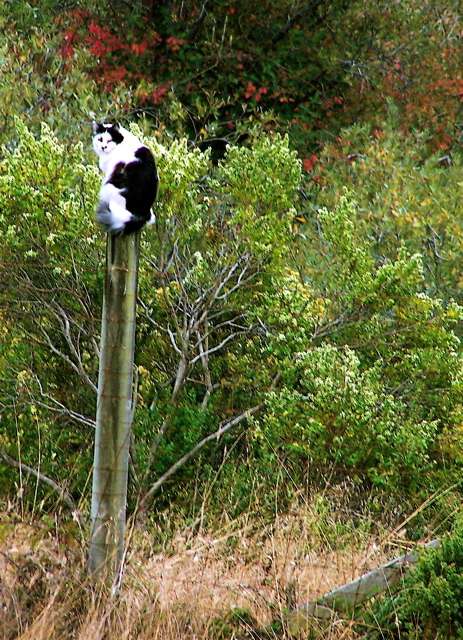
Cats kill roof rat “pups” but seldom the adults. Charlie cat seen here fence sitting belongs to neighbors Jay Haas and Didi Thompson, whose dishwasher has thus far escaped rat damage. Whether Charlie should get the credit, however, is unclear.

Because roof rats (which like to gnaw their way into attics) are arboreal — traveling along branches, utility lines, and fence tops — they seldom fall prey to cats except when the “pups” are young and still “dispersing,” the University of Florida notes.

000_0111.jpgTraps are more effective in controlling roof rats.


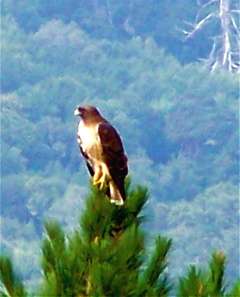
Hawks, such as this redtail on my hill, and owls (especially barn owls) are even better, the University of Florida reports.

A female roof rat can have as many as five litters a year of up to eight pups each. And each generation is ready to begin reproducing in three to four months.

For the past two centuries, rats have been a fact of life on every continent but Antarctica.

The so-called Norway rats or “sewer rats” (Rattus norvegicus) are actually native to northern China. They reached Europe and the Americas from Asia much later than roof rats. The University of Michigan Museum of Zoology reports they were inadvertently carried on ships to Europe in the early 1700s and the New World in the 1770s.

“In Asia, Rattus norvegicus was native to forests and brushy areas,” the museum notes. “Today, however, Norway rats find preferred habitat to be alongside the rapid expansion of the human population. Nearly every port city in the world has a substantial population of these rodents.”

I happened to have been reporting for the old San Francisco Examiner back in 1982-83 when the City of San Francisco reconditioned its cable car tracks and — while it was at it — replaced antiquated sewer lines underneath.

A supervising engineer on the sewer project told me at the time that he and another employee had recently gone into a sewer tunnel under Market Street at the edge of the Financial District. The tunnel opened into a large chamber, he said, and as the two of them shone their flashlights around the tiered vault, they saw reflections from eyes of hundreds of rats. The two men beat a hasty retreat. A typical city, the engineer noted, has one rat for every human.

In case you have your own encounter with a representative of the genus rattus and wonder just what species you’re dealing with, the easiest way to distinguish between Norway rats and roof rats is by the length of their tails.

Norway rat tails are shorter than their bodies while the tail of a roof rat is noticeably longer than its body. Norway rats have bald ears. The ears of roof rats are furry. Norway rats are only slightly longer than roof rats; in fact the rattus rattus above would probably measure more than a foot from the tip of its nose to the tip of its tail. In general, however, Norway rats are far heftier.

100_3146_1.jpg

Flashing wildlife makes some nature photography possible that would otherwise be difficult at best. *

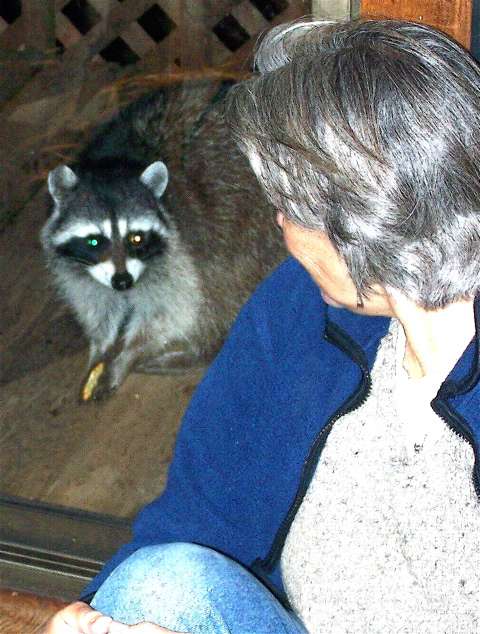
The results of flashing, however, can be gratifying or frustrating, depending on how one sees things. Flashes often give humans red eye, and I don’t mean conjunctivitis (AKA pink eye). In fact, possums are the species that end up with pink eye in flash photography. Blacktail deer come out with blue eye while raccoon eyes can end up white or green or both.

100_3086.jpg

A blacktail fawn gets “blue eye,” not “red eye,” from being flashed.

(For the edification of readers in other parts of the country, I should note that flash photography can make prairie dog eyes look orange and alligator eyes look red.)

However, the reason flashes — which are often vital for photographing nocturnal wildlife — give these animals’ eyes their various colors is not the same reason flashes can make human eyes look red.

100_2493_4.jpg

The eyeshine of possums is pink.

Among mammals, the iris of the eye expands and contracts to let in the optimum amount of light as conditions become darker or brighter. When a camera flashes, the human iris cannot contract fast enough to keep bright light from reaching the back of the eye; as a result, red blood vessels of the retina reflect light and show up in photos as “red eye.”

Unlike humans, many other mammals, especially nocturnal creatures, have a mirror-like surface, the tapetum lucidum, behind their retinas. The eyeshine of a deer caught in the headlights is a reflection off the tapetum lucidum.

The tapetum lucidum helps nocturnal animals hunt and forage in low light. Here’s how. Light from outside the eye passes through the iris and the retina and then bounces off the tapetum lucidum back through the retina. This magnifies the intensity of the light reaching the rods and cones of the retina, which are what sense light.

However, the color of the tapetum lucidum differs from species to species, which is why rabbits have orange or red eyeshine while dogs are often green or blue.

100_2400_1.jpg
Showing both green and white eyeshine, a raccoon looks through my kitchen door at Nina Howard of Point Reyes Station.

Nor is having a tapetum lucidum an unmixed blessing. As Wikipedia notes, the tapetum lucidum “improves vision in low light conditions but can cause the perceived image to be blurry from the interference of the reflected light.”

And then there are other curiosities. The Minnesota Department of Natural Resources reports, “Animals in which the views of the two eyes overlap a lot — such as people and owls — have good stereoscopic vision [which helps them gauge distances]. Animals whose vision overlaps less — such as deer and rabbits — have less stereoscopic vision, but they can see more around them.”

Not all animals have round pupils like those of human eyes. In the same way we squint to see more clearly, some animals’ pupils are naturally narrow to sharpen their vision — perhaps somewhat offsetting any blurring their tapetum lucidum might cause.

The pupils of foxes and small cats, for example, are vertical slits, which help these predators notice when any prey is scurrying around off to their sides. The pupils of goats, sheep, and deer are horizontal slits, as can be seen in bright light; this gives them better vertical vision on steep terrain.

100_1480_1.jpg

When I spotted a blacktail doe grazing in the shade of a pine tree outside my bedroom, I opened a window to take a picture. The doe looked up and saw me, but she appeared oblivious to being flashed and went back to grazing. Notice her horizontal pupils.

Surprisingly, wildlife including birds do not usually show any reaction to sporadic flashes — even those directly in their faces— but a quick succession of flashes gets their attention.

* SparselySageAndTimely.com wishes to thank
Inverness Park resident Linda Sturdivant
and three blacktail residents of Point Reyes Station
for posing for this posting.

“By means of water, We [God] gave life to everything” — The Qur’an

My two acres adjoin the land of Point Reyes Station’s venerable Toby Giacomini, and one of the stockponds on his property is only 10 yards from our common fence. Living next to that pond for the last 30 years has been an education. Livestock such as cows and horses have long watered there, of course, but the stockpond also provides habitat for an amazing array of wildlife.

100_3036.jpg
Red-winged blackbirds from a colony that nest at Toby’s Giacomini’s stockpond near my cabin flock in whenever I put out birdseed.


Threatened Western pond turtles have found refuge in Toby’s stockpond. The pond provides a home for newts, frogs, snakes, various fish, and a colorful colony of Red-winged blackbirds.

Deer, foxes, and raccoons frequently drop by for a drink. Badgers — and an occasional coyote — can be found around it.

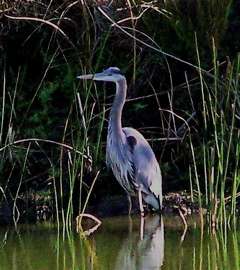
100_2631_1_1.jpgHere a Great blue heron picks its way through the reeds along the edge of the stockpond.
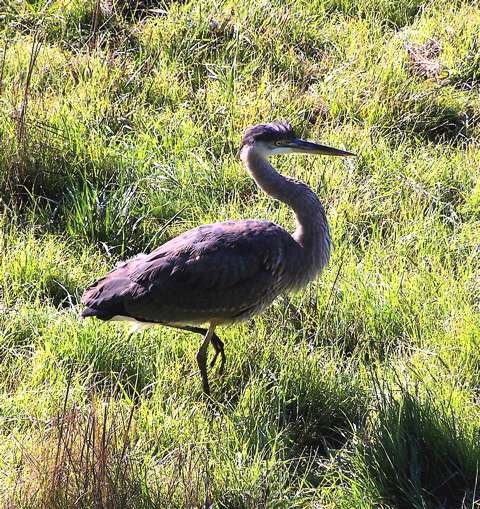

Among the birds that can be frequently seen hunting for dinner at Toby’s pond are several varieties of duck.

In addition, an occasional goose or two shows up although I’m more likely to spot them overhead.

However, as far as I’m concerned, the true celebrity hunters are the Great blue herons.

Having these long-legged stalkers around the cabin is exciting.

I’ve lived in small, rural towns for 35 years, but I still get a thrill when a heron lands next to my parked car and then goes hunting in the field just below my deck.

100_1133.jpg

Great blue heron on the prowl in my pasture.

For the sake of birds that don’t hang out around the pond, I provide a birdbath on my deck where these living dinosaurs* can drink as well as bathe.

100_3013.jpg

A mourning dove in my birdbath takes a drink while a brown towhee eats seed and waits its turn.

100_2296.jpg
“Well, I’ll be a dirty bird” — George Gobel (1919-91). Splashing wildly, a brown towhee becomes practically submerged in my birdbath while cleaning up.

Although not the only species to bathe on my deck, none do it with more enthusiasm than brown towhees. It so happens that I too like a good soaking now and then, and more than once while half-dozing in the hot tub on my lower deck I‘ve been abruptly awakened by a shower of cold water from a towhee splashing in the birdbath a deck above me.

* Please see Nature’s Two Acres Part II: Living Dinosaurs
Actually Found Around My Cabin

Point Reyes Light publisher Robert Israel Plotkin — a defendant in a federal bankruptcy case growing out of a $77 million Ponzi scheme — will be allowed to keep some money swindled from other people.

That was the word this past week from Plotkin’s lawyer, Robert H. Powsner of Point Reyes Station. Powsner did not reveal how much of his profits from the Ponzi scheme Plotkin can retain, and several of us are now endeavoring to find out the amount. As soon as we do, Powsner’s long and rambling letter will be published in full.

Here is the essence of the case, as this site reported earlier. The Ponzi scheme, which lasted from 1998 to 2003, was investigated by the FBI and prosecuted by the US Attorney’s Office. The ringleaders, Moshe Leichner and Zvi Leichner, are now serving time in prison; a US bankruptcy trustee is trying — so far without success — to get at money the Leichners squirreled away in one Swiss and two Israeli bank accounts; and the Justice Department has warned Moshe and Zvi Leichner they may be deported.

The Leichners’ Ponzi scheme operated under the name Midland Euro, and the US Justice Department notes, “The Leichners told their investors that Midland Euro would invest their funds in foreign currencies which Midland Euro would then trade on the international currency market for profit. Although the terms of the investments tended to vary slightly among victims, generally the Leichners claimed Midland Euro would generate guaranteed monthly profits of between 2% and 4%.”

100_0459.jpgThink of it: “guaranteed” 24% –to-48% cash profits annually in the high-risk foreign-currency-exchange market. How money-hungry does one have to be to fail to notice something suspicious?

CPA Grant Newton, an expert witness hired by the bankruptcy court, explained the swindle this way. The Leichners until 2003 “operated a Ponzi scheme: namely, a phony investment arrangement whereby earlier investors are paid fictitious profits from the funds of later investors.”

A US bankruptcy trustee has reported that in 2004, he “filed over 150 adversary proceedings…. These proceedings seek recovery of funds in excess of $20 million in pre-petition transfers made by [Moshe and Zvi Leichner] to insiders and other parties.”

As Powsner explains it, “Mr. Plotkin [seen here] was one of thousands of passive investors into a huge investment scam. He had never heard of or had any contact with the crooks. He was one of about 150 who were lucky to get paid back — with an investment return — before the crooks were outed.

“Because of a bankruptcy-statute technicality, he could have been liable to pay back the money, and he and 150 or so other investors were sued by the trustee for that.”

Wow! Attorney Powsner actually calls a law requiring repayment of ill-gotten gains merely a “technicality.”

The bankruptcy trustee last summer notified “defendant Robert Israel Plotkin” and his lawyer Powsner their case would come up at a hearing in October, but Powsner now reports they were able to skip the hearing.

“When [Plotkin] asked me to help,” writes Powsner, “I quickly negotiated a settlement (without any hearings or meetings) in which [Plotkin] had to return a portion — and only a portion — of the profits he made.”

Such a deal! There aren’t many lawyers who would brag about helping a client hold onto “fictitious profits [that came] from the funds of later investors,” who had been swindled.

Addendum: Although Powsner has recently justified his untrue statements in unrelated court filings as merely the result of his “forgetfulness,” he wants it known that he won’t begin his 79th year until this fall. This site had erroneously given his current age as 78 when he is, in fact, 77. My apologies to the bad old boy.

As I was driving through San Geronimo Friday, I was reminded of the days when I covered Sheriff’s Calls for The Point Reyes Light. Every couple of years, some motorist would notify sheriff’s deputies he had been driving past the San Geronimo Valley Golf Course when his car was hit by a golf ball. Last week, it finally happened to me.

The ball came off a fairway south of Sir Francis Drake Boulevard, bounced on the shoulder, and then off the hood of my car. It didn’t do any damage; however, it felt like a rite of passage: somewhat akin to Bolinas and Stinson Beach motorists being inducted into the Lagoon Club — but without all the mess.

Immediately I knew how I would begin this week’s blog entry, but what I didn’t figure on is what would happen next.

100_2904_13.jpgSurprisingly big pot busted by hurricane-force gusts
Helping keep this blog online is computer technician Keith Matthews of Point Reyes Station, and for Christmas he gave me his copy of the Morris Dictionary of Word and Phrase Origins. Matthews said he’d spent the last year working his way through the dictionary and thought I too might find it interesting. I already have.

As it happened, when I opened the dictionary, the first word my eye fell upon was “halcyon.” Although I seldom use the word, I have occasionally quipped about “the halcyon days of yore” in referring to mellower times, but I knew nothing about the word’s origin. It turns out, “halcyon” has had particularly ironic meaning for West Marin these the past few weeks.

Here’s the Morris Dictionary’s explanation of the word: “Halcyon (pronounced HAL-see-un) is an adjective meaning ‘calm and peaceful.’ It comes from the Greek word for kingfisher. Legend was that the kingfisher’s brooding period was the seven days before and the seven days after the shortest day of the year. Since the kingfisher’s nest was believed to be borne on the waves of the ocean, it followed that during this period the weather would surely be calm and peaceful — or halcyon.”

Tuesday evening after this week’s storm had caused a several-hour blackout, I mentioned to Nina Howard of Point Reyes Station that the foul weather ran afoul of the original meaning of halcyon. I explained about the Greeks believing the kingfisher’s nest floated on the ocean and, therefore, needed calm weather to get through the brooding that supposedly occurred at this time of year.

“Did the Greeks ever see any kingfishers nesting on the ocean?” Nina asked. “Not that I know of,” I told her, “but scholars in ancient Greece — even Aristotle — weren’t into empiricism.”

“Well, so much for that theory,” remarked Nina.

Waking Wednesday from the night’s heavy rains, high winds, and several-hour-long blackouts, I looked out on my deck Wednesday morning to see if the storm had caused any damage. What I saw was a big pot bust.

Indeed, lying busted up on my deck was a heavy, terra cotta flowerpot that had blown off my picnic table. A root ball from the chrysanthemums and ice plant growing in it was still intact, and later in the day I was able to find another large pot at Toby’s Feed Barn and replant the flowers.

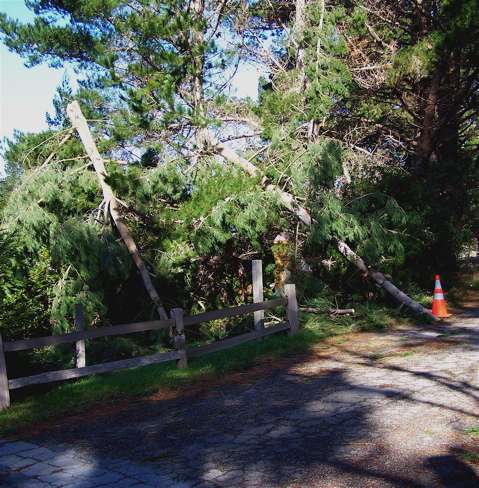
100_2947.jpgPredictably, the most noticeable damage I spotted around my property was not to my flowerpot. On the way into town, I discovered a massive limb had broken off one of the pines of my neighbors, and part of the tree was sticking into Campolindo Drive.

Someone had stuck orange traffic cones around it, giving maintenance of our private road a sort of Public Works Department ambiance.

What got me out of my cabin before showering and shaving Wednesday morning, however, was not finding a replacement for my broken flowerpot. Two friends called to say that Manka’s had caught fire during the night and was still burning. Owner Margaret Grade is a long-time friend, so I immediately headed for Inverness to see what was happening to her restaurant. That story follows.

« Previous PageNext Page »