
Thu 28 Aug 2008
How park administration used deception & sometimes-unwitting environmentalists to harass oyster company with bad publicity
Posted by DavidMitchell under agriculture, General News, Marin County, West Marin nature
1 Comment
Last in a series. The Inspector General’s report on its investigation into the Point Reyes National Seashore administration’s treatment of Drakes Bay Oyster Company includes numerous summaries of what various witnesses told investigators. By quoting the actual comments of witnesses and investigators, this series has attempted to show that far more has come to light about National Seashore wrongdoing than one might infer from what’s mentioned in the report’s conclusion.
It was one of the more bizarre moments in Point Reyes National Seashore Supt. Don Neubacher’s assault on Drakes Bay Oyster Company. Although it occurred just before the Inspector General of the Interior Department issued its report on that conflict, the incident highlighted the alliance arrayed against the Lunny family’s business at Drakes Estero.
As reported in the May 7 Marin Independent Journal, “The point man for the local Sierra Club chapter issued a threat to Marin supervisors. He and possibly his politically powerful club will fight a proposed county parks and open space tax if supervisors don’t support the Point Reyes National Seashore’s restoration efforts.
 “Those efforts include a back-to-nature push by park Supt. Don Neubacher to shut down an oyster farm in Drakes Estero…. Gordon Bennett, who regularly represents the Sierra Club at county meetings, warned supervisors on [May 6] that unless they tell US Sen. Dianne Feinstein that they don’t oppose Neubacher’s efforts, he would urge the club to actively oppose the county’s tax plan.
“The county is considering an open space tax for the November ballot that would need a two-thirds majority vote to pass, and the Sierra Club’s opposition could doom its chances.†The tax “would raise $10 million per year for… improving and maintaining parks, acquiring open space, preserving farmland and paying for wildland fire protection.†Supervisor Steve Kinsey said Bennett’s “blackmail†was “myopic.â€
Although the Marin Sierra Club Group plays political hardball, Bennett’s attempt to blackmail county supervisors on Neubacher’s behalf was over the top, and the group quickly announced it wouldn’t necessarily follow his advice. All the same, county supervisors did not put the tax measure on the ballot.
 Bennett’s threat could have been anticipated. National Seashore Supt. Neubacher admitted to federal investigators that in April 2007 he had told “Kinsey that environmental groups might ‘go to war’ to ensure that Drakes Estero becomes wilderness in 2012,†the Inspector General’s report says.
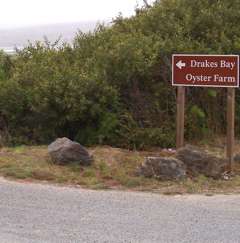
Although the oyster company is half a mile up a dirt road from Sir Francis Drake Boulevard, Neubacher ordered that the turnoff sign, which for years had said when the business was open, be changed to eliminate the hours.
The report indeed makes clear how much the park superintendent has counted on the environmental community, along with his staff, to wage a propaganda war against the oyster company on his behalf.
Some highlights from the propaganda war:
In May 2007, county supervisors held a hearing on county support for the oyster company. Neubacher and his senior science advisor Sarah Allen showed up go argue against the idea. In making his case, the Inspector General’s Office wryly commented, Neubacher “could have used better judgment.â€
Supt. Neubacher, investigators noted, “exaggerated the Marin Mammal Commission’s role in responding to Drakes Bay Oyster Company’s impact on the harbor seal population in Drakes Estero when he spoke before the Marin County Board of Supervisors.â€
 Neubacher (right) told supervisors the oyster company was disturbing harbor seals and that the Marine Mammal Commission had begun an investigation.
What actually happened, investigators discovered, was that Allen wrote Timothy Ragen, executive director of the commission, saying the company’s oyster bags were disturbing seals, and she asked him if the “commission would consider writing a letter raising concerns about the farm’s impacts on the seals.â€
The Inspector General reported, “Our investigation determined that Ragen faxed a letter to Neubacher… the day of the hearing based on Neubacher’s and Allen’s request. The letter states the following in part…. ‘Unfortunately, I have just learned of this issue and have not had time to bring this matter to the attention of our commissioners.’â€
 Nonetheless, as investigators noted, at the supervisors’ hearing “Neubacher portrayed the Marine Mammal Commission’s interest in the issue by stating, ‘I mean it’s that complex, because now you’re talking about the Marine Mammal Commission [which] wrote us a letter this morning. They’re going to take it up on a national level.â€
“Neubacher’s statement,†the commission’s executive director Ragen commented to investigators, “was ‘a shade of not quite accurate.’â€
Investigators then asked the park superintendent about the untruth, and “Neubacher conceded that it might have been a little bit misleading for him to say that the Marine Mammal Commission was taking up the issue and had written the National Park Service a letter.â€
Equally misleading, park advisor Allen told the supervisors, “This year, chronic disturbance and the placement of bags on nursery areas has caused an 80 percent reduction of the seals.â€
Federal investigators, however, reported that “an official transcript of the hearing revealed that [while] Allen did initially specify that seals had abandoned one area of the estero, [she] did not clarify in her next sentence that the 80 percent reduction to which she referred only applied to that particular site in the estero.â€
 Well before the supervisors’ hearing, the park’s propaganda war against the oyster company was underway, with several prominent West Marin environmentalists unwittingly lending their credibility to the park’s misrepresentations of science.
As previously noted, the Inspector General reported, “Our investigation determined that in her [Sheltered Wilderness] Report and in a [Point Reyes Light] article, Point Reyes National Seashore senior science advisor Sarah Allen had misrepresented research regarding sedimentation in Drakes Estero completed in the 1980s by USGS scientist Roberto Anima.â€
She claimed Anima had found “oyster psuedofeces [to be] the primary source or a primary source for sediment†in the estero,†but Anima told investigators “his report never said that oyster feces were affecting the sedimentation in Drakes Estero.â€
Nonetheless, as was noted here last week, investigators reported, “Both the article titled Coastal Wilderness: The Naturalist, which Allen co-authored in The Point Reyes Light in April 2007 and an editorial piece titled Save Drakes Estero published in The Coastal Post as a ‘collaborative effort’ by conservation groups in May 2007 refer to oyster feces as the primary cause of sedimentation in the estero.â€
The Inspector General reported that “the other authors of [The Light] column, John Kelly, the director of Conservation Science and Habitat Protection at [PRBO’s] Cypress Grove Research Center [in Marshall], and Jules Evens a self-described ‘naturalist and biologist’ [in Point Reyes Station], told investigators that Allen was the primary author of the column.†Allen agreed.
Dr. Corey Goodman of Marshall, a member of the National Academy of Sciences, was the first member of the general public to suspect the National Seashore administration was misrepresenting research. Investigators reported that Dr. Goodman had tried unsuccessfully to get the park to provide copies the “over 25 years of seal data from Drakes Estero†Allen had told county supervisors the Park Service possessed.
 In the course of filing a series of Freedom of Information Act request on harbor seal data, investigators noted, Dr. Goodman claimed “there was a ‘double standard’ in the way the National Park Service supplied information to members of the public.
“Specifically, Goodman referenced an article that Gordon Bennett of the Sierra Club had published in the July-August issue of the Sierra Club Yodeler.
“While I was denied access to 2007 harbor seal data based on deliberative [legal] process privilege… Bennett… appears to have free access to this data.†Investigators asked Bennett about this, and “he said there were times he would simply ask for materials from either Neubacher or Allen and he would receive the information….
“He said he also obtained specific numbers pertaining to seals for that [Yodeler] article without filing a Freedom of Information Act request.†An investigator wrote, “We confirmed that Bennett was able to obtain some information from the Point Reyes National Seashore with only an informal, verbal request.â€
 Although an agent of the Interior Department’s Inspector General said that Bennett and Dr. Goodman had asked for different seal data, Dr. Goodman’s repeated requests for data on seals finally forced the Park Service to admit it had none prior to 1996. Allen herself would later admit to investigators that her statement to county supervisors that the Park Service possessed 25 years of data on seals in the estero was untrue.
“In an effort to explain why Goodman was initially denied the 2007 harbor seal data,†an investigator wrote somewhat sarcastically, the director of the Pacific West Region of the Park Service, Jon Jarvis, said, “We don’t require Freedom of Information Act requests generally to get this kind of information… because… it’s publicly accessible information.â€
 How did some environmental groups come to be primed for an attack on the oyster company? To some degree, it would appear, this happened during one or more meetings at the park. One gathering was in January 2005, Lunny (right) told investigators. He said it included “Neubacher and local environmentalists Ken Fox, president of the Tomales Bay Association; Jerry Meral, member of the Environmental Action Committee of West Marin; and Gordon Bennett, vice chair of the Sierra Club’s Marin Group,†the Inspector General reported.
Fox told investigators he remembered such a meeting in the Red Barn at park headquarters but couldn’t recall whether Neubacher was there. “Bennett recalled attending at least one meeting at the Point Reyes National Seashore with Neubacher, Fox, and Meral,†the investigators added.
 The inspectors did not report what was said at these meetings. They note only that Fox — like Bennett — said their discussions did not include “financially ruining the Lunnys or about trying to shut Drakes Bay Oyster Company down prior to 2012.â€
Be that as it may, Bennett and other environmentalists would later take part in spreading negative publicity (much of it misrepresentations provided by the park) regarding the company.
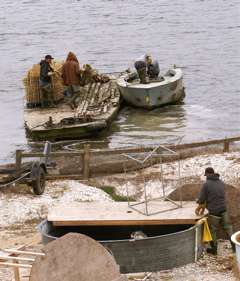
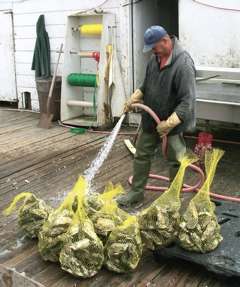
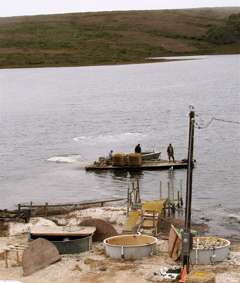
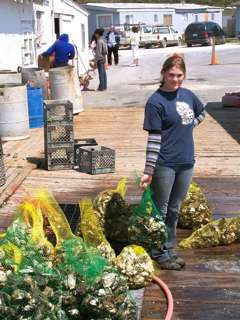
A company barge brings freshly harvested oysters ashore.
When Marin Agricultural Land Trust held a tour of the company on Oct. 28, 2006, for example, Bennett showed up with copies of Allen’s since-discredited Sheltered Wilderness Report and handed them out to counter positive comments about the business.
“Neubacher said he did not ask Bennett to disseminate the report,†investigators noted. However, the park superintendent did say he had “a stack of copies in his office…. [and] he was sure Bennett got a copy of the report because he (Bennett) was very active in local politics.†Active on Supt. Neubacher’s behalf, it might be added.



 In recent months, two problems in particular been been bugging me: white specks caused by shooting through windows and digital “noise” — tiny dots of color where there should be none.
 As it’s turned out, Jasper was right, but what a surprise! I was able to shoot my nightly raccoons at close range, I discovered, mainly because they walked right in the kitchen door when I left it open to avoid shooting through the glass.
 The federal investigation was launched in April 2007, the Inspector General wrote, shortly after oyster company owners “Kevin and Nancy Lunny wrote to us requesting an investigation into the actions of Point Reyes National Seashore Supt. Donald Neubacher. Specifically, the Lunny family… alleged that Neubacher had undermined and interfered with the family’s business and had slandered the family’s name….
 • “Our investigation determined that in this report and in a newspaper article, Point Reyes National Seashore senior science advisor Sarah Allen had misrepresented research regarding sedimentation in Drakes Estero completed in the 1980s by US Geological Survey scientist Roberto Anima.
 And where did this “information contrary to her characterization of Anima’s findings†come from? Both a fisheries biologist with the National Park Service and an environmental scientist with the California Department of Health Care Services.
 “The Department of Health Services environmental scientist said he told Allen in a telephone conversation in approximately October 2006 that Anima had not tested any correlation between sediment and oyster feces in Drakes Estero.â€
 Allen, for example, had cited the assessment in blaming oyster growing for invasive species showing up in Drakes Estero. Dr. Elliott-Fisk, however, told investigators that although any introduction of an invasive species to the estero was “‘bad’…researchers could not definitely attribute the invasive species to the mariculture operation.â€
 • Going even further in his criticism was John Wullschleger, a fishery biologist with the National Park Service in Fort Collins, Colorado. The fisheries biologist had provided “technical oversight†for the UC Davis’ assessment of Drakes Estero, and he didn’t consider the assessment thorough enough on some matters to be cited as authoritative on key claims in Allen’s Sheltered Wilderness Report.
 • National Seashore Supt. Neubacher (right) repeatedly comes off in the Inspector General’s report as deceitful — even in petty matters. For example, The Point Reyes Light on May 18, 2006, published an article that cited a UC Davis assessment of Drakes Bay in concluding that oyster farming was not harming Drakes Estero, prompting Allen to write the Sheltered Wilderness Report as a rebuttal.
 The article, which also quoted Kevin Lunny (left), said the assessment showed that oyster growing “has no statistically significant effects on the estuary’s water quality, fish, and eelgrass.â€
 • Even within the regional office of the Park Service, the National Seashore administration’s politicizing research bothered staff. Investigators reported, “A scientist for the Pacific West Region of the National Park Service opined that in the Sheltered Wilderness report, Allen and ‘probably her colleagues’ had ‘drawn conclusions… that simply cannot be sustained, particularly since there was something a little bit sketchy about the [underlying Drakes Estero Assessment],’ which ‘itself is overreaching.’â€
 • “After reading those articles, Anima told Allen that his report did not state that he had ‘collected sediment cores from the estero,†as she had claimed, investigators said. Nor had he “‘identified pseudo feces of oysters as the primary source for sediment fill.’
 • “Further, Anima’s statements that the effects of oyster mariculture on sediment in Drakes Estero required further study were omitted from both versions of the Sheltered Wilderness reports that were released to the public.â€

 The Inspector General’s report also reveals that Neubacher shares Allen’s low opinion of The Light. A federal investigator said Neubacher had “opined†to him “that although The Point Reyes Light was not very objective, it …carried a certain amount of weight in the community — but not a lot.â€
 Although both the press and the park have focused their attention on Kevin Lunny, the entire Lunny family feels under attack. In a letter to the Inspector General’s Office, an investigator noted, Lunny complained that “Neubacher was… slandering the family name.”
 A symbolic depiction by Mexican muralist José Clemente Orozco (1883-1949) of official ‘Cruelty‘ toward common people.
 The story begins in 2006. Lunny (left), who is active in Marin Organic, wanted to be able to promote the fact that as a rancher he is a good “steward of the land,†so he applied for certification from an organization called
  Lunny also claims Neubacher told Salmon Safe’s executive director, “This is my park, and you will not certify any ranch in this park without my permission.â€
 • The park had complained about piles of plastic left over from covering fermenting silage, but Lunny pointed out that the plastic is hauled off and “recycled two or three times per year.â€
 And while he would not reveal his dealings with National Seashore Supt. Neubacher (above), Kent (left) on Monday noted, “This was the most politically charged Salmon Safe certification in 12 years and more than 300 site inspections.â€